
It was a big year for Nvidia with the release of an entirely new generation of gaming graphics cards, the much-anticipated Blackwell GeForce models.
Those RTX 5000 GPUs debuted with quite some teething troubles, though, and later models came unstuck around VRAM issues, too – but despite definite setbacks, Nvidia maintained its graphics card dominance. And, as you likely didn’t fail to notice, the company’s AI juggernaut continued on its merry way, amassing ever-more profit as its seemingly unstoppable wheels rolled onwards.
Let’s break down 2025 for Nvidia looking at all the highs and the lows, before drawing a conclusion about how Team Green has fared this year – and what that might mean for the future.

Nvidia’s Blackwell gaming GPUs arrived led by a mighty flagship
Nvidia began the year with the long-awaited reveal of its new generation of Blackwell desktop GPUs at CES 2025.
There were four initial models: the flagship GeForce RTX 5090, the RTX 5080, and then the RTX 5070 Ti and vanilla RTX 5070, plus Team Green also unveiled laptop versions of those graphics cards at the show, too.
The desktop gaming GPUs were first to muscle onto the scene, with the mobile variants following later in a staggered release schedule throughout the first quarter of the year. (Mostly – save for the laptop RTX 5070 which didn’t pitch up until April, and the desktop version was slightly delayed, too – it was pushed back from late February to early March).
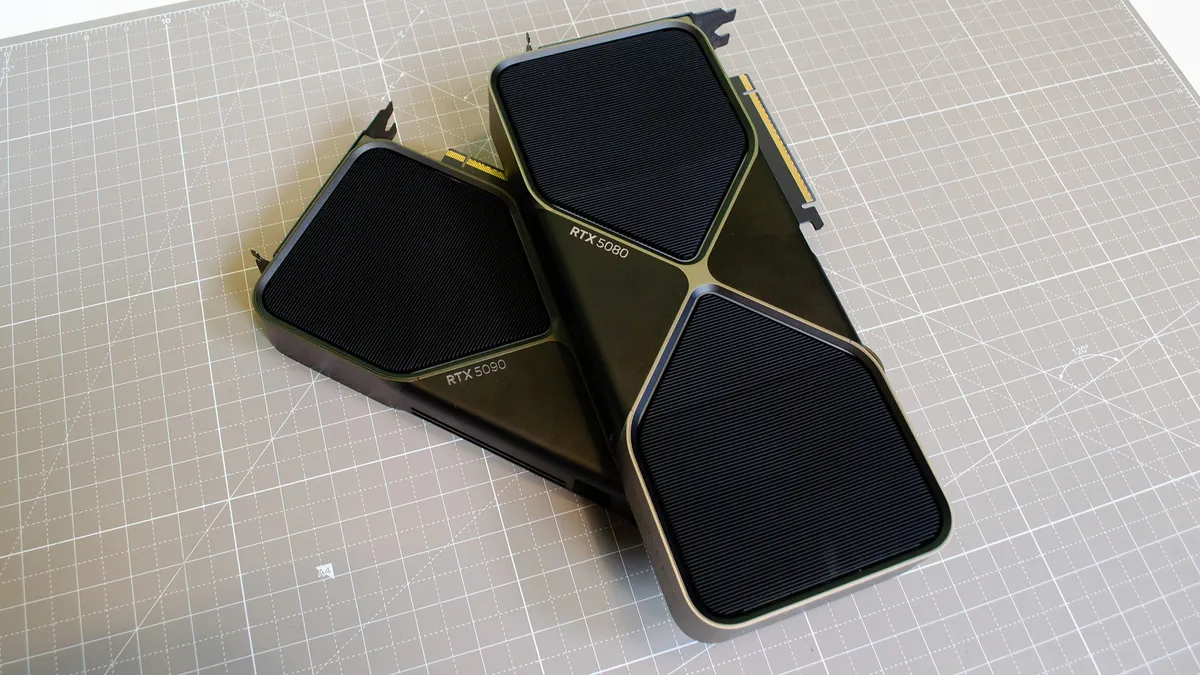
The RTX 5090 and 5080 were first out of the gate, and the new flagship GPU blew us away. We dubbed it the ‘supercar of graphics cards’ and noted that it was so powerful, this GPU was capable of 8K gaming (in native resolution, without DLSS, for that matter). The main point of contention was whether this Blackwell monster was too powerful for most gamers and just plain overkill, with an eye-wateringly weighty price tag attached.
Nvidia’s RTX 5080 was an equally impressive second-tier offering, albeit it was still expensive – but when considering that this GPU almost matched the RTX 4090 for gaming frame rates, it was a relatively more palatable effort price-wise.
The RTX 5070 Ti followed (though there was no Founders Edition in this case, with it being the odd GPU out in that respect with this first batch) and outdid both of its more powerful siblings for pure punch in terms of value proposition. Indeed, it delivered what we described as “absolutely incredible performance for its MSRP” hitting frame rates akin to the RTX 4080 Super.
Unfortunately, the most affordable of these initial Blackwell GPUs hit a sourer note. Where the other RTX 5000 offerings all managed to score 4.5-stars (out of our 5-star maximum), the RTX 5070 was adrift with just 3-stars, an average rating. This GPU – the most crucial for many given its more mainstream price bracket – just wasn’t enough of an advance compared to the RTX 4070 Super, and Nvidia also hampered it by limiting the VRAM pool to 12GB (a move that did not go down well).
Overall, though, Blackwell established itself with a strong, if pricey, line-up, but there were two big problems aside from the cost of these GPUs: stock and bugs (or indeed outright technical fails).
Early Blackwell GPU stock nightmare
Supply problems were predicted before a single Blackwell graphics card was released, and the doom-mongers were sadly very correct on this score.
Stock issues quickly became apparent with the arrival of the RTX 5090 and 5080 at the end of January. This pair of GPUs had a deeply troubled early existence, with supply very thin on the ground, and Nvidia being accused of having a ‘paper launch’ (in other words, a launch just for show, without any meaningful levels of inventory to back it).
And guess what? This meant that these already seriously pricey graphics cards suffered from price inflation, meaning that if you wanted one, you were scrambling to buy at an extortionate level – unless you lucked out (quite literally as some retailers resorted to a kind of lottery system where you had to win the right to buy a Blackwell GPU). The RTX 5090 in particular ended up at ridiculous price tags, which partly helped to solve the problem of stock vanishing instantly, as the cost eventually climbed so high that even keen enthusiasts couldn’t be tempted.
The RTX 5070 Ti arriving didn’t help much – stock shortages hit that GPU, too – and frankly the whole first quarter of Blackwell availability was woeful. Things did ease a little at the very end of Q1, and supply levels picked up some steam thereafter, with asking prices finally relenting somewhat as we rolled towards May, but really, the whole launch was a nightmare from an inventory perspective.

And don’t forget that other RTX 5000 nightmare in the first half of 2025 – all those bugs
Stock wasn’t the only problem with Blackwell GPUs in the initial stages of their existence, and if you were lucky enough to grab an early slice of the RTX 5000 action, you faced an entirely different specter – a minor avalanche of bugs and glitches.
Before we get to the dire state of Nvidia’s graphics drivers with Blackwell in some respects, the biggest fail of all here was the fact that some of these early GPUs had a literal hole in their hardware specs.
This was the case of the missing ROPs, where due to a chip-level fault, the RTX 5090, 5080 and 5070 Ti (but not the 5070, or any laptop GPUs) suffered from some missing rendering pipelines (Raster Operations Pipelines or ROPs). That meant somewhat slower performance in PC games, with a variable impact on a case-by-case basis, though of course, regardless of the level of slowdown, people were outraged to have been sold a (very expensive) graphics card with a hardware flaw baked in by Nvidia.
Okay, so it was a rare fault, and anyone affected could get a replacement GPU (as you’d hope), although the latter endeavor was something of a hassle that was made worse by the scarcity of replacement graphics cards to go around (as stock woes were still very much in full swing when this fault came to light).
Most people didn’t suffer a ROPs crisis, though, but all Blackwell buyers were driven to distraction by all the bugs hitting Nvidia’s shiny new expensive GPUs. That included games crashing, black screen lockups and worse (like the graphics card not being recognized by the host PC any longer).
This led to Nvidia pushing out fixes on a scale I’ve never witnessed before, and gamers being very wary of going near freshly deployed GeForce driver versions from Team Green – a sad state of affairs indeed.

Mid-range Blackwell arrived – and VRAM proved a thorny issue
As expected, Nvidia followed up its initial RTX 5070 and higher-tier releases with RTX 5060 models to round things off. These also arrived on the laptop front, too, to flesh out the mobile offerings, and we were treated to an RTX 5050 as well – with a desktop version this time around (the RTX 4050 was laptop-only, if you recall). By July 2025, with the kick-off of the second half of the year, we had a full Blackwell range consisting of the RTX 5050 and upwards, for both desktop and mobile.
Nvidia still had a shaky time of it with these fresh RTX 5060 and 5050 launches, though. Bugs were still kicking about when the RTX 5060 and 5060 Ti hit the shelves, and sadly stock problems still made life difficult for would-be buyers of these mainstream Blackwell workhorse GPUs.
And there was another fly in the rendering pipelines with the RTX 5060 models, too, in that Nvidia only equipped the vanilla model with 8GB of video RAM. There was also one flavor of the 5060 Ti with just 8GB of VRAM, too (funnily enough, there weren’t stock issues with that spin on the GPU at launch).
With the RTX 5070 already seen as stiffing PC gamers due to being equipped with just 12GB at its not inconsiderable asking price, an RTX 5060 Ti with 8GB was deeply frowned on by many – as was the allocation of that same amount of video memory for the base RTX 5060.
8GB just wasn’t enough, gamers complained, and yes, while DLSS 4 certainly helped the RTX 5060’s cause (I’ll discuss that tech in a moment), the overall consensus was that this GPU fell short. That’s especially true when you view 8GB through the lens of any kind of future-proofing.
It’s also worth noting that there was another wrinkle with the RTX 5060 Ti 8GB GPU in the form of the ‘motherboard tax’ whereby those with an older motherboard using PCIe 4.0 (rather than PCIe 5.0) suffered a performance hit, too, thanks to Nvidia’s design decisions here.

Nvidia continued to dominate the GPU world
At this point, you’re probably thinking that looking back on all this, Nvidia’s 2025 feels pretty terrible and packed with fails – but of course that wasn’t the case in the latter half of the year.
As 2025 progressed, and stock problems plus price inflation settled down, Blackwell graphics cards carved out a considerable market for themselves. At heart, these are good GPUs – with some mostly VRAM-related exceptions – even if the top-tier models are admittedly very pricey.
GPU market share figures continued to reflect Nvidia’s desktop dominance, with research firm JPR showing that Team Green had never been more secure in its lead over AMD than this year. Now, there are caveats to those stats, namely that these are shipments (not sales) for the whole market for discrete graphics cards – meaning not just gaming boards, but data center GPUs (which skews the figures towards Nvidia more).
So, we need some seasoning in that regard, but other sources, such as the Steam hardware survey, also showed RTX 5000 products establishing themselves nicely throughout 2025. As of November 2025 (the latest Steam stats at the time of writing this), Blackwell desktop GPUs are in approximately 7.5% of the gaming PCs running Valve’s platform, whereas AMD’s rival RDNA 4 GPUs are nowhere to be seen. Indeed, the most popular Radeon desktop GPU isn’t even in the top 30 of Steam’s rankings for graphics cards (and that’s a last-gen model).
True, the RX 9070 XT is a great GPU – it was our top graphics card overall, in fact, for 2025 – and it made the list of top 10 graphics card bestsellers with popular retailers this year. However, despite that, it doesn’t seem to have moved the needle in the overall desktop GPU stats – not yet, anyway. Nvidia remains the totally dominant force looking at that overarching perspective, and the victory for Blackwell versus RDNA 4 going by Steam’s stats is clear enough to see.

DLSS 4 triumphs and other software wins
One of the drivers (no pun intended) of the success Nvidia had with Blackwell sales in 2025, despite that very rocky start to the year, was DLSS 4. This was a major leap forward for smoother gaming (with supported titles) and we were very impressed with the progress that Team Green made with this particular technology.
For starters, DLSS 4 improved image quality drastically with Nvidia’s new transformer model, which we called a “genuine game changer” offering far better clarity and stability in fast motion scenes.
Then Multi Frame Generation (MFG) also stepped up to the plate in a big way to speed up frame rates (check our experiments with 8K gaming) with a bigger boost than Nvidia’s previous frame generation tech. MFG proved to be amazing, frankly, in some games like Doom: The Dark Ages. There are notable caveats, though, in terms of RTX 5000 exclusivity for MFG, and needing a decent base frame rate to begin with – if you’re playing a stuttering mess in the first place, MFG is not going to work well.
Overall, though, DLSS 4 was nothing short of a triumph for Nvidia, and it seriously bolstered the appeal of Blackwell graphics cards. And while as noted, game developers do need to support DLSS 4 to give you the benefit of all this goodness, Nvidia also introduced DLSS Override this year – which is a way to force the tech on with an unsupported game (for both DLSS 4 upscaling, and MFG).
The catches are that DLSS Override only works with certain games (those with DLSS 2 upscaling, or DLSS 3 with frame gen if you want MFG), and even then, you get mixed results – some games encounter much less glitching than others. However, it’s a great option to have where override is available in the Nvidia App.
On top of this, Nvidia also provided Smooth Motion tech for boosting frame rates in all PC games (at a driver-level), initially for RTX 5000 models, but this was later expanded to include RTX 4000 GPUs. In short, this allows for frame generation outside of DLSS games (though it’s not as good as the frame gen you get with DLSS, of course).

No sign of rumored RTX 5000 Super refreshes – and worrying VRAM rumbles
Throughout this year, there were consistent rumors that Nvidia had some RTX 5000 Super refreshes planned. These were the purported RTX 5070 Super with a supposedly much-increased 18GB of VRAM (a 50% boost on the vanilla variant), and an RTX 5070 Ti Super plus RTX 5080 Super (both with 24GB of VRAM). Despite the GPU grapevine insisting on a late 2025 launch – which was still the theory in September 2025 – as we know, this never happened.
As things stand now (at the time of writing), rumor has it that these Blackwell Super refreshes won’t happen until late in 2026 – and those hefty VRAM plans could be the reason for this. The price of video RAM has spiked – as part of the overall memory pricing crisis – and so this does make sense. As do some of the worrying rumors that were circulating about Nvidia heavily cutting GeForce graphics card production in 2026, as scant RAM allocations are slanted to favor AI GPUs in a predictable, profit-led scenario.
All of this is just chatter from the rumor mill, mind, but RTX 5000 Super refreshes were a strong bet for this year, and they never landed.

AI, AI, and more AI
Naturally, 2025 was a major year for AI with Nvidia, just as 2024 was before it (last year the company exceeded a market cap of $3 trillion). Driven further by huge AI profits, Nvidia hit a fresh high with a $4 trillion valuation in the middle of 2025, and then blew past $5 trillion in October, rather incredibly.
How do you spell ‘bubble’ again?
Nvidia’s CEO Jensen Huang was unsurprisingly keen to dismiss talk of an AI bubble and any comparisons to the epic Dotcom deflation which were inevitably drawn this year. Huang instead painted a picture of long-term success and talked of AI being about “fundamental changes in computing infrastructure”, but he would say that, wouldn’t he?
Yet AI momentum doesn’t show any signs of diminishing in the slightest, it must be said. Nvidia’s various advances on this front were pretty remarkable, too, in terms of its new Blackwell Ultra GPU series, representing the firm’s most powerful AI hardware yet – alongside the DGX Spark mini PC that’s “built to bring AI experimentation to your desk“.

Conclusion
While Nvidia’s Blackwell GPUs got off to a distinctly dodgy start in terms of stock and pricing, plus all those bugs, these graphics cards were, in the main, compelling products for gamers – when all the dust settled later in the year. DLSS 4 and associated frame rate boosting tech was a big win for Nvidia, too, and the company remained dominant in the world of desktop GPUs.
My main worry, though, remains AI. Is Nvidia deprioritizing gaming GPUs in favor of AI products that are far more important and profitable to Team Green? It’s entirely plausible that this is happening to a greater extent now, particularly given the memory crisis affecting VRAM supply, and the potentially vast amount of money to be made from AI, which is a seemingly endless fountain of wealth.
Looking at how those new Blackwell gaming GPUs came off the rails with hardware faults, and seriously glitchy drivers, early in the year – the launch of these graphics cards was pretty baffling in this respect. Could this be a side-effect of said shift in priorities towards AI GPUs?
Nvidia has been historically favored by gamers due to the stability of its drivers versus AMD – whether you feel that’s justified, or not, it has been a general longstanding perception – but after Blackwell, that feels like a far shakier notion than ever.
As a result, there are serious concerns over what 2026 might bring in terms of Nvidia taking its eye of the ball with gaming GPUs – making those rumors about GeForce cards having their production levels slashed next year believable enough, frankly.
Follow TechRadar on Google News and add us as a preferred source to get our expert news, reviews, and opinion in your feeds. Make sure to click the Follow button!
And of course you can also follow TechRadar on TikTok for news, reviews, unboxings in video form, and get regular updates from us on WhatsApp too.
https://cdn.mos.cms.futurecdn.net/D9pZcgdPinp5ty7pPDjKeY-1920-80.png
Source link





