
- You can’t afford it
- You don’t have room for it
- It’s probably quite nice, though
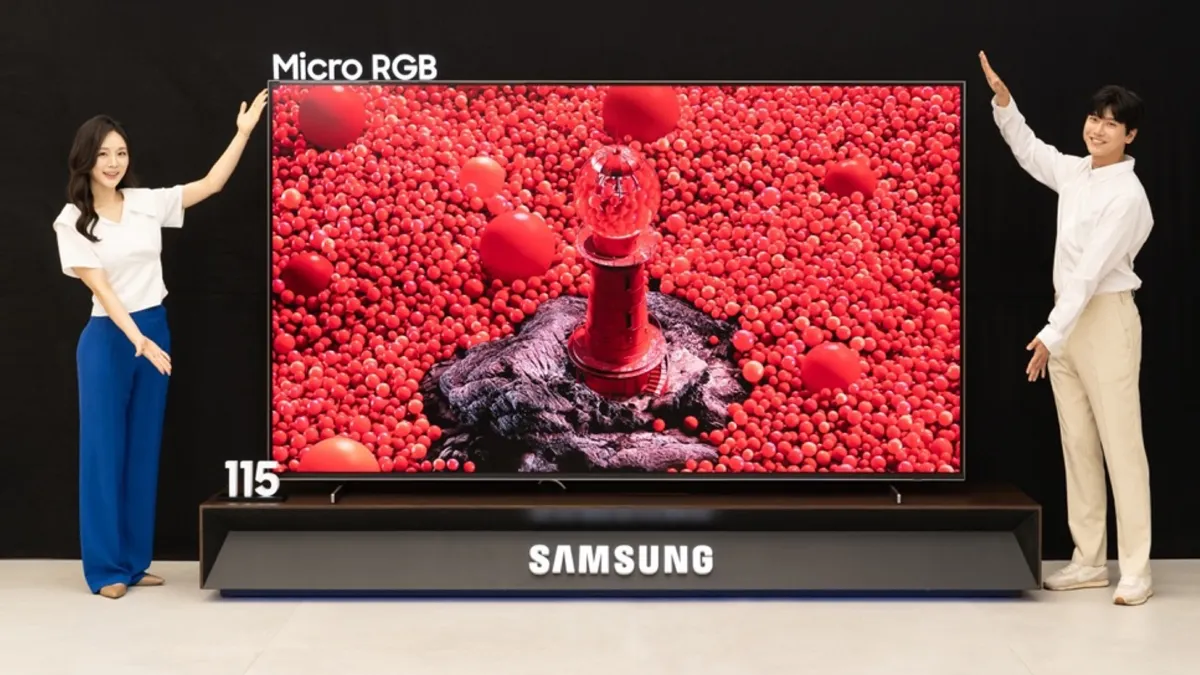
When we saw Samsung’s world-first 130-inch RGB TV in person back in January, we thought it was beautiful, but it wasn’t clear whether it would actually go on sale – at the time Samsung said it was just a concept, but now there’s more rumblings that it might happen.
But now a new report suggests that if it does become available to buy, it’s going to be very, very expensive.
Enormous TV in ‘expensive’ shocker, I know. But there’s a significant jump in production cost between the current 115-inch / 116-inch panels and a 130-inch one, so there’s likely to be a very significant cost for early adopters.
How much will a 130-inch TV cost?
The current flagship extra-large TVs are 116-inch models, such as the Hisense 116UX, which had a launch price of $29,999 / £24,999 / AU$39,999.
According to research firm Counterpoint, as reported by FlatpanelsHD, the cost of a 130-inch LCD panel is nearly 1.5x the cost of a 115-inch one.
It’s tempting to grab the calculator and multiply the cost of the Hisense 116UX by 150%, but the panel is only part of the cost of a TV. While it’s a significant chunk of the overall bill of materials, there are other factors at play including the processor, sound system – in the case of the Samsung, 14 built-in bass units – and the cost of engineering and building the frame for such a large, heavy panel. Some of those might cost more than for a 115-inch TV, some might cost the same.
(If you’re wondering about the crude value proposition here, a 130-inch screen is 27% larger than a 115-inch screen in terms of the area – so 50% higher price for 27% more screen.)
It’s clear that the first 130-inch LCD TVs are going to be out of reach for most of us, but their role isn’t really to sell in serious numbers: the first flagships are there to showcase new technology and to burnish brands’ reputations as market leaders, so they’re only really bought by the most affluent early adopters.
As we said of Samsung’s 130-inch prototype, “it’s a big flashy showcase”. Every new generation of TV tech has started off with sky-high price tags and then getting much cheaper in a relatively short space of time as manufacturing improves and becomes more efficient.
Assuming you’re even in the market for one of the new TVs, there’s also the issue of performance. The “never buy a 1.0 product” advice is an old tenet of tech, and it applies to TVs too: for example when we reviewed the Hisense 116UX we noted that it had screen uniformity issues and struggled with some dark scenes.
With each new wave of TV tech we’ve seen the panels and the TVs containing them improving over time – and price dropping – and it’s highly likely that the same will happen with these even bigger flagships. So at first, a high-end 130-inch may be in the $40-$45k region – but later, who knows? Maybe you’ll only be paying a bargain $20k. I’ll have two!
Thinking of buying a new TV?
Try our TV size and model finder! You tell it how far you sit from your TV, we’ll tell you what size to buy based on viewing angle advice from image quality experts, and we’ll recommend our three top TVs at that size for different prices.
Follow TechRadar on Google News and add us as a preferred source to get our expert news, reviews, and opinion in your feeds. Make sure to click the Follow button!
And of course, you can also follow TechRadar on YouTube and TikTok for news, reviews, unboxings in video form, and get regular updates from us on WhatsApp too.
https://cdn.mos.cms.futurecdn.net/SD3xEk6QkicbcWUa66BEuN-2560-80.jpg
Source link





