
[
Some of the greatest songs in rock ‘n’ roll have their roots in literature. Music and books share one essential foundation: great writing. Whether it’s a timeless character, a setting worth painting, or themes that resonate outside the pages, a powerful story can inspire artists to expand the work further. While many classic rock songs typically come from a musician’s personal experiences, others draw from certain novels into something entirely fresh through music.
From faithful tributes to imaginative reinterpretations, these songs prove there is more than one way to expand a literary world. They breathe new life into iconic stories, introducing them to new audiences while offering longtime readers a fresh perspective on familiar tales. Without further ado, here are the 10 best classic rock songs inspired by famous books, ranked.
10
“Childhood’s End” by Pink Floyd
Inspired by ‘Childhood’s End’ by Arthur C. Clarke
The hard sci-fi book Childhood’s End opens by introducing aliens known as the Overlords. In the beginning, they arrive on Earth promising nothing but peace and harmony, even advocating for a no-war utopia. However, underneath their facade, the Overlords secretly harvest human children to be sent to a higher collective consciousness called the Overmind.
Pink Floyd‘s “Childhood’s End” might not share the same, direct extraterrestrial link as the novel. Instead, the song alludes to the loss of childhood innocence the moment we grow up. Our penchant for fantasies evolves into a stronger sense of consciousness, especially when it begins to “merge with harsh realities.”
9
“To Tame a Land” by Iron Maiden
Inspired by ‘Dune’ by Frank Herbet
Now an Oscar-winning cinematic phenomenon, Dune revolves around the war for the desert planet Arrakis, the only source of the invaluable spice melange. At the center is House Atreides and its young heir, Paul Atreides. After being betrayed by the rival House Harkonnen, Paul escapes into the desert, joins the native Fremen, and begins fulfilling his prophetic destiny as Muad’Dib.
Iron Maiden‘s “To Tame a Land” is chock-full of Dune references, with the novel’s terminology scattered throughout the lyrics. There’s the obvious overarching theme of conquering the “Kingdom of the sands,” which refers to Arrakis itself. But there are also more specific references, including the “Kwisatz Haderach,” the prophesied male; Caladan, Paul’s homeworld; and the Gom Jabbar, the painful trial Paul must endure.
8
“1984” by David Bowie
Inspired by ‘Ninteen Eighty-Four’ by George Orwell
An anti-authoritarian staple, Nineteen Eighty-Four follows Winston Smith, a government worker living in the totalitarian state of Oceania. With Big Brother watching every move in this reality, independence is merely a myth. Winston believes there’s more than meets the eye. Risking his sense of security, Winston rebels against the Party in pursuit of the truth.
David Bowie‘s “1984” isn’t a direct retelling of Nineteen Eighty-Four. Instead, it reflects the novel’s themes of governments and powerful institutions surveilling and shaping society behind the scenes. Bowie warns that, much like the Party, those in power demand obedience by imposing their own version of the truth — one people are expected to accept without question or face the consequences.
7
“Wuthering Heights” by Kate Bush
Inspired by ‘Wuthering Heights’ by Emily Brontë
Emily Brontë‘s “Wuthering Heights” follows the turbulent romance between the orphan Heathcliff and the affluent Catherine Earnshaw. Having been adopted by the Earnshaw family, Heathcliff develops a close bond with Catherine — only to have his heart broken when she marries the wealthy Edgar Linton. Years later, Heathcliff returns to society, this time as a man of status and eager to exact revenge.
Kate Bush puts the novel to music with “Wuthering Heights,” written from Catherine’s perspective after her death. From direct references to the Yorkshire moors — “Out on the wily, windy moors” — to self-confessional lyrics reflecting the couple’s passionate yet emotionally draining romance, “Wuthering Heights” reflects the same volatile nature of Brontë’s seminal work.
6
“White Rabbit” by Jefferson Airplane
Inspired by ‘Alice’s Adventures in Wonderland’ by Lewis Carroll
Lewis Carroll’s children’s book Alice’s Adventures in Wonderland is just as capricious as it is surreal. When a young Alice tumbles down a rabbit hole, she ends up in a fanciful realm where the world literally turns upside down. As she tries to find her way out, she encounters zany characters like the White Rabbit, Cheshire Cat, and Mad Hatter — only to come face to face with the evil Queen of Hearts.
Just like Alice, Jefferson Airplane questions the bizarreness of reality through “White Rabbit”—”When logic and proportion / Have fallen sloppy dead.” The song definitely takes a more PG-rated approach, replacing potions and cakes with pills while portraying the Caterpillar as a hookah-smoking creature. It also references the novel’s most famous command: “Off with her head!”
5
“Tom Sawyer” by Rush
Inspired by ‘The Adventures of Tom Sawyer’ by Mark Twain
There’s a reason why Mark Twain‘s The Adventures of Tom Sawyer remains a timeless American literary classic. The coming-of-age story follows the cheeky Tom Sawyer in 19th-century Missouri, where the woods are dense and the rivers are winding. His carefree adventures take a deadly turn after he and Huckleberry Finn witness Injun Joe commit a murder.
While not a direct retelling, Rush‘s “Tom Sawyer” immortalizes the beloved character as a symbol of youthful independence. Tom Sawyer may be young, but he is firm in his convictions. The adults see him as reckless and naive, but, as the lyric goes, “Though his mind is not for rent / Don’t put him down as arrogant,” he possesses more integrity than many of the grown-ups around him.
4
“Scentless Apprentice” by Nirvana
Inspired by ‘Perfume’ by Patrick Süskind
Set in 18th-century France, Patrick Süskind‘s Perfume follows Jean-Baptiste Grenouille, an unloved orphan born with an extraordinary sense of smell. After becoming a gifted perfumer, he grows obsessed with preserving the irresistible scent of young women. But as he becomes consumed by murder, his pursuit of the perfect fragrance spirals into an all-consuming passion for crime.
Nirvana‘s “Scentless Apprentice” is just as provocative as the book itself. Instead of celebrating fragrant scents, the band fixates on nauseating odors that most people couldn’t fathom smelling, from “Electrolytes smell like semen” to mushrooms leaking gas fumes that are turned into perfume. But despite the apprentice’s obsession with perfumery, he remains utterly senseless when it comes to morality.
Inspired by ‘Johnny Got His Gun’ by Dalton Trumbo
Published between the two World Wars, Johnny Got His Gun is Dalton Trumbo‘s original take on anti-war sentiment. Young American soldier Joe Bonham awakens after a World War I artillery blast. Although he survives, he discovers that he has lost his arms, legs, eyes, ears, nose, mouth, and tongue. Unable to speak or move, he is effectively imprisoned within his own body, with his consciousness very much alive.
Metallica‘s “One” amplifies what it’s like to be stuck inside your own body, tortured by the horrors of war but unable to voice them literally. The band lists each of Joe’s physical injuries, but the most painful of them all is his psychological suffering. He becomes trapped in a living limbo, as the lyrics say, “I cannot live / I cannot die.”
2
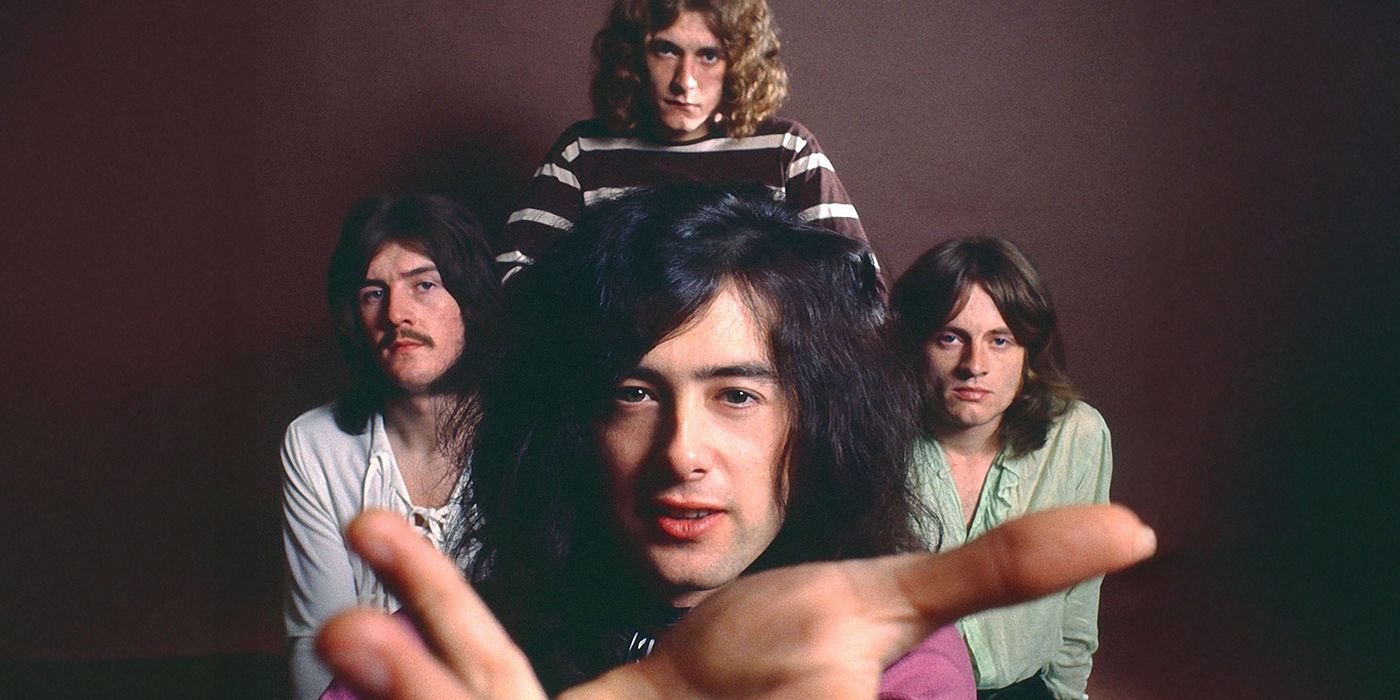
“Ramble On” by Led Zeppelin
Inspired by ‘The Lord of the Rings’ by J. R. R. Tolkien
One of the most celebrated epics in fantasy, J.R.R. Tolkien‘s The Lord of the Rings is the illustrious journey of young hobbit Frodo Baggins. Entrusted with the One Ring after Bilbo’s departure, Frodo must destroy the Ring in the fires of Mount Doom before the Dark Lord Sauron gets to him. Thankfully, his travel to Mordor is accompanied by Gandalf the Grey.
Led Zeppelin frontman is a well-known fan of Tolkien’s works, so much so that he references them greatly in “Ramble On.” From the direct references to Mordor, Gollum, and the “Evil One” (Sauron), the many Middle-earth characters, and even a homage to Tolkien’s Elvish poem, “Namárië” — “Leaves are fallin’ all around,” the song is just as whimsical as the books.
1
“Sympathy for the Devil” by The Rolling Stones
Inspired by ‘The Master and Margarita’ by Mikhail Bulgakov
The 20th-century Russian literary masterpiece by Mikhail Bulgakov, The Master and Margarita is a surreal, religious-inspired trip. Set between 1930s Moscow and Pontius Pilate’s Jerusalem, the fiery Satan disguises himself as Professor Woland to expose greed and corruption by raising hell. Meanwhile, an embittered writer, Master, and his devoted lover, Margarita, seek redemption by performing the ultimate sacrifice.
Satan is commonly portrayed as an evil figure, but The Rolling Stones present him in a more sophisticated light in “Sympathy for the Devil.” Like the book, the song captures Professor Woland’s duality. Woland behaves more honestly than the corrupt Soviet officials and writers he exposes, just like the lyric: “Just as every cop is a criminal / And all the sinners saints.”
https://static0.colliderimages.com/wordpress/wp-content/uploads/2025/09/led-zeppelin-3.jpg?w=1200&h=675&fit=crop
https://collider.com/best-classic-rock-songs-inspired-by-famous-books-ranked/
Dyah Ayu Larasati
Almontather Rassoul




