
[
Good morning. CFOs at newly independent companies can see substantial increases in compensation.
A Compensation Advisory Partners (CAP) study of industrial and manufacturing spinoffs, shared with CFO Daily, found that median target total compensation rose roughly 66% for “SpinCo” CFOs with comparable pre- and post-transaction pay disclosures, compared with 57% for CEOs.
CFO salaries rose 11%, while annual long-term incentive opportunities increased 102%. The study covered 19 major separations involving 29 resulting companies. Median revenue was $11.8 billion for parent companies before the transaction and $5.2 billion for the resulting companies.
The larger equity packages reflect the shift from divisional leadership to the top ranks of a standalone public company, Ryan Colucci, a CAP partner and author of the report, told me. “The buck stops with you now,” he said.
That expanded responsibility also helps explain a striking difference in hiring patterns. While 79% of SpinCo CEOs came from within their organizations, 58% of CFOs—11 of 19—were recruited externally. Many of those external hires had experience as public company CFOs, Colucci said.
“Honeywell Aerospace, for example, hired the former CFO of Deere & Company,” he said. Honeywell Aerospace, a spinoff of Honeywell, became an independent, publicly traded company in June, trading on the Nasdaq under the ticker symbol HONA. Josh Jepsen joined Honeywell Aerospace as CFO on Feb. 23. According to his offer letter from Honeywell, his annual base salary is $1 million, and he was also offered a cash sign-on bonus of $1.525 million, payable within 30 days of his start date.
Colucci said boards may turn to external candidates because an internal divisional finance leader may have had limited exposure to investor relations, public-company reporting, capital markets strategy, and board or audit committee relationships. However, recruiting an experienced CFO can bring additional costs.
Incoming CFOs may forfeit equity awards or bonuses from their previous employers, prompting companies to offer cash or equity sign-on packages. These awards can help replace forfeited compensation while giving executives a financial stake in the new company, although the replacement awards are not necessarily dollar for dollar, Colucci said.
Recruitment also begins well before a separation is complete. Some externally hired CFOs join six to nine months before the transaction closes, initially working within the parent organization, he said.
The median transaction took approximately 13 months from announcement to launch. Approximately three-quarters of SpinCo CEOs and CFOs had their compensation established before separation or through a staged process that began before closing.
One-time transaction or launch awards were also common: 83% of the resulting companies provided them, with median awards of approximately $3 million for CEOs and $1 million for CFOs. These awards were separate from recurring target compensation and recruitment packages.
Yet becoming independent rarely means abandoning the parent company’s entire incentive framework. Companies generally retained familiar structures while adjusting performance measures or equity vehicles to reflect their new circumstances, Colucci said. A standalone business might add cash-flow or working-capital measures, introduce strategic goals related to the separation, or reconsider its use of stock options, he said.
For finance leaders, the distinction is important: recurring pay increases reflect the broader accountability that comes with overseeing a public company’s finances, while separate awards can address recruitment, retention, and the work involved in completing the separation.
Sheryl Estrada
Sheryl.Estrada@fortune.com
Leaderboard
Kelsey Cassinelli was promoted to EVP, CFO and principal finance officer of Plumas Bancorp (Nasdaq: PLBC), the holding company for Plumas Bank, effective Jan. 1. Cassinelli will succeed Richard Belstock, CFO since 2011, who is retiring. Cassinelli currently serves as SVP and principal accounting officer of Plumas Bancorp and Plumas Bank. Joining Plumas in April, she held various positions at KPMG LLP since 2016, most recently serving as a senior manager specializing in financial reporting, audit leadership and complex regulatory matters.
Scott Schiffres was appointed CFO of Oofos, a recovery footwear brand. Schiffres joins the company with more than 25 years of experience across global consumer brands. Most recently, he served as CFO and interim general manager of Tea Forté, part of Keurig/JDE Peet’s. Previously, Schiffres held CFO and senior finance leadership roles at Heineken and served as CFO and COO of Unreal Candy.
Big Deal
In the age of AI, many employers still value candidates with college degrees.
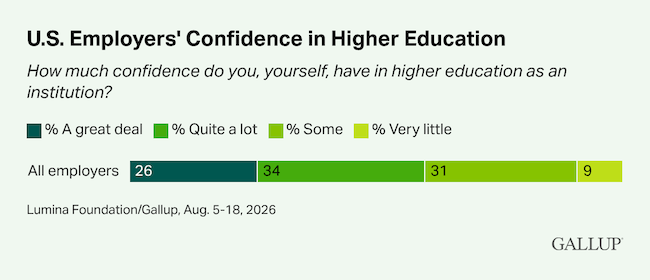
Lumina Foundation and Gallup’s second annual study of employers finds that six in 10 U.S. hiring decision-makers have a great deal (26%) or quite a lot (34%) of confidence in higher education. Nearly half (48%) expect AI to make college degrees more important over the next five years, compared with 26% who expect them to become less important.
The findings are based on a survey of 2,500 U.S. hiring decision-makers. Respondents represent a range of industries, regions and organization sizes, from businesses with fewer than 10 employees to those with 1,000 or more.
Expectations that AI will increase the importance of college degrees vary by industry. That view is held by 59% of employers in information, 53% in financial activities, and 49% each in trade, transportation and utilities and in education and health services.
Confidence in higher education also varies by company size. Hiring decision-makers at companies with fewer than 10 employees report the lowest confidence (44%), compared with at least 59% in every larger size category. Confidence peaks at 70% among those at companies with 500 to 999 employees.
Going deeper
Deloitte’s CFO Signals article finds that many organizations manage AI spending reactively rather than proactively and rely on basic or general controls. Nearly three-quarters of surveyed CFOs say their organizations typically take several business days to several weeks to pause or shut down AI usage when costs exceed approved limits. Gaps in governance, limited visibility into usage and costs, and restrictive vendor terms further complicate oversight—underscoring the need for stronger cost controls as organizations scale AI.
Overheard
“What drives genuine enjoyment, loyalty, and performance are feeling that your work matters and feeling respected, supported, and connected to the people around you.”
—Deborah Lovich, a managing director and senior partner in the Boston office of Boston Consulting Group, writes in a Fortune opinion piece titled “Only 46% of employees trust their leaders. A BCG partner says the fix is simpler than CEOs think.”
https://fortune.com/img-assets/wp-content/uploads/2026/10/GettyImages-2283940119.jpg?resize=1200,600
https://fortune.com/2026/10/26/cfo-pay-jumps-66-percent-major-industrial-spinoffs/
Sheryl Estrada




