
[
In October, in a converted church in West London, Jensen Huang stepped onto a stage to preach to a packed congregation. The then–Nvidia CEO had a gospel to share with the politicians, tech executives, and journalists, Fortune among them, crowding the room: The AI boom was only getting started, and Nvidia was in town to help bankroll it.
“I’m gonna invest in you! I’m gonna invest in you!” he shouted at the founders in the crowd. “We’re not your largest investor, but we are your best investor.”
Huang’s London visit was one stop on a European charm offensive that also swept through France, Sweden, and Germany. At the time, the trip had the feeling of a victory lap. Nvidia is the default supplier of the vital chips that are fueling the AI industry’s rapid growth, and with a market cap that, at one point, topped $5.7 trillion, had seeded an entire ecosystem that came to depend on Nvidia’s support.
If the AI boom is a kind of religion, then Huang had been its high priest—proselytizing to investors and policymakers, ministering to the faithful, and doling out alms to needy startups, AI labs, and neoclouds. Nvidia was the world’s most valuable company, and Huang was one of the world’s most powerful men.
Just three weeks later, that victory lap across Europe looks more like a last hurrah. The man who sold the world his vision of an AI future was soon fighting for his own future—and on Thursday morning, the seismic news broke: Jensen Huang had resigned from his role as CEO.
His abrupt departure followed reports that U.S. intelligence agencies believed Huang had been involved with a woman who was working as a Chinese intelligence asset—Alice Huang (no relation), a former executive at Megaspeed, a Singapore-based data center company that had bought billions of dollars’ worth of Nvidia chips.
For the once seemingly untouchable founder, the fall from grace came fast. Within a week, Huang had sent a memo to Nvidia’s 42,000 staffers acknowledging he had been “unfaithful” to his wife and was “deeply sorry.” Nvidia’s board launched an independent investigation; U.S. congressional leaders summoned Huang to answer questions; and federal agencies said they were investigating the matter. Nvidia shares tumbled, and prediction sites began to take bets on whether Huang would resign.
The other shoe dropped when the New York Times reported allegations of a second affair, this time with an Nvidia executive who reported directly to Huang. By the next morning, Nvidia’s CEO of 33 years had submitted his resignation. Nvidia’s brief announcement of that fact, and the appointment of chief financial officer Colette Kress as interim CEO, gave no reason for his departure.
The timing couldn’t have been worse for Nvidia or for the AI industry in which Huang played such a central role. Worries about rising interest rates, dire warnings about AI’s extinction-level risks, and Americans’ opposition to data centers—on display in November’s midterm elections—have already put the AI boom’s foundations on shaky ground.
Critics have long warned that Nvidia’s AI investments had created a risky “circular” web in which Nvidia pours money into AI labs and data center companies, which in turn buy Nvidia chips. The company said that as of the end of July it had invested nearly $50 billion into leading AI model companies alone, and its equity investments across the AI ecosystem totaled twice that amount. The company has increasingly stepped in to use its investment-grade credit to help AI companies and so-called neocloud data center providers obtain financing. In total, it has pledged $170 billion on commitments of this kind, including guarantees valued at $105 billion to OpenAI for just one facility in Ohio. Additionally, Nvidia has been in talks with a consortium of Wall Street lenders to help backstop a $500 billion plan to turn AI chips into tradable securities.
This “central bank of AI” role, as some have characterized it, masked weak demand and inflated a dangerous financial bubble, critics argued. Just as worrisome, it positioned Nvidia as a single point of failure that could destabilize the entire industry. But even the company’s harshest critics didn’t expect the biggest threat to Nvidia to come from the man at the center of it all.
To be clear: Even with its charismatic founder no longer in the CEO role, Nvidia’s core business isn’t going anywhere. Its chips remain the industry standard; its supply is sold out and contracted through the next year. Francine McKenna, an investigative journalist and expert on corporate governance and accounting, says the company can survive “independent of his cult of personality.” But Jay Goldberg, an analyst at Seaport Research Partners, warns that Nvidia risks losing what made it exceptional: Huang’s willingness to make big bets and keep moving even when some—like Nvidia’s ill-fated effort to make chips for mobile phones—failed. “If they lose that,” he says, “they’re going to become just another chip company.”
Indeed, for all its dominance, Nvidia was never invincible: Some of its best customers were already turning to rival chips or building their own, and governments were pushing for “sovereign AI” that doesn’t depend on American tech.
The AI boom is bigger than any one company, but the sector has yet to prove it can thrive without Nvidia—and Nvidia has yet to prove it can thrive without Huang. Can the industry outgrow its dependence on its most powerful evangelist, or will Huang’s ouster from the company he built expose how much of the boom was built on faith?
It all starts in China
In a wide-ranging interview with Fortune in London—before news of the affairs broke but months after concerns about Nvidia’s dealings with Alice Huang and Megaspeed first surfaced—Huang was still going full speed even though he’d only eaten “half of a half sandwich” all day.
He was behind schedule for his next engagement in the church across town, but waved his hand dismissively. “I’ve been late all day,” he said. This was a man who knew very well: The show couldn’t go on without him.
Huang was characteristically optimistic about the future of AI, and about another topic: China. The opportunity there “is large and growing,” he said, wearing his signature black leather jacket in the sweeping lounge of a Central London office building that had just hosted an Nvidia-sponsored hackathon. “We should provide, and we do provide, the best, the soonest, and the most to American companies,” he said. “However, we should compete.”
To understand what happened to Huang, one has to understand Nvidia’s history with China, which has long been a major part of the Santa Clara, Calif.–based company’s business. That business took a hit in 2022 when the Biden administration barred Nvidia from selling its most advanced AI chips there, in an effort to slow Beijing’s progress in the AI race. Successive rule changes forced out even Nvidia’s scaled-down chips. And Beijing started discouraging Chinese AI companies from buying American chips.
Huang—who once publicly complained that U.S. export controls had shrunk Nvidia’s share of China’s AI chip market from 95% to zero—lobbied hard to roll back the export controls. He argued that allowing Nvidia to sell its chips in China would help make American tech the global standard—and crowd out Chinese competitors who were advancing quickly.
When Donald Trump won a second term in 2024, Huang donated $1 million to his inaugural fund and began making frequent pilgrimages to Mar-a-Lago. By all accounts, the two men became close. Trump once phoned while Huang was onstage at a summit in Los Angeles; Huang put him on speaker, and the pair dismissed fears about AI to the crowd.
In late 2025, Huang won a key compromise: Nvidia would be allowed to ship a second-tier chip model to approved Chinese customers. In an unprecedented arrangement, the U.S. government would take a 25% cut.
Huang’s lobbying proved “very effective,” said Ed Mills, a policy analyst with investment firm Raymond James. “There was an ‘in Jensen we trust mantra’ within D.C. and a push within the tech industry to pivot away from seeking to restrict what China got, to seeing if we could get China hooked on our technology.”
It emerged after the scandal broke that Megaspeed had long been suspected of helping Chinese firms dodge export controls. People briefed on U.S. intelligence told the Times that Alice Huang had been recruited by China’s Ministry of State Security to gather information on American AI chips and to persuade Nvidia to push for its advanced chips to be sold in China.
China hawks in both U.S. political parties have accused Nvidia of downplaying chip smuggling and overstating the strength of China’s homegrown chips to win looser rules. Huang’s affair with a suspected China asset gave them fresh ammunition to question his motives. “This episode makes clear what we have been alleging the whole time, which is that Nvidia is deeply compromised,” said Brad Carson, president of Americans for Responsible Innovation, a group that lobbies for regulation of the tech and AI industry. “At best they turned a blind eye to smuggling of their chips into China. At worst, they were complicit in it.”
Meanwhile, China called the allegations “groundless speculation and slander,” and Nvidia’s board said it had “no reason to believe” firm secrets or national security were compromised. (Nvidia did not respond to multiple questions from Fortune seeking additional comment after news of the affair and eventual resignation.)
Later reporting revealed that a U.S. Commerce Department probe into whether Megaspeed smuggled Nvidia chips into China was halted and passed to the Justice Department after Nvidia’s general counsel contacted the agents running it. An Nvidia spokesperson told the Times that the company had contacted officials “to answer their questions, provide information we have gathered from the field,” and to seek guidance.
Soon after news of Huang’s affair with Alice Huang broke, President Trump called the Nvidia CEO “very aboveboard” but described the situation as “very complex.”
The scandal has also exposed a rift inside the Trump administration. Treasury Secretary Scott Bessent took to CNBC this week to suggest Howard Lutnick’s Commerce Department had stalled efforts to restrict Megaspeed, saying Treasury, Defense, and State had “for months” favored putting the company on the entity list. Bessent said that the focus on Huang’s personal life missed the point. “The real story here should be: Did Nvidia know their client, and was there a robust effort at Nvidia to make sure that there was no leakage?” he said.
Reports have also emerged that Bessent had pressed Lutnick in the White House Situation Room over his resistance to export controls (a Commerce spokeswoman later denied this). Alongside Huang, Lutnick has been summoned to testify before the Senate Banking Committee about the department’s handling of Nvidia chip exports and the Megaspeed case.
“A cheerleader for the market”
At Nvidia’s flagship GPU Technology Conference (GTC) in Berlin a few days after Huang’s London visit, his keynote hit capacity almost two hours before he took the stage. In his speech, Huang was relentlessly upbeat about the AI boom. He urged Europe to embrace its AI future and build more AI “factories”—Huang’s preferred term for data centers. He wrapped the show with a Eurovision song contest performed by AI agents.
But despite Huang’s onstage enthusiasm and his rock-star reception, the AI boom was already showing signs of strain. “He is a cheerleader for a market, and he is cheerleading it,” Paul Miller, a principal analyst at Forrester, said at a crowded Berlin coffee shop after Huang’s event. “But even he’s not blind to the problems that this sector faces.”
Those ranged from concerns about an AI bubble to fears that AI could pose catastrophic risks to humanity. And by November, a new problem had emerged for the industry: the U.S. midterm elections. Democrats, many of whom had campaigned on reining in AI and data center development, won control of Congress, and voters overwhelmingly backed ballot measures aimed at restricting new data centers. AI stocks tumbled following the blue wave elections, as investors braced for a tougher regime of regulation.
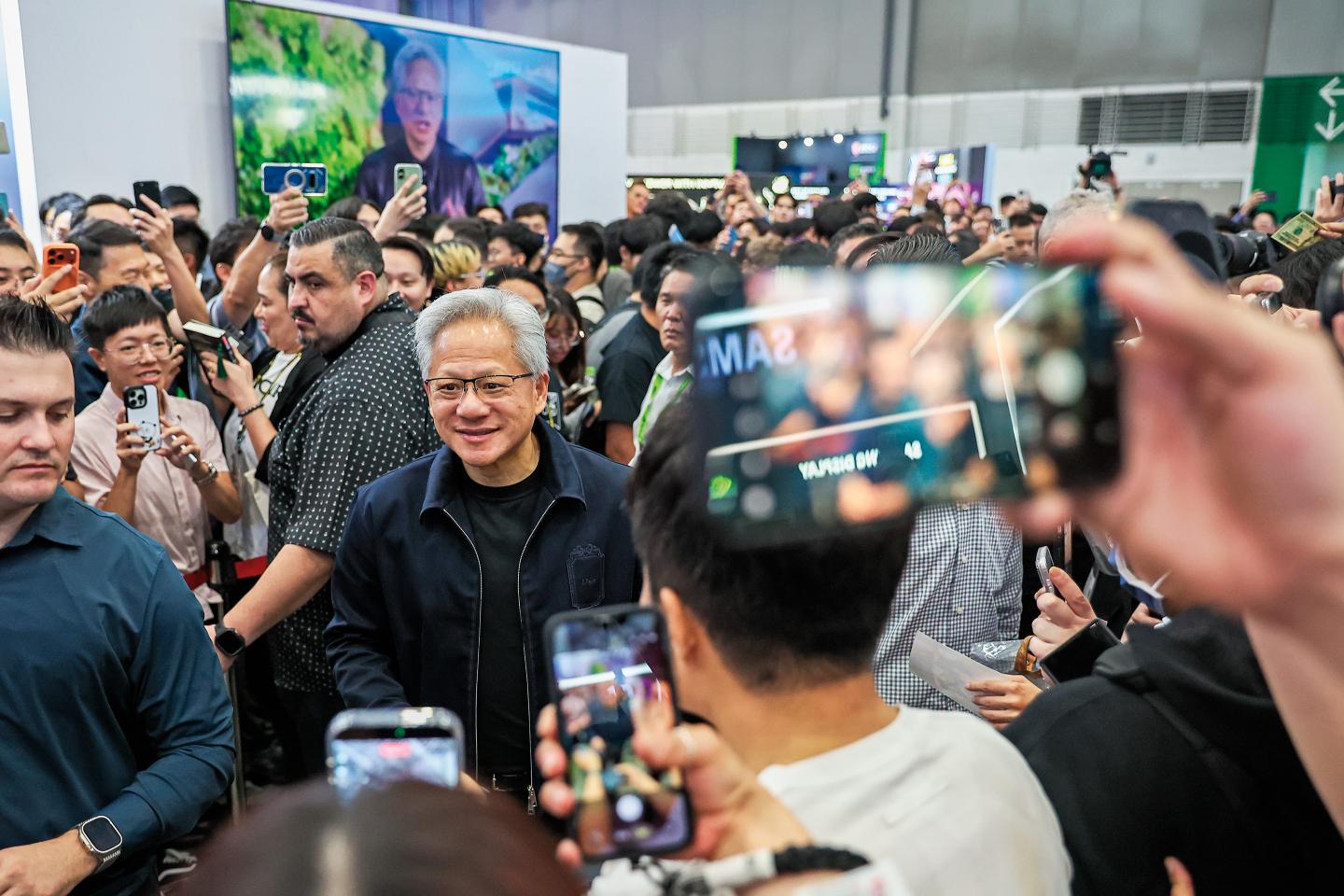
Daniel Ceng—Anadolu/Getty Images
Meanwhile, an even more pressing threat to Nvidia is emerging: Its best customers want to build their own AI chips to reduce their costs and to give themselves more control over chip supply.
Google already trains its Gemini models on its own TPU chips instead of relying solely on industry-standard GPUs. Amazon is pushing its Trainium chips. OpenAI is designing its own silicon with Broadcom. Anthropic increasingly uses Google TPUs, AMD’s GPUs, and Amazon’s Trainium chips, too—although it also uses Nvidia’s. AI itself is making it easier for Nvidia’s customers to switch, with developers using frontier AI coding agents to handle the otherwise difficult and time-consuming work of migrating AI workloads between different chip types.
Countries including the U.K. are also trying to develop their own chips and pursuing AI models that might be able to run on “heterodox compute”—which mixes chips of different types in a single data center—to lessen dependency on American tech like Nvidia’s.
This is all bad news for Nvidia. Hyperscalers and large cloud providers account for about half of its data center revenue, which makes up more than 90% of its total sales.
Huang was in Europe in part to play out his defense strategy and counter the continent’s sovereign AI push, pitching Nvidia as the solution: Europeans could run any model they liked, including open-source ones like those from French AI company Mistral, as long as it ran on Nvidia chips. Huang and Nvidia have heavily backed open-source AI, or models whose underlying “weights” are published for anyone to download, modify, and run on their own hardware. (Anthropic and OpenAI, in contrast, keep their weights secret and sell access only through their own apps and cloud services.) The reasoning, for Nvidia: A thriving open-source ecosystem full of companies that need Nvidia chips and its CUDA software to run their models would offer the chipmaker a hedge for if and when the leading closed labs start getting their chips elsewhere. And it’s good for the world, Huang argued in London: “Our business model is so transparent,” he said. “We benefit when the world uses AI. Period. Whether it’s closed or open.”
But not everyone is convinced. Aldo Podestà, CEO of Italian AI startup Giotto.ai, calls Nvidia’s strategy a “Trojan horse.” The company gives away free software that works best on its own chips, he says, so the more people use it, the more they end up relying on Nvidia. “Some dependence is easier to accept when it arrives in the language of freedom,” he says.
Many analysts think Huang was attempting to pursue a similar strategy vis-à-vis China. Nvidia wanted Chinese AI companies using Nvidia’s chips because it would reduce China’s incentive to develop competing chips that might one day best Nvidia’s and challenge Nvidia’s global dominance.
Analysts estimate that Nvidia controls roughly 80% of the global market for AI chips, and its hardware fills the data centers that tech giants are racing to build. At GTC Berlin, the AI industry’s reliance on Nvidia was on full display.
Beyond the robot demos and packed panels, Nvidia’s partners, including many neocloud companies, took up much of the floor. These newer cloud companies, including Nebius and CoreWeave, buy Nvidia chips in vast quantities, pack them into data centers, and rent the computing power to AI labs and businesses. Many of them count Nvidia as a supplier, an investor, and in some cases, a customer. (Megaspeed, the Singapore-based company at the center of the recent scandal is also a neocloud.)
As of late July, Nvidia held about $99 billion in investments across what Huang calls AI’s “five-layer cake”: energy companies, data center operators, chipmakers, model builders, and the apps that sit on top: “Every single one of the layers we’ve selected are very strategic and really high-quality companies to invest in,” Huang said. “Everybody we invest in are connected into Nvidia’s ecosystem, and so we’re making our platform more vibrant.”
That web of investment, including stakes in OpenAI, Anthropic, and Elon Musk’s xAI, has planted Nvidia firmly in the middle of the AI boom. In several cases, those deals come with promises from the labs to spend heavily on Nvidia’s chips.
To Huang, this was all just good business. But to critics like Michael Burry—the investor famed for betting against the U.S. housing bubble—Huang is inflating a dangerous financial bubble in AI with “circular financing” deals.
In his interview with Fortune, Huang dismissed the idea that Nvidia is propping up the AI boom. The company, he said, only takes minority stakes in a given venture, meaning other investors have to believe in the companies, too. He insists that Nvidia’s investments are necessary since AI, unlike earlier software booms, requires enormous amounts of capital upfront. “We’ve created an industry that the VCs alone cannot fund,” he said. And the bets, he added, “have returned fabulously.”
The neoclouds exhibiting in Berlin make a similar case. “If it’s all going to come down to Nvidia’s capital, we would have run out already,” says Marc Boroditsky, chief revenue officer at Nvidia-backed neocloud Nebius. But even he acknowledges that “many companies out there … have more extreme financial relationships with Nvidia than we do.”
Of course in boom times, the vulnerabilities in the system are easy to ignore. But, McKenna says, “Nvidia’s role propping up much of the AI sector puts enormous pressure on weak links if demand ends up less than the very rosy forecasts.”
The worst case is that several big customers such as OpenAI or CoreWeave can’t earn enough to cover their bills. If that happens, Nvidia could find itself losing chip sales and its equity investment in these companies, and find itself on the hook for some of their debts. Such fallout would cause widespread carnage in the financial markets, starting with Nvidia’s own share price.
It’s worth remembering that Cisco, whose routers and switches carried much of the early internet’s traffic, occupied, as a “picks and shovels” operator in the dotcom bubble, a place similar to the one Nvidia occupies now, and it, too, engaged in vendor financing to seed the market for its networking hardware. When the bubble burst in late 2000, Cisco didn’t go out of business. But its market value plunged more than 85%, and to this day, it has never touched those levels again.
“Weak links come from unexpected places and create systemic risks that can ripple through supply chains and sales cycles,” McKenna said in an interview in late October. Now, the vulnerability has emerged at the very center of that web. How far the damage will spread remains to be seen.
What happens after Jensen?
It wasn’t just Nvidia’s pile of cash or its investment-grade credit rating or its advanced chips that helped fuel the AI boom: It was also Huang’s good name. Huang was well-regarded long before AI made him a corporate celebrity.
His personal story was well-known and gave him an underdog credibility few tech billionaires can claim: His first job was as a teenage dishwasher at Denny’s, and he’d later sketched out his idea for the chip company in one of that restaurant chain’s booths. Nvidia chips went on to become the go-to for the video gaming industry. Huang steered Nvidia through a near-death experience in its earliest days, when the company almost ran out of money, then built it into the engine of the gaming industry and a Fortune 500 company—then, two decades later, into the backbone of artificial intelligence.
One of the longest-serving founder-CEOs in tech, Huang seemed destined to stay at the helm of Nvidia as the AI boom played out, and his decisions carried enormous weight. When he backed a partner, a deal, or a policy, customers, investors, and governments took notice.
If Nvidia is the linchpin of the AI industry, Huang was the linchpin of Nvidia, and his ouster exposed just how much of the company’s success rests upon him. In trading following his resignation, Nvidia stock dove as much as 14%, briefly pushing the company below a $4 trillion market cap for the first time in more than a year—then recovering somewhat.
Huang put himself squarely in the middle of a company that still operates “like a startup,” says Laura Fay, who reported directly to Huang for a decade at Nvidia before retiring in July. His management style is famously flat: He has said that at one point he had around 60 direct reports.
That structure helped Nvidia move at what Huang likes to call the “speed of light.” It has also left the company unusually dependent on one man. At the time of his ouster, Nvidia had no president, no chief operating officer, and no obvious No. 2. Its board had no executive chairman.
Nvidia may feel Huang’s absence most acutely in Washington, where he spent years bending policy in the company’s favor. In May, Trump even brought Huang aboard Air Force One to China—joking at the time to Fortune that he was surprised Huang didn’t have his own private jet. That was reportedly around the same time Secretary of State Marco Rubio briefed the president on the suspected spying operation. (Trump has since said that warning “didn’t make much of an impact on” him.)
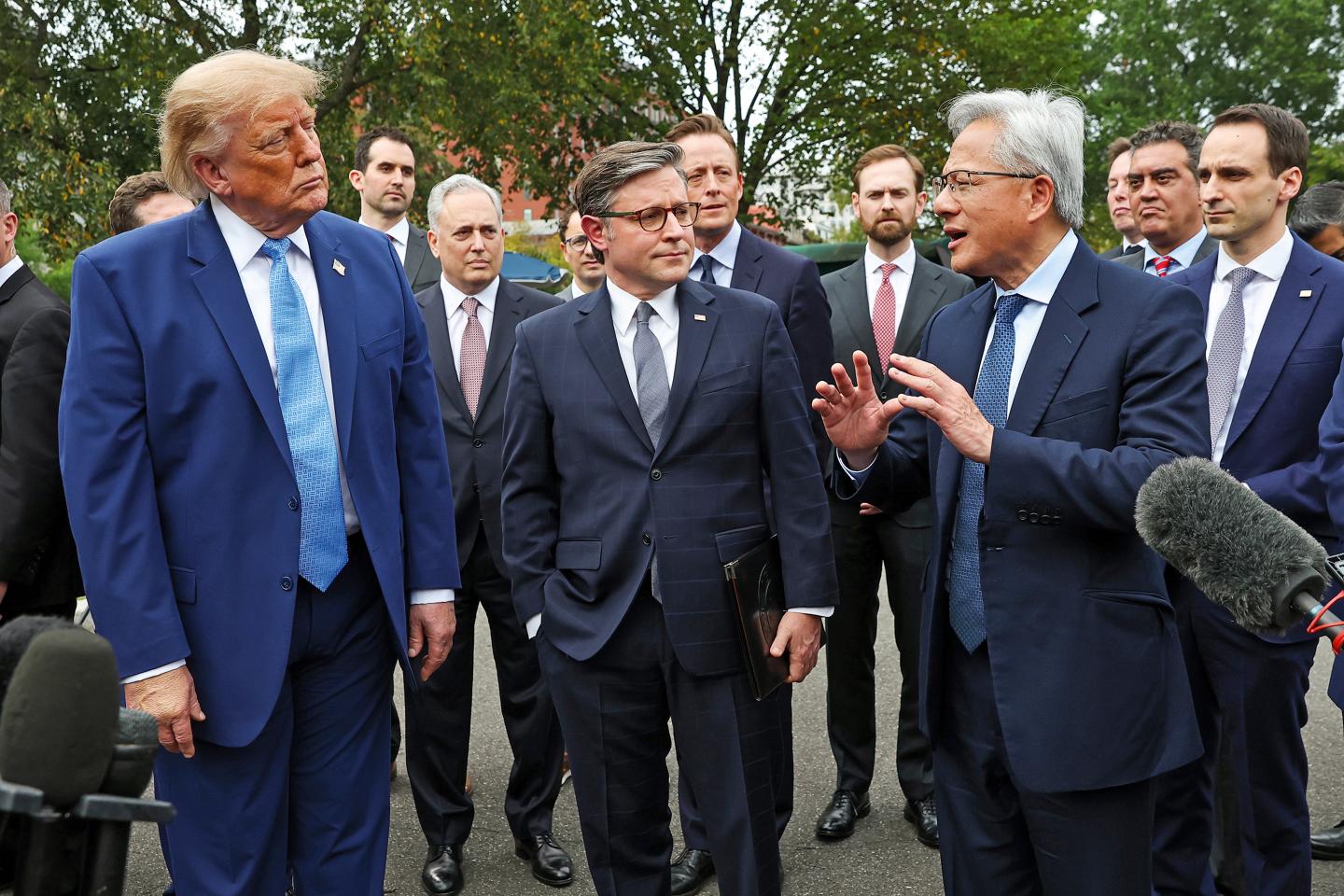
Kevin Dietsch—Getty Images
The company has pushed back hard on think tanks that advocated tougher chip export controls, and some customers, including OpenAI CEO Sam Altman, have avoided taking public positions on the issue for fear of angering the chipmaker, according to a report from The Information. In a statement to the outlet, an Nvidia spokesperson defended the company’s stance against export controls: “America cannot win the AI race unless America’s AI infrastructure wins worldwide.”
Some have called Nvidia a bully and complained that anyone who disagrees with its stances can be put in “Jensen jail” and cut off from much-needed chips. Others say it’s just a function of the company’s success: Nvidia “make[s] the best chips, and companies want them a lot and are afraid of doing things that could anger [Nvidia],” says Nathan Calvin, general counsel and VP of state affairs at Encode, a nonprofit that advocates for regulation of AI and Big Tech. “They have a lot of influence and leverage that they can use to advance their favored policy positions.”
It remains to be seen what will happen to that leverage. Huang was Nvidia’s most effective advocate in Washington, and with him gone, the company has lost its loudest voice opposing the tightening of rules on chip sales to China. New export controls are probable, even before the new crop of lawmakers is sworn in. “This guarantees new export controls,” Raymond James analyst Mills said of Huang’s departure. Three bills proposing new export controls on AI chips and advanced semiconductor equipment are attached to the defense authorization bill awaiting passage on Capitol Hill. The Nvidia scandal “is the accelerant to push [the legislation] over the finish line,” Mills said.
What remains uncertain, he said, is how far those restrictions will go and how robustly the Trump administration will enforce them. The bills still have a loophole for “remote access” in which Chinese AI companies can access Nvidia chips in data centers located in other Asian nations, he noted. That access is exactly what Alice Huang’s former neocloud company, Megaspeed, reportedly provided to Chinese firms. Mills said such loopholes could be closed by policies that would require Nvidia and other chipmakers to implement know-your-customer policies and, in the case of resellers and cloud companies, to identify who their customers’ customers are.
It is also possible that Washington will enact licensing requirements or restrictions on open-source AI models, measures Huang had advocated against. Because the best open-source models have been created by Chinese AI labs, “open-source equals China” in the minds of many lawmakers, Mills said. “If Washington is serious about trying to win the AI race against China we need to see regulations on open-source.”
Waiting for the other shoe to drop
For investors, policy questions run second to a more immediate one: With Huang gone, who keeps the AI boom intact?
The companies most exposed in the wake of his ouster are the neoclouds. The future of all those ventures now looks unclear. Some of Huang’s most ambitious plans to finance these companies, including the more than $500 billion financing platform Nvidia announced with Wall Street firms in August, had already faced resistance at senior levels inside Nvidia, according to Goldberg of Seaport Research Partners. “Nobody at Nvidia could replace Jensen’s role in bringing that together,” he said. Without Huang, he expects many neocloud projects simply won’t get funded.
Following Huang’s exit, investors may also start to scrutinize the numbers Huang used to justify Nvidia’s complex web of investments, said Jason Schloetzer, an associate professor at Georgetown University’s McDonough School of Business. “Is ‘Jensen’s Math,’ the term used for the complex financial entanglements of these AI firms … about to collapse?” Schloetzer asked rhetorically. “What else has he covered up? What else is lacking candor?”
Nvidia’s partners may also find they have more leverage. Companies that once took Nvidia’s money on Nvidia’s terms could start pushing back. “Maybe they’ll drive a harder bargain,” McKenna said.
The rest of the industry won’t escape unscathed. AI has the momentum to keep going, Goldberg said, but it will become “much more vulnerable to political pressure,” especially amid the backlash against data centers. Anthropic, which is set to go public just days after Nvidia reports its first-ever quarterly earnings without Huang, will be the industry’s first taste of a world after Jensen. Nvidia has agreed to buy about $10 billion of shares as part of a $26 billion private placement alongside the listing, and investors expect that commitment to go ahead without Huang. But his departure could raise the stakes for the wider industry and put some of the companies’ partners under intense scrutiny. Schloetzer, for example, said he expects “much closer scrutiny of [Anthropic’s] ties to Nvidia and customers associated with Nvidia.”
The likely winners are Nvidia’s rival chipmakers. The turmoil, Goldberg says, is “really good for AMD, and it’s really good for Broadcom.” Google’s TPUs are likely to benefit from any concerns about Nvidia’s long-term prospects. AMD, Nvidia’s longtime archrival in the GPU market, will probably see some market share gain, too.
Since the scandal broke, one of the loudest voices in tech has gone quiet. Huang pulled out of public appearances, and his only public statement has been an apology to his staff. “I support the investigation and will cooperate fully,” he wrote. “I am committed to protecting Nvidia and supporting America’s national security.”
The chastened tone was a far cry from the bombastic man on the sofa in London. What Huang was selling then was the rosiest possible vision of our AI future. The technology, he argued, would give a small local business the same software firepower as a tech giant. “As a result, everybody will become more ambitious,” he said. “And so I’m excited about that.”
The AI boom has run, in large part, on faith in Jensen Huang. He’d promised that demand for his chips would keep climbing, that AI’s risks could be engineered away, and that the companies building the future-shaping technology could be trusted to police themselves. And for so long, investors, customers, and global leaders happily took that leap with him.
But now that faith has been shattered. The AI boom’s high priest is gone, and the world is waiting to see if the entire AI church he helped construct comes toppling down with him, steeple and all.
https://fortune.com/img-assets/wp-content/uploads/2026/11/NVI_Jensen-Huang_Horizontal.jpg?resize=1200,600
https://fortune.com/2026/11/14/jensen-huang-nvidia-ai-5-7-trillion-downfall/
Beatrice Nolan, Jeremy Kahn





