
[
The Federal Reserve is getting ready to raise interest rates again, after a hike in September. This time it’s pinning part of the blame on artificial intelligence.
Minutes from the Fed’s late-October meeting, released Wednesday, show “almost all” officials thought more rate hikes “would likely be appropriate.” The usual suspect was there: the “vast majority” said high energy prices were still feeding inflation. The new one was AI. “Many participants observed that demand for products associated with the AI buildout was continuing to strain supply and raise prices of technology-related consumer goods,” and several said the price pressure was spreading “beyond industries directly affected by data center construction.”
That meeting was held a week before the midterms. Measures restricting data centers passed in 44 places, from Ohio to Nevada, according to a Redbud Consulting count reported by U.S. News & World Report.. In Ohio, Sherrod Brown’s campaign ran an ad calling his opponent “the face of data centers.” Brown won. The governors-elect in Texas and Georgia have both talked about pausing new projects. In a Pew Research Center survey this summer, 60% of U.S. adults said they’d be not too or not at all comfortable with a new data center in their area.
Put those together and many Americans end up squeezed from both sides. Where data centers were on the ballot, voters rejected them.The Fed is now lining up to raise their borrowing costs, partly because of data centers. And those same data centers are still the biggest thing holding up the economy heading into next year.
Torsten Slok, chief economist at Apollo, estimated Thursday that AI investment accounted for roughly 65% of U.S. economic growth over the past three quarters. He said the true figure is “likely somewhat smaller” once you subtract chips and equipment bought from overseas, but “AI is the number one source of growth for the US economy.”
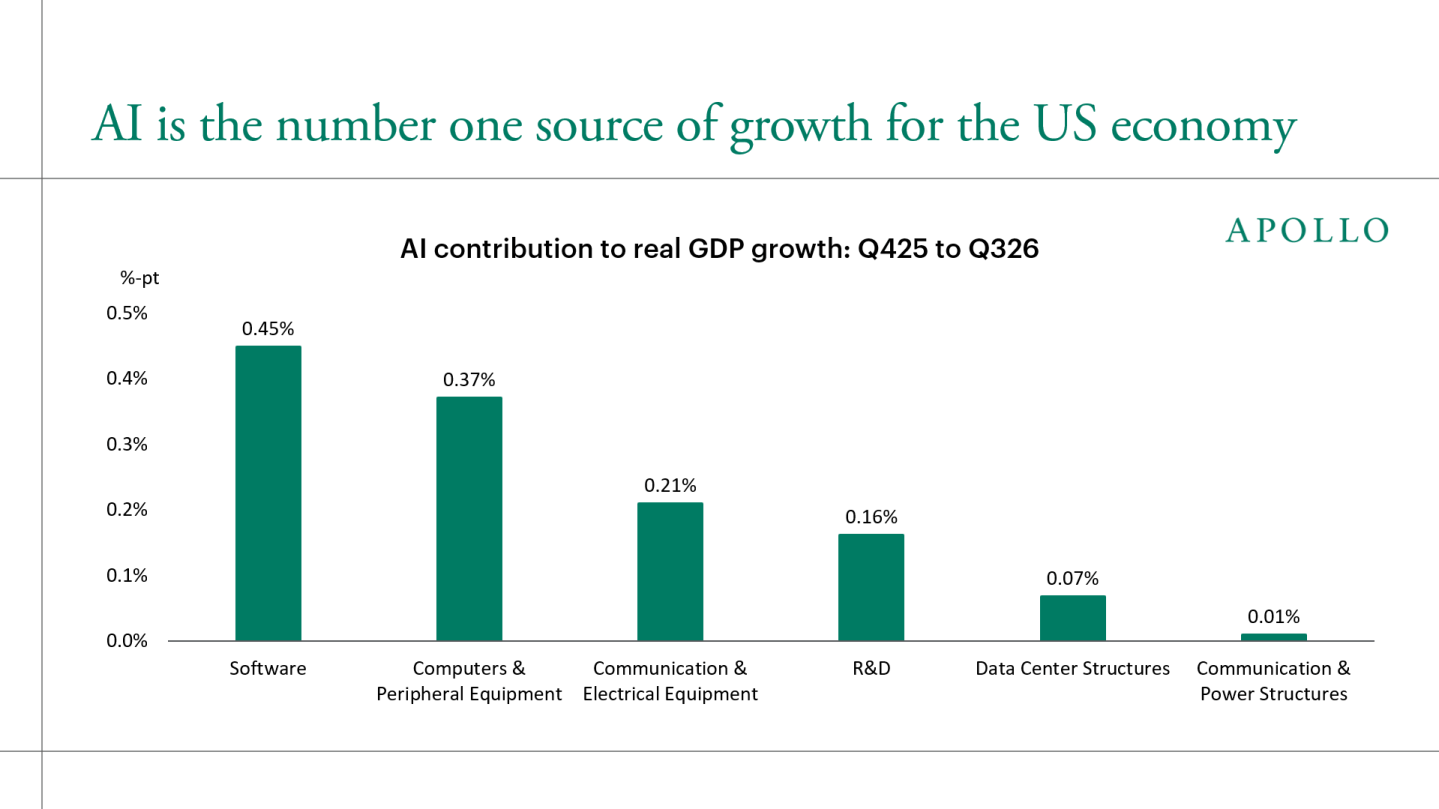
Anyone forecasting stocks and credit for 2027, he wrote, “is implicitly making assumptions about the pace and magnitude of the AI data center buildout,” according to Slok.
Other analysts have similar questions. “How much of this new dent in the GDP growth outlook is going to factor into the Fed’s thinking?” David Rosenberg of Rosenberg Research asked after the election. The Fed hasn’t met since. Its next meeting, Dec. 8-9, is its first chance to answer.
Why your car loan is paying for their chips
The problem with fighting AI inflation using interest rates is that the AI spenders barely feel them. Paul Donovan, chief economist at UBS Global Wealth Management, said in his Thursday morning commentary that the Fed’s inflation worries center on oil prices, “which the Fed cannot influence,” and “perhaps AI-related demand,” which he called “largely beyond the Fed’s reach.” The only way to offset those, he said, would be to create “near-recessionary conditions in the parts of the economy that respond to Fed action.” That means people with mortgages, car loans and credit card balances, and small businesses borrowing to make payroll.
Most Fed officials judged that wage growth “was broadly consistent” with their 2% inflation target. Donovan reads that as wages falling behind prices. Higher rates would land on households whose paychecks are already losing ground.
The Fed held rates at 3.75% to 4% in October. Bank of America Research analysts wrote last week that “the Fed seems to be falling behind the curve on inflation.” Fed Governor Christopher Waller said he was leaning toward a quarter-point hike in December, but a double-size hike “should be considered” if inflation ran hot, because a normal one “would put our credibility at risk.” Traders put about 96% odds on a quarter-point hike in December, with the rest on a half point, according to 24/7 Wall St.’s read of CME data on Nov. 18.
The voters may cool what the Fed can’t
The vote could do what interest rates can’t: slow the buildout itself. Jefferies called the election “the Worst-Case Near-Term Scenario” for data centers and cut its forecast for new capacity through the end of the decade to 112.8 gigawatts from 122.4. Goldman Sachs economists expect “conditional moratoria” in Texas, Georgia and Michigan, but project they won’t be long-lived if enacted, because data centers actually ranked low on voters’ priorities this election. JPMorgan strategists see no “material changes” to 2027 spending, but “some impact” in 2028 and beyond. Morgan Stanley estimates about 5 gigawatts of capacity slips from 2028 to 2029, according to a summary of its Nov. 9 report.
Oxford Economics wrote that “slower construction in the medium to long term wouldn’t necessarily be a bad outcome for the macroeconomy.” Less AI demand would mean less pressure on prices, after all.
But then there’s the debt question. The buildout runs partly on borrowed money, and the Fed’s own minutes are worried about it. “Most participants observed that AI-related debt had grown rapidly and that much of this growth had taken place through complex and opaque financing structures.” Junk bonds sold to build data centers saw “an especially notable widening” in their borrowing costs during the period.
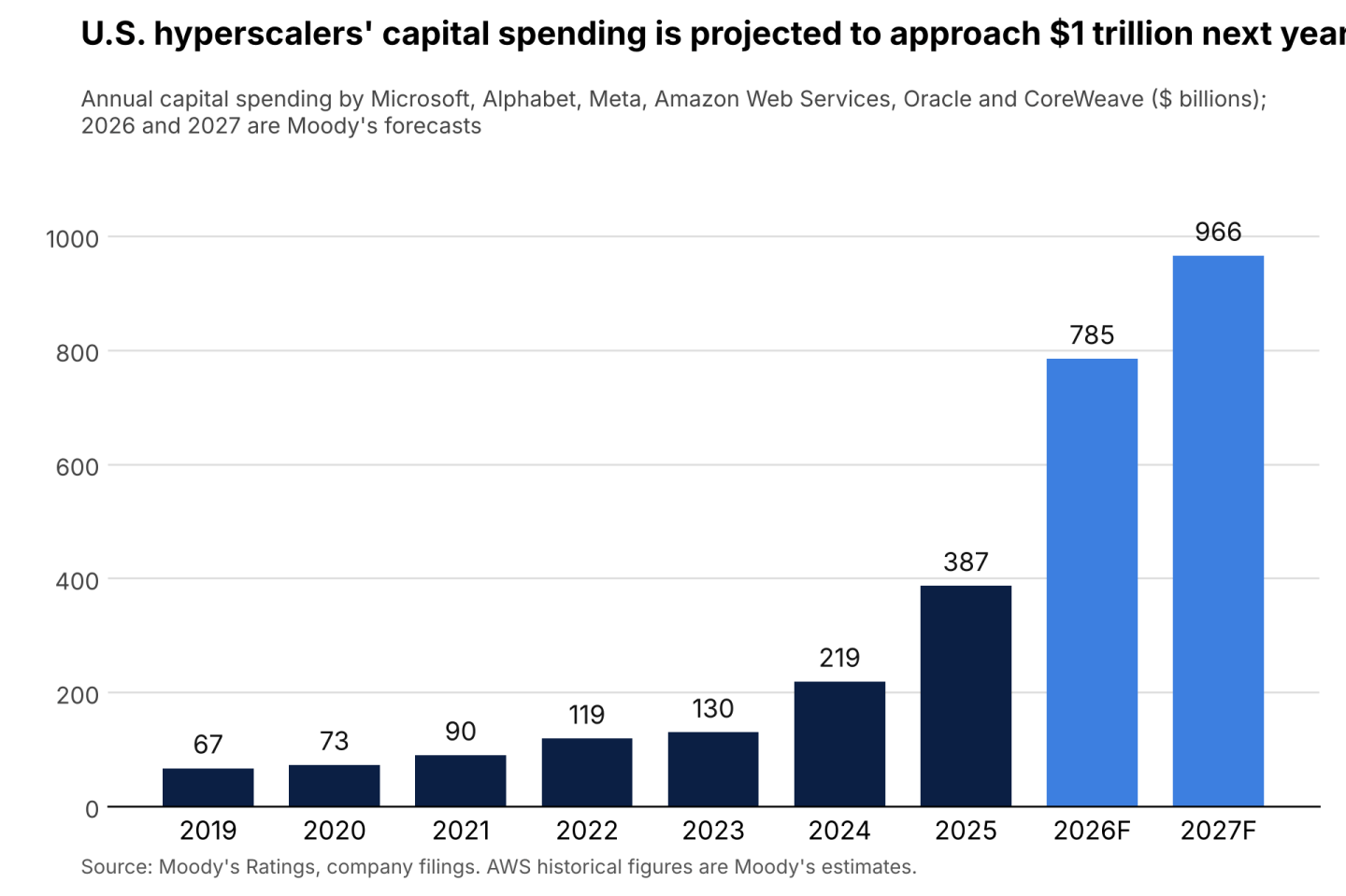
courtesy of Moody’s
Credit rating agency Moody’s said in a report this week that data-center financing is moving out of construction loans and into long-term debt, and that recent “market volatility” suggests the shift “may require stronger protections,” including more equity and paying the debt off within the first lease term. In plain terms, the bet has moved from “will they build it” to “will the tenant still be paying in 10 years.” A town vote against a project, or a Fed hike, makes that bet harder to refinance.
That’s why this reaches people who will never live near a data center. Your 401(k), your company’s hiring plan and next year’s raise all sit downstream of Slok’s assumption about the buildout. The midterms made that assumption shakier. The Fed is about to make money more expensive anyway.
The Fed meets Dec. 8-9, for the first time since voters said no. How much growth is the central bank willing to give up to chase prices driven by a boom the voters just tried to stop?
https://fortune.com/img-assets/wp-content/uploads/2026/11/GettyImages-2304953963-e1795097687874.jpg?resize=1200,600
https://fortune.com/2026/11/19/fed-minutes-ai-inflation-data-centers-midterms-2027-rate-hike/
Nick Lichtenberg





