
- At CES 2026, Nvidia revealed new advancements in its ‘ACE’ in-game AI technology
- Team Green claims 2026 will be the year we properly see AI-powered guides and teammates in games
- However, it seems like we’re still a long way off from this tech being widely implemented
At CES 2026 in Las Vegas, Nvidia had a lot to talk about. The reveal of DLSS 4.5 was the headline news, with new 6X frame generation arriving to boost framerates to even more ridiculously high numbers. We also saw new display tech, upgrades for the GeForce Now cloud gaming service, and unsurprisingly, a whole host of AI stuff.
I’ll be honest – I skimmed past some of the AI-related announcements shown in Nvidia’s presentation last week. A decent chunk of it isn’t really my ballpark; LLM building and generative video models are the territory of my colleague Graham Barlow and the TechRadar AI team.
But there was one section that immediately piqued my interest – and not just because it was something already familiar to me. When Nvidia starts talking about its ACE tech I always listen up, but I don’t always like what I hear.
ACE in the hole
For the uninitiated, Nvidia ACE is a framework for creating fully AI-powered non-player characters (NPCs) in games. It’s mostly only been a theoretical thing so far – after all, Nvidia can’t force developers to use it – but its few appearances have been fairly impressive. In fact, it actually outfoxed me when I tried to mess with it in a tech demo back in 2024.
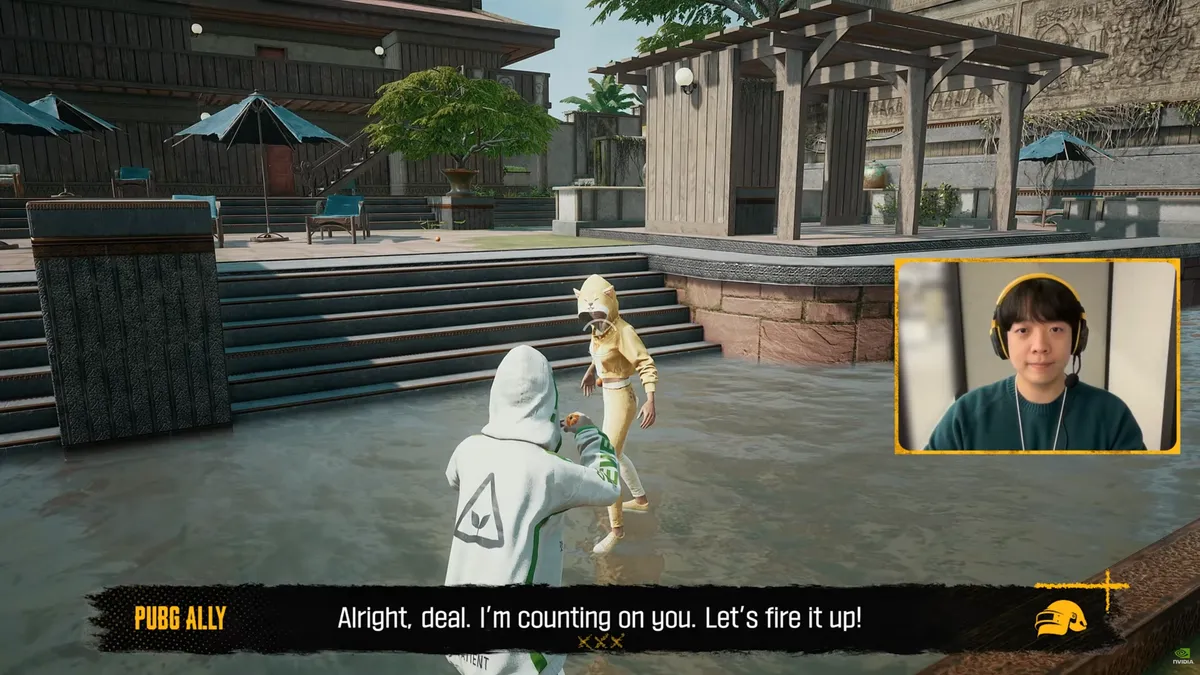
Now, Nvidia is ploughing ahead with bold plans for ACE. No longer will these LLM-driven NPCs be confined to tech demos; at CES, Nvidia showcased several new use cases for ACE, including a player assistant for Total War and fully AI-driven teammates in PlayerUnknown’s Battlegrounds. ACE is also being deployed in Korean developer WeMade’s upcoming MIR5 to power a ‘learning boss battle’, and to create dynamic interrogations in murder mystery title Dead Meat.

I’ve got mixed feelings about this. On the one hand, deploying AI tech like ACE specifically to make games more challenging and engaging is a potentially interesting use case. To be clear, I am not endorsing MIR5 overall here, because I was disappointed to learn that it’s NFT blockchain garbage that has no place in gaming; but the general concept of an evolving boss fight that learns from your encounters and adjusts its behavior accordingly is a solid one. Just don’t tell WeMade that Alien: Isolation effectively did that years before modern generative AI made its meteoric debut…
On the other hand, some of these ACE ideas are just… utterly antithetical to the goals of gaming as a form of art and entertainment. Dead Meat isn’t taking you on a lovingly crafted narrative journey – it’s essentially outsourcing the dialogue to a chatbot. Krafton’s ‘Co-Player Characters’ in PUBG aren’t some revelation to multiplayer gaming – they’re just glorified bots, which frankly defeat the purpose of playing a competitive online game like PUBG in the first place.
With great power comes great responsibility
Nvidia might be the creator of ACE, but of course it’s fundamentally down to individual developers when it comes to how it actually gets used in games. So it’s fair to say that I’m more frustrated with companies like Krafton right now – sorry, but the ‘Co-Player Character’ thing is absolutely nuts. Personally, I’d be furious if I found out the person who just killed me in a multiplayer game was actually someone’s AI ally, not a real player who beat me with their own skill.
“But Christian!” I hear the AI apologists cry, “What if someone doesn’t have friends to play squad-based games like PUBG with?” And to that I say: cry me a river, you losers. It’s literally never been easier to find a community to play online games. Get your ass onto Reddit or Discord. If I’m playing a multiplayer game, I want it to be with other real human beings, dammit!
The ‘Pharaoh’ ACE advisor for Total War is frustrating, but for different reasons. The demo video essentially shows it providing step-by-step advice on how to play the game, making the smartest possible recommendations to ensure victory. ‘Depth and complexity are hallmarks of PC gaming,’ proclaimed one of the slides in Nvidia’s CES presentation – except the Pharaoh advisor effectively removes that depth and complexity by spelling everything out for the player.
You don’t have to follow its advice, obviously, and Nvidia contends that it’s a useful tool for new players who aren’t familiar with the strategy genre, but come on – figuring things out through trial and error, and slowly improving as you learn how a game works is literally part of the experience. By removing that, you’re essentially removing the fun of mastering a game yourself.
Hardware needs
Of course, there’s another problem with ACE being implemented in games. Nvidia is championing it as an example of on-device AI, meaning it runs locally on your hardware – ideally, an RTX 5000-series GPU from Nvidia. I don’t think local AI is inherently evil; it’s generally better to run AI models locally where possible, as it’s more secure and reduces the load on datacenters (which are becoming a real problem for gamers right now).
But if we start locking actual gameplay elements behind specific hardware requirements, that’s a bridge too far for me. Graphics and performance are one thing; people might complain about tools like DLSS and Multi Frame Generation being exclusive to newer Nvidia hardware, but PC gaming has always been like that. If you’ve got newer hardware, your games are going to look better.
They shouldn’t play better, though. If I need a next-gen graphics card to get the full experience from a game, I’m straight up just not buying that game. I do actually have an RTX 5070 in my desktop rig, but it’s the principle that matters; and a dreadful irony here is that AI is currently making it harder than ever to buy a new graphics card at a reasonable price.

Still, control ultimately rests with the developers, which is why I’m not panicking too much about Nvidia ACE seeping into more projects. I spoke to Nvidia’s PR recently about my concerns with ACE, and they raised the excellent point that it’s simply another string to the bow of game devs; like ray-tracing, motion controls, and even 3D graphics before it, there will still be fantastic gaming experiences built without AI, and there’s no guarantee that ACE will even end up being that popular with devs. When I interviewed ‘GeForce Evangelist’ Jacob Freeman about the tech back in 2024 he acknowledged that in some cases, deploying ACE was actually more work for developers than simply scripting a conventional NPC.
And after all, one of the biggest releases of 2025 was Hollow Knight: Silksong, a game made by three dudes with virtually none of the fancy ‘innovations’ of modern gaming. The development landscape might shift, but those games aren’t going away – no matter how much the tech industry tries to force AI onto us.
https://cdn.mos.cms.futurecdn.net/EuEFf8DDE4xU9hEPpugrCP-1920-80.jpg
Source link
christian.guyton@futurenet.com (Christian Guyton)





