
[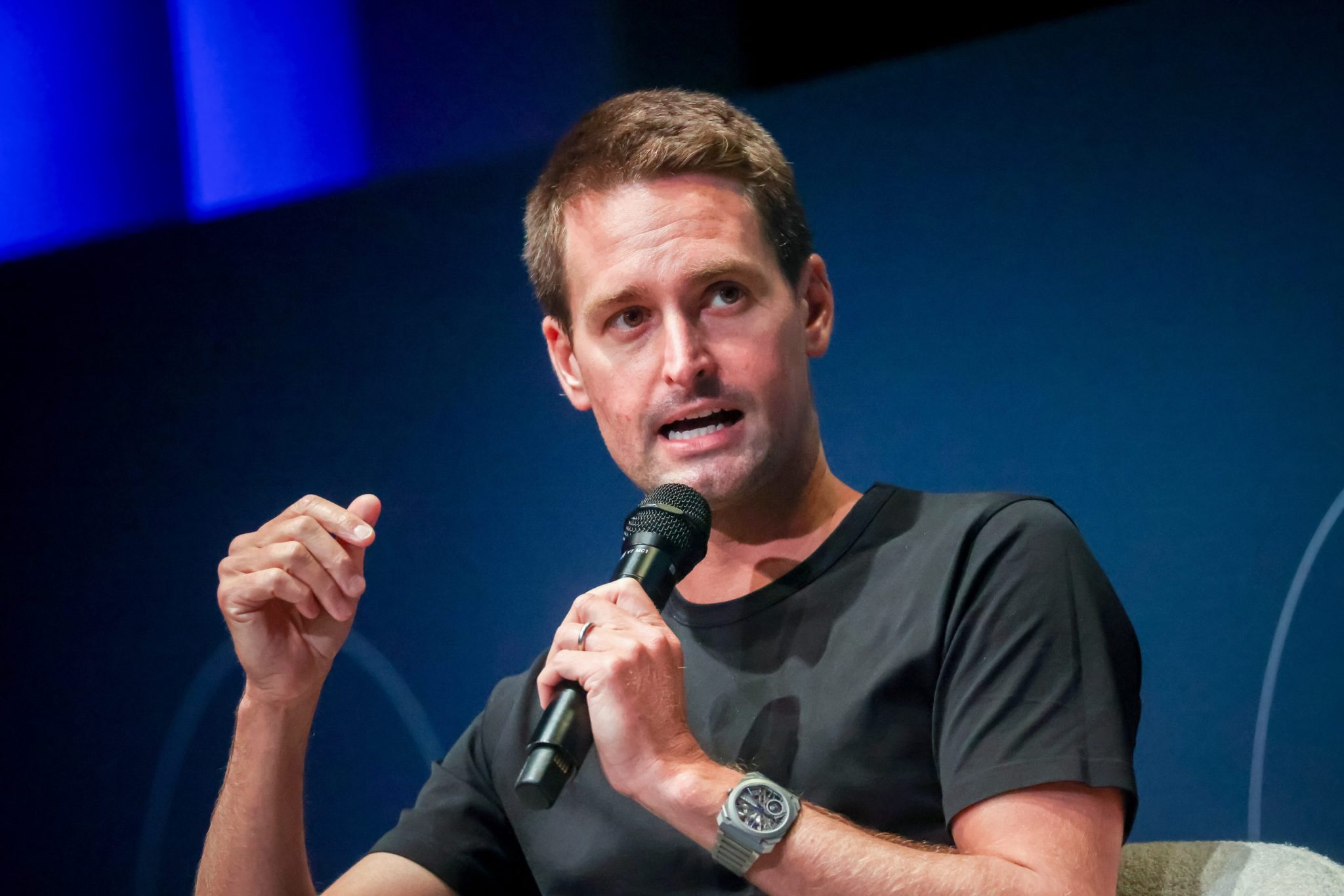
Snap, the tech company behind the social media app SnapChat, introduced on Tuesday AI Sponsored Snaps, an advertising tool that will allow users to chat with AI bots from a brand partnered with the social media platform. It’s one of the many ways the company has continued to lean into AI. But Snap CEO Evan Spiegel said the pivot toward new technologies won’t necessarily help the company score any popularity points.
“I think technology leaders think that folks will just blindly adopt new technology as it comes out,” Spiegel said in an episode of “Lenny’s Podcast” earlier this week, “And I think we’re going to enter a period of time where there’s going to be a huge amount of societal pushback on a lot of the changes that are coming with AI.”
Spiegel has touted Snap’s own ability to lean hard into AI without alienating usership—the company currently boasts a billion monthly users. The platform launched its chatbot “My AI” in Feb. 2023, just months after the release of OpenAI’s ChatGPT. Earlier this month, Spiegel called AI “probably the best thing that’s ever happened” to the company and said AI now writes two-thirds of the company’s code. Snap grew its subscriber count 71% year-over-year in the last quarter of 2025 and now has more than 25 million paid subscribers. Its revenue grew 11% year-over-year in 2025, reaching $5.9 billion.
An NBC News poll published in March found that of 1,000 registered voters, only 26% had a positive view of AI, while 46% had a negative view. That makes AI only more popular than the Democratic party, which had a 22-point net negative rating, as well as Iran, which had a 53-point net negative rating. Fear of the technology has even pushed some employees, particularly young people, to undermine their workplace’s AI rollout. A survey of 2,400 knowledge workers from AI agent firm Writer and research firm Workplace Intelligence found 29% of employees—and 44% of Gen Z workers—admitted to sabotaging their employer’s implementation of AI tools.
Despite heavy criticism, Big Tech has poured $700 billion in capital expenditures into AI. The tech’s usership has also continued to grow, with 57% of Americans reporting using the technology, and 40% using generative AI more than they did a year ago, a Brookings Institute report noted.
But CEOs are also continuing to grow more aware of how the broader public feels about the technology. In March, Sam Altman admitted AI had become the bogeyman, warning continued widespread scrutiny could slow the technology’s growth.
“AI is not very popular in the U.S. right now,” he said.
Why do so many people dislike AI?
Altman attributed disapproval toward AI to data centers’ association with rising electricity bills, as well as widespread layoffs employers attribute to AI, “whether or not it really is about AI.” Snap announced in April it would slash about 1,000 roles in the company, or about 16% of its full-time staff, as well as eliminate about 300 roles for which it was planning to hire.
Despite lack of evidence of widespread labor displacement as a result of AI, there’s still anxiety around the future of jobs in a world with AI. Stanford Institute for Human-Centered Artificial Intelligence’s 2026 AI Index Report found nearly two-thirds of Americans believe AI will result in fewer jobs twenty years five now, and only 5% expected the number of jobs to increase.
The AI Index Report likewise found significant distrust in the ability of the U.S. to regulate AI. The U.S. had the lowest-rated levels of trust in its government to regulate the technology, with less than one-third of participants reporting trust, compared to the average of 54% across all countries. Some AI leaders, such as Anthropic CEO Dario Amodei and “godfather of AI” Geoffrey Hinton, have admitted the technology needs to have higher guardrails, lest the world becomes more susceptible for cyber attacks, or, at worst, an AI takeover.
Spiegel’s own concerns around broader AI acceptance stem from a similar anxiety of AI companies prioritizing short-term profits over serving humanity’s best interests.
“Humanity is far more important than than the technological developments largely because humanity dictates how technology is adopted,” he said, “A lot of our focus as an industry but more broadly in the world needs to be putting humanity first, making sure that the tools we’re developing are advancing humanity’s goals in addition to uh business goals.”
At the same time, he suggested tech leaders are in a tough spot.
“On the one hand, this is really dangerous…and we need people to know this because this is happening and moving quickly,” Spiegel said. “On the other hand, how do you not just freak everyone out and make everyone so afraid of where things are going?”
https://fortune.com/img-assets/wp-content/uploads/2026/04/GettyImages-2235601523-e1777582870609.jpg?resize=1200,600
https://fortune.com/2026/05/01/snap-ceo-ai-coding-societal-pushback-tech-leaders/
Sasha Rogelberg




