
[
Dystopian movies are a vast genre of cinema that will always be compelling, a means of exploring humanity’s greatest fears about the future, the trajectory of oppressive government systems, and the collapse and reformation of entire societies. Countless dystopian movies have been made, from Blade Runner to The Hunger Games, though some are far more compelling and culturally significant than others.
Dystopian movies can take various forms. While plenty are gray, grim, and bleak, they can also be brighter animated family films, major action blockbusters, and/or huge spectacles that kick off entire franchises. Ultimately, all of them carry messages warning against the dangers of potential futures that are worse/more challenging than the present.
The best and most memorable dystopian movies arguably balance entertaining storytelling and compelling concepts with unique world-building. Keeping that in mind, here’s our ranking of the top 15 greatest dystopian movies/franchises of all time (from great to greatest, with honorable mentions including A Clockwork Orange, 28 Days Later, Gattaca, and RoboCop).
12
1984

Michael Radford’s adaptation of George Orwell’s iconic novel Nineteen Eighty-Four remains a core foundation for so many dystopian movies that would come after. Set in a society controlled by “Big Brother”, free thought is considered dangerous, personal connections and relationships are forbidden, and the past is rewritten to serve the goals of the oppressive government. Exploring the concepts of invasive surveillance, propaganda, and overwhelming authoritarian control, the themes and warnings in 1984 are just as prevalent today, while still being one of the grimmest watches on this list.
11
Snowpiercer

The world of Bong Joon-ho’s Snowpiercer involves a failed attempt to reverse global warming that has completely frozen the planet, leaving all of humanity’s survivors on board a massive train that circles the Earth. Each car is divided by class, with the wealthy elite having the best accommodations while the less fortunate are in worse condition the further back you go. The movie stars Chris Evans as a leading revolutionary determined to make it to the front engine car and overthrow the ruling class.
An impressively direct and straightforward commentary on social inequality, the movie inspired a television series on TNT that ran from 2020-2024 (though the original movie was received much better). However, movies ranked higher on this list arguably have stronger nuance and more dimension to their core themes.
10
Minority Report

Steven Spielberg’s Minority Report presents a future where nearly all murder in Washington, D.C. has been eliminated with a system known as PreCrime, using three precognitive psychics who predict crimes and make arrests before said crimes are even committed. Starring Tom Cruise as a leading PreCrime officer who finds himself accused of a future murder, Minority Report is a fast-paced action thriller full of impressive futuristic set pieces and technology, featuring major themes and questions about free will, privacy, and what happens when too many individual rights are sacrificed in the name of security.
However, Minority Report’s more singular focus on Tom Cruise’s character and his personal goal of breaking the system means the world and its society are explored less than most would likely prefer.
9
WALL-E
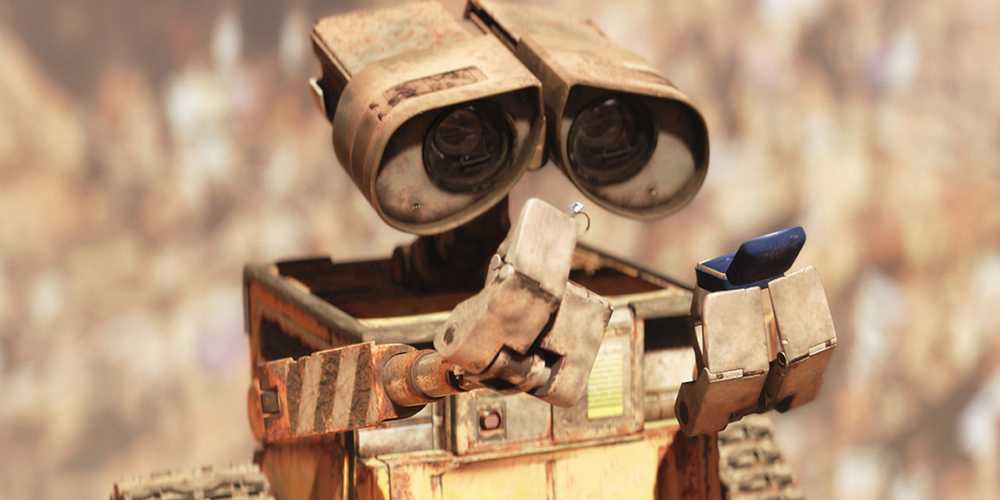
Pixar’s WALL-E takes place in a future where humanity has completely abandoned the planet and taken to the stars after covering the Earth with mountains of garbage and toxic waste, making the world uninhabitable. Living aboard a massive cosmic cruise ship while they wait for robots to clean up the planet, humans rely on technology for every aspect of their lives.
Despite being a family-friendly animated adventure starring the titular robot and his personal mission to find love with another robot named EVE, WALL-E still provides one of the greatest and most poignant environmental messages/warnings in all of cinema, as well as what humanity can lose the more we rely on technology in our lives. However, the movie does end on a hopeful note with Earth showing enough signs of growth and habitability for humans to return home. While WALL-E admittedly has a narrower scope of its dystopian society, its emotional storytelling and visual world-building make it one of Pixar’s best films 18 years later.
8
Planet of the Apes

Few science fiction franchises have built such an expansive dystopian world as the Planet of the Apes franchise. Beginning with Franklin J. Schaffner’s 1968 original, the series imagines a future in which intelligent apes have replaced humanity as Earth’s dominant species. When it comes to movie twists, few can beat the original film’s iconic reveal that the planet was not an alien world, but, in fact, Earth itself in a dystopian future where humanity lost it all. Likewise, the franchise has continued for decades, with the most recent iteration of the franchise having produced some of the best dystopian movies in the modern era.
Two of the most notable entries include Dawn of the Planet of the Apes, when humanity is still struggling (and failing) to remain the dominant species, as well as the most recent Kingdom of the Planet of the Apes, which is set generations later. As such, the ability to explore so many different eras in the same world’s complex dystopian timeline is a major advantage, even if some Planet of the Apes movies are more entertaining than others.
7
V For Vendetta

Set in a version of Great Britain ruled by an oppressive fascist government, V for Vendetta follows a young woman named Evey played by Natalie Portman, who finds herself involved with a masked revolutionary named V (Hugo Weaving). As V begins a one-man war against the entire corrupt government, Evey starts aiding V in his efforts as the film explores mass censorship, propaganda, and the enduring power and legacy of resistance amid its fairly straightforward messages about revolution. Featuring stylized visuals and impressive action, the movie is an easy rewatch every 5th of November.
6
Children of Men

Alfonso Cuarón’s Children of Men (2006) imagines a truly bleak future where humanity has become infertile, leaving civilization on the brink of extinction, with Britain having gradually transformed into an authoritarian state. Rather than featuring some futuristic society with hi-tech visuals and the like, the movie is set in the year 2027 with an incredibly grounded approach as a former activist protects a woman who is remarkably pregnant, representing a massively rare source of hope for humanity’s future it hasn’t seen in years.
While it’s certainly one of the bleakest films on this list, it’s without a doubt one of the very best dystopian movies of all time (even if others are more memorable with greater cultural impact).
5
The Terminator

James Cameron’s The Terminator franchise features one of the most popular dystopian futures and worlds in all of cinema. In the ashes of nuclear apocalypse, an AI system now known as Skynet takes over the world and wars with humanity, using machines and killer robots to hunt down the remaining human survivors. This includes going back in time and sending Terminators to the past to kill the mother of humanity’s future savior before he can even be born.
The franchise has since expanded into multiple films and shows, with many identifying Terminator 2: Judgment Day as the best entry overall. While the actual dark dystopian world of the future receives less screen time, it’s the threat of this future and its efforts to rewrite the past that makes the franchise so compelling (that and killer robots ironically played by Arnold Schwarzenegger).
4
The Hunger Games

Based on Suzanne Collins’ bestselling novels, The Hunger Games franchise takes place in Panem, a post-apocalyptic nation built on the ruins of what was once North America. Divided into 12 oppressed districts, with the wealthy elite living in the Capitol, yearly “games” are held, with children from each district being randomly selected to horrifically fight to the death to keep the population in line.
The first four movies focused on District 12’s Katniss Everdeen, her survival after being chosen for the Hunger Games and her transformation into the major revolutionary known as “The Mockingjay” who helped topple the Capitol regime.
However, the franchise continues to expand with dynamic prequels, continuing to flesh out the world of Panem, its history, politics, and key characters. This includes Sunrise of the Reaping, which has just been released in theaters and features a 94% audience score on Rotten Tomatoes. Combined with its predicted $120 million opening weekend, it feels pretty likely that The Hunger Games franchise will continue as one of the biggest and most culturally significant dystopian movie franchises of all time.
3
The Matrix

Without a doubt, The Wachowskis’ Matrix franchise presents one of the most inventive and unique dystopian concepts in film history. Humanity has been unknowingly enslaved by intelligent machines, with their minds placed inside a simulated digital reality as their bodies are harvested for power. Keanu Reeves plays Neo, a computer hacker who discovers the truth and joins a rebellion against his artificial prison, while also becoming a messianic figure known as “The One.”
Exploring the nature of reality and our perceptions of what’s real or not, free will, humanity’s ever-growing technological dependence, faith, religion, and so much more all at the same time, the themes and ideas of The Matrix franchise are just as memorable as the groundbreaking action and visual effects that made the first movie and its sequels such definitive pillars of the dystopian genre. It’s endlessly fascinating.
https://static0.srcdn.com/wordpress/wp-content/uploads/2026/11/mcdhuga_lg058.jpg?w=1600&h=900&fit=crop
https://screenrant.com/best-dystopian-movies-all-time-ranked/
Kevin Erdmann
Almontather Rassoul