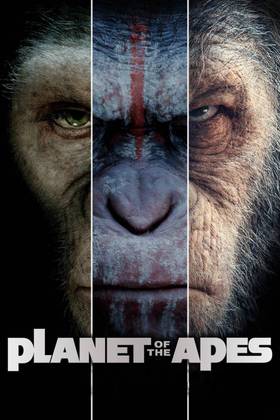
As of today, the four modern Planet of the Apes movies are officially streaming, having been added to HBO Max and giving subscribers the perfect opportunity to revisit one of the most visually impressive sci-fi franchises in recent years. It’s also a great opportunity to re-watch or discover one of the greatest sequels of all time.
Showcasing the evolution of Earth as its predominant species shifts from humans to intelligent apes, watching all four films in the modern Planet of the Apes franchise, which first began 15 years ago, is quite the experience. From Rupert Wyatt’s Rise of the Planet of the Apes (2011) to Wes Ball’s Kingdom of the Planet of the Apes (2024), few franchises have been as consistently impressive in both story and visuals as this one (each movie has a Rotten Tomatoes score above 80%).
Although all four films have earned generally positive reviews, one sequel absolutely stands above with Matt Reeves’ Dawn of the Planet of the Apes. Not only does it remain the best of the entire modern franchise, but it also sits as one of the best sci-fi sequels ever made.
All 4 Modern Planet Of The Apes Movies Are Now Streaming On HBO Max
Caeser from the Planet of the Apes prequel trilogyCustom Image by Yeider Chacon
The modern series begins with 2011’s Rise of the Planet of the Apes, directed by Rupert Wyatt and starring James Franco as scientist Will Rodman, whose experimental Alzheimer’s treatment grants a chimpanzee named Ceaser (Andy Serkis) and more of his fellow apes increased intelligence, while conversely serving as a deadly contagion for a massive percentage of the human population. The movie also stars John Lithgow, Freida Pinto, Brian Cox, and Tom Felton.
Then there’s 2014’s Dawn of the Planet of the Apes from Matt Reeves, following Ceaser’s growing community of apes 10 years after the events of Rise and their clashes with a colony of human survivors. Starring Jason Clarke, Gary Oldman, Keri Russell, and Toby Kebbell, Dawn was an exceptional follow-up (but more on that later).
Reeves returned to direct 2017’s War for the Planet of the Apes, set only a couple of years after Dawn. Tensions with the remnants of humanity have only become worse, as Caesar faces a ruthless (and desperate) military leader played by Woody Harrelson in the face of new human crises. Beyond Harrelson, notable stars include Steven Zahn and Amiah Miller.
Lastly, the most recent entry in the franchise is also streaming on HBO Max: 2024’s Kingdom of the Planet of the Apes. Directed by Wes Ball, Kingdom is set multiple generations after the time of Ceaser, with apes having transitioned from basically a Stone Age era to more of a structured Bronze Age-type society. The movie stars the ape known as Noa (Owen Teague) and his encounters with a human woman named Mae (Freya Allan), as well as Proximus Ceaser (Kevin Durand), a ruling ape who’s taken the name of the legendary ape and his teachings to secure power and build an empire.
Overall, the modern Planet of the Apes franchise is well worth revisiting if you’ve seen it before, and there’s no better time for those who haven’t seen it to check them out now that they’re all streaming in the same place.
Dawn Of The Planet Of The Apes Is One Of The Greatest Sci-Fi Sequels Ever Made
While all four modern Planet of the Apes movies are worth watching, the one I would most recommend personally is Matt Reeves’ Dawn of the Planet of the Apes. Taking the foundation of the world and status quo established by Wyatt in Rise, Reeves expands the scope of the narrative into something far more complex and compelling, surpassing most expectations in terms of its depth.
Rather than being a straightforward clash between intelligent apes and human survivors, Dawn also features major struggles within both communities and rising tensions, undermining Ceaser attempts to forge peace with Jason Clarke’s Malcom. As the movie progresses and violence becomes inevitable, the action sequences are on another level as the apes storm the humans’ defenses.
From a 1963 Pierre Boulle Novel to a 300-Years-After Sequel · Eight Questions How Well Do You Know Planet of the Apes? “Take your stinking paws off me, you damned dirty ape!”
🗽Classic1968 · Heston
🐎Sequels1970-73 · McDowall
🦍Burton2001 · Wahlberg
🦍Caesar2011-17 · Serkis
👑Kingdom2024 · Wes Ball
01
The 1968 original ends with one of the most-quoted final shots in science-fiction cinema: astronaut George Taylor (Charlton Heston) gallops along an unfamiliar beach with Nova, rounds a bluff, falls to his knees and screams “You maniacs! You blew it up!” What national landmark, half-buried in the sand, has he just recognised — revealing the simian world is in fact post-apocalyptic Earth?
✓ Correct! The Statue of Liberty — the closing 90 seconds of Franklin J. Schaffner’s 1968 film, scored to Jerry Goldsmith’s percussive cue, with Taylor pounding the sand. The shot was added by Rod Serling, who took the first crack at Pierre Boulle’s novel and replaced the book’s ending (Taylor returns to a sky-Paris that has fallen to apes) with this single-image twist set on the “Forbidden Zone” coastline. The matte painting was built by Emil Kosa Jr. and combined with a buried prop on Westward Beach in Malibu. The reveal that the planet was Earth all along is widely cited as the first true cinematic “rug-pull” ending and inspired everything from Soylent Green to The Sixth Sense. Heston only signed on after Boulle’s novel was reframed, and the screaming-on-the-beach take was the very first one printed.
✗ Wrong. The answer is the Statue of Liberty — half-buried in the sand at the close of Schaffner’s 1968 film, revealing the simian planet is in fact post-apocalyptic Earth. Rod Serling rewrote Boulle’s novel ending (a sky-Paris fallen to apes) and gave us the single-image twist that has been homaged from Soylent Green to The Sixth Sense. The matte was painted by Emil Kosa Jr. and shot on Westward Beach, Malibu.
02
The franchise originates from a 1963 French satirical novel titled “La Planète des singes” — a swift, allegorical tale of journalist Ulysse Mérou marooned on the simian world Soror. The author, who had also written the 1952 novel that became David Lean’s 1957 epic The Bridge on the River Kwai, won an Oscar for that film’s screenplay despite barely speaking English. Name him.
✓ Correct! Pierre Boulle (1912–1994), a French engineer-turned-novelist who’d spent the war as a colonial agent for the Free French in Indochina before being captured and held as a prisoner of forced labour — experiences that fed both Le Pont de la rivière Kwaï (1952) and La Planète des singes (1963). Boulle famously credited two screenwriters (Carl Foreman and Michael Wilson) for Kwai’s script even though they were both blacklisted by HUAC and could not be named on screen; Boulle himself spoke almost no English. He won the 1958 Adapted Screenplay Oscar for a screenplay he did not write; the Academy retrospectively re-attributed the award to Foreman and Wilson in 1984. Boulle’s Planet of the Apes novel ends on Earth too — but with Paris fallen to apes, a far darker beat than Schaffner’s Statue-of-Liberty reveal.
✗ Wrong. The answer is Pierre Boulle (1912–1994). The same Free French POW-novelist who wrote The Bridge on the River Kwai (1952) wrote La Planète des singes (1963). He notoriously “won” the 1958 Adapted Screenplay Oscar for Kwai despite barely speaking English — the script was secretly by the blacklisted Carl Foreman and Michael Wilson, who were retro-credited in 1984. Boulle’s novel ends on a Paris fallen to apes; Rod Serling rewrote the ending into the iconic Statue of Liberty reveal.
03
One British-American actor — the original chimpanzee archaeologist Cornelius in 1968’s Planet of the Apes — went on to anchor four of the five original films (1968, 1971, 1972, 1973) under the make-up, and played Cornelius’s son Caesar from Conquest onward. He even returned as Galen in the short-lived 1974 TV series. Name him.
✓ Correct! Roddy McDowall — the franchise’s connective tissue across the original cycle. He played Cornelius in Planet of the Apes (1968) and Escape from the Planet of the Apes (1971); Cornelius’s son Caesar in Conquest of the Planet of the Apes (1972) and Battle for the Planet of the Apes (1973); and the chimp Galen in the 1974 CBS TV series. (He missed only Beneath the Planet of the Apes in 1970, owing to a directing conflict on his film Tam-Lin.) John Chambers’s prosthetic ape make-up — which won a Special Achievement Oscar in 1969 — took roughly five hours to apply on McDowall and made eating during shoot days nearly impossible; he survived on milkshakes. The traps are all era-correct: Maurice Evans is the orangutan Dr. Zaius; Kim Hunter is Zira; Ricardo Montalbán is Armando in Conquest and Battle.
✗ Wrong. The answer is Roddy McDowall — Cornelius in films 1 and 3, Caesar in films 4 and 5, and Galen in the 1974 CBS series. (He missed only Beneath in 1970, due to a directing conflict.) John Chambers’s ape make-up took five hours to apply and reduced him to milkshakes between takes. Maurice Evans is Dr. Zaius; Kim Hunter is Zira; Ricardo Montalbán is the circus-owner Armando in films 4 and 5 — all real franchise players but the distractor here.
04
Heston’s most-quoted line in the 1968 film — “Take your stinking paws off me, you damned dirty ape!” — is the first sustained English speech the apes hear from Taylor, who had been mute (from a throat wound) for most of the film up to that point. In what specific dramatic context does he finally yell it?
✓ Correct! It is shouted while a gorilla handler hauls Taylor down a corridor after his first escape attempt is foiled — the precise moment the speaking-human secret breaks. Heston had been mute for most of the first hour (a throat wound silenced him on arrival), so the line is the dramatic hinge that reveals to the apes — and to Zira and Cornelius in particular — that this captured creature can speak. The line was so iconic by the 1980s that Charlton Heston himself parodied it on The Simpsons “A Fish Called Selma” episode (1996), in the Stop the Planet of the Apes! On Ice! musical performed by Troy McClure. The other options reference real scenes in the 1968 film — courtroom, beach finale, mutant caves — but the line is delivered after the foiled first escape.
✗ Wrong. The answer is during a corridor drag by gorilla handlers, just after Taylor’s first escape attempt fails — the speaking-human secret breaks at exactly that beat. He’d been mute (throat wound) for most of the prior hour, so the line is the film’s dramatic hinge. The line was famously parodied by Heston himself on The Simpsons (Stop the Planet of the Apes! On Ice!, 1996). The other options are real scenes — courtroom, beach, Forbidden Zone caves — but the line lands in the corridor.
05
Tim Burton’s 2001 “re-imagining” (deliberately not a sequel or a straight remake) was Fox’s first attempt to revive the franchise after 28 years. It made $362m on a $100m budget, divided critics, and is most often remembered for its bewildering twist ending in which the hero returns to Earth and finds the Lincoln Memorial replaced by a statue of General Thade. Who starred as astronaut Leo Davidson?
✓ Correct! Mark Wahlberg, fresh off The Perfect Storm (2000), as USAF Captain Leo Davidson. Burton’s film was a stylistic departure from the 1968 chamber piece — ape society is a feudal-medieval, hyper-active society with Tim Roth as the snarling chimp General Thade and Helena Bonham Carter as the human-rights activist Ari. Make-up was Rick Baker (six Oscars by 2001), who designed wholly new prosthetics that allowed actors to move on all fours. Burton’s ending — Davidson returning to Earth to find the Lincoln Memorial replaced by Thade — was widely panned as nonsensical and was never explained even in tie-in material. There was no sequel; the franchise sat dormant until Rise of the Planet of the Apes in 2011. Brendan Fraser was an early candidate but passed.
✗ Wrong. The answer is Mark Wahlberg, in Tim Burton’s 2001 reimagining as USAF Captain Leo Davidson. Tim Roth played General Thade, Helena Bonham Carter played Ari, Rick Baker did the prosthetics. The film’s twist (Davidson returns to find the Lincoln Memorial replaced by Thade) is widely cited as one of the more incoherent franchise endings — never explained, never sequelised. The franchise sat dormant for a decade until 2011’s Rise. Brendan Fraser was an early candidate but passed.
06
The 2011-2017 Caesar trilogy — Rise (Rupert Wyatt), Dawn (Matt Reeves) and War (Matt Reeves) — abandoned prosthetic make-up entirely in favour of Weta Digital’s on-location performance-capture. The same actor played the lead chimpanzee Caesar in all three films and was widely argued to deserve an Oscar nomination by his War (2017) turn, in which Caesar speaks more dialogue than any other character. Name him.
✓ Correct! Andy Serkis — already canonical for performance-capture from Gollum in The Lord of the Rings (2001-03), Kong in Peter Jackson’s King Kong (2005) and Caesar across Rise (2011), Dawn (2014) and War (2017). Weta’s breakthrough on the Caesar trilogy was full on-location performance-capture — redwood forests, rivers, snow — rather than the soundstage mocap of the LOTR era. Serkis’s campaign for Oscar recognition of mocap performance, championed by Reeves and Wyatt, became a recurring talking point of the 2010s award seasons; the Academy never nominated him in the category and the rules were eventually clarified to confirm that mocap performances are acting eligible. Toby Kebbell did mocap Koba in Dawn and War; Terry Notary did Rocket and is Reeves’s key ape-movement coach; Doug Jones does prosthetics work (The Shape of Water, Hellboy), not mocap-ape work.
✗ Wrong. The answer is Andy Serkis — already the canonical performance-capture actor from Gollum (LOTR, 2001-03) and Kong (2005), then Caesar in Rise (2011), Dawn (2014) and War (2017). Weta’s on-location performance-capture across all three is widely cited as the genre’s technical high-water mark. Toby Kebbell did Koba; Terry Notary did Rocket; Doug Jones works in prosthetics (Shape of Water, Hellboy), not the Caesar trilogy.
07
War for the Planet of the Apes (2017), Matt Reeves’s trilogy capstone, leans heavily into Apocalypse Now-style militarised iconography — including a shaven-headed, monologuing human antagonist known only as “the Colonel,” who has the simian-flu-immune humans build a wall at an old border weapons depot. Which actor — in his most Brando-esque role since the early 1990s — plays the Colonel?
✓ Correct! Woody Harrelson as “the Colonel” (the character is named McCullough only in supplementary material). Reeves and co-writer Mark Bomback shot Harrelson’s monologue scenes against a near-bare wall in deliberate homage to Marlon Brando’s Colonel Kurtz in Apocalypse Now (1979) — the script even references the “horror” speech directly. Harrelson shaved his head for the role; the Colonel’s arc reveals he murdered his own infected son once the simian flu’s second-strain ALZ-113 began stripping humans of speech. The film made $490m worldwide on a $150m budget and Michael Giacchino’s score is widely considered the trilogy’s peak. The traps are all real franchise figures: Gary Oldman is Dreyfus in Dawn (2014); Jason Clarke is Malcolm in Dawn; Stephen Lang did not appear (a deliberate red herring).
✗ Wrong. The answer is Woody Harrelson — shaved head, Apocalypse Now-style Kurtz homage, base built at an old weapons depot. The Colonel’s ALZ-113 secret (the simian flu’s second strain now mutes humans, including his own son) is the film’s key reveal. Gary Oldman is Dreyfus and Jason Clarke is Malcolm — both in Dawn (2014), not War. Stephen Lang is a deliberate distractor — not in the franchise.
08
Kingdom of the Planet of the Apes opened on 10 May 2024 — the first new entry since War (2017), set approximately 300 years after Caesar’s death, with a new young chimp protagonist named Noa (Owen Teague) discovering a corrupted bonobo kingdom that has built itself around the worship of a misremembered “Caesar.” The film opens the planned new trilogy and was a $397m hit on a $160m budget. Name its director.
✓ Correct! Wes Ball, the Maze Runner trilogy director (2014-18), who pitched a soft reboot set centuries after Caesar — not a fourth Caesar film. The premise: Caesar’s teachings (“ape together strong”) have been distorted across three centuries into a cult by the bonobo king Proximus Caesar (Kevin Durand), who enslaves other clans while searching for a pre-collapse human vault. Noa (Owen Teague), a young eagle-keeper chimp, becomes the franchise’s first protagonist born into the post-Caesar world. Freya Allan plays the “feral” human Mae, whose secret cognition the film’s back third reveals. Ball signed on for at least two more films. Reeves was offered a return but had moved to The Batman; Wyatt directed only Rise (2011); Gareth Edwards is a deliberate sci-fi-credentialled distractor (Rogue One, The Creator).
✗ Wrong. The answer is Wes Ball (the Maze Runner trilogy), who took the franchise 300 years past Caesar with a new chimp protagonist Noa (Owen Teague), antagonist bonobo king Proximus Caesar (Kevin Durand) and the secretly-cognitive human Mae (Freya Allan). Released 10 May 2024, $397m on a $160m budget, opening a new trilogy. Reeves had moved to The Batman; Wyatt directed only Rise (2011); Edwards is a deliberate sci-fi distractor.
Sacred Scrolls · Final Scorecard Your Simian Standing
🦍
/ 8
Lawgiver-grade ape historian — or still mute on the beach?
One notable scene in particular sees Ceaser’s rival Koba (Toby Kebbell) leading a force of apes against the humans’ community in San Francisco and personally hijacking an armored vehicle. This results in an incredible extended single-take sequence centered on the vehicle as its firing turret rotates, showcasing the full scope of the major battle with a continuous, 360-degree shot.
While the motion-capture work is extraordinary in the entire franchise, it’s particularly captivating in Dawn of the Planet of the Apes. This is largely due to the personal conflict between the peace-seeking Ceaser and Koba, who believes the ape leader should wipe out all the humans. Remarkably, the visuals impressively enhance the performances rather than distract. All things considered, Dawn is easily the best chapter in the modern Planet of the Apes franchise (though it really hasn’t yet had a bad entry). With all four now on HBO Max, the timing couldn’t be better for a full marathon.
Video Game(s)
Planet of the Apes, Revenge of the Apes, Planet of the Apes: Last Frontier, Crisis on the Planet of the Apes
Planet of the Apes is a multimedia sci-fi franchise that began in 1963 with Pierre Boulle’s novel, which was later adapted into a film in 1968 starring Charlton Heston. The success of the movie led to four sequels, two TV shows, a remake from Tim Burton, and a reboot trilogy. The Planet of the Apes franchise has also seen success in video games and comic books.