
[
In September 2017, Google researcher Austin Fowler stood before a room of quantum engineers at a conference in College Park, Md., and admitted something rarely heard from Big Tech: He was stuck. Quantum computers make mistakes constantly, and every error must be caught within a millionth of a second before the whole calculation collapses. The best chip available was still 10 times too slow, Fowler said. Many in the room left convinced the problem might never be solved.
But across the Atlantic, on a quiet street in Cambridge, a five-person startup was developing its own solution to the problem. Steve Brierley, a Cambridge University research fellow, had founded Riverlane from his kitchen table the year before. “Even Google can’t solve this problem,” he recalls thinking when he heard Fowler’s admission. In 2024, Riverlane ran what it describes as the world’s first low-latency quantum error-correction experiment, decoding errors in under a microsecond— fast enough to keep the machine running.
Today, Riverlane employs nearly 200 people and works with more than 60% of the world’s quantum computer makers.
With U.S. tech companies dominating the digital economy, and China and America pulling ahead in the race for AI supremacy, quantum computing represents a rare opportunity for Europe to establish itself at the forefront of a transformative technology. The European Commission’s Quantum Europe Strategy, aims to make the continent a global quantum leader by 2030, and McKinsey estimates the technology could create $2.7 trillion of economic value worldwide by 2035.
The most advanced quantum computers hang like gilded chandeliers, their cores chilled to a fraction of a degree above absolute zero, more than 100 times as cold as deep space. Quantum technology builds on the principles of quantum mechanics and the ability of particles to act as both a particle and wave. Quantum computers harness this capability with qubits, allowing them to tackle problems that are prohibitively difficult for conventional machines, such as simulating molecules to accelerate drug discovery or modeling complex financial risks.
Development of a quantum computer that is sufficiently powerful and reliable to complete these tasks would have strategic implications for nations, as it would theoretically be capable of breaking the encryption protecting banks and digital communications.
“The company that builds the first large-scale quantum machine could seize an entire industry overnight,” says Jérémie Guillaud, an architect at Alice & Bob, one of France’s most promising quantum startups. Guillaud believes that the winner could be European. “There is a good possibility.”
“We haven’t lost the race yet,” says Lionel Martellini, a finance professor with a PhD in astrophysics who founded the EDHEC Quantum Institute in France. “Which doesn’t mean that we’re not going to lose it.”
Quantum was “born in Europe,” Martellini notes, and the continent still produces much of the field’s foundational research. Quantum theory grew out of the work of Max Planck, Niels Bohr, Albert Einstein, Erwin Schrödinger, and Werner Heisenberg in the early 20th century. European physicists have since collected a string of quantum Nobel prizes.
$2.7 T
The value QUANTUM COMPUTING COULD DELIVER TO COMPANIES WORLDWIDE BY 2035
32%
PERCENTAGE OF WORLD’S QUantum COmpanies Based in the EU
Source: McKinsey: The Joint Research Centre
That legacy has seeded a thriving startup scene. The EU is home to 32% of the world’s quantum technology companies, according to the European Commission’s Joint Research Centre.
France alone has five leading hardware contenders—Pasqal, Alice & Bob, Quandela, Quobly, and C12—each developing a different way to build a qubit, the basic unit of a quantum computer. Britain has Oxford Quantum Circuits and Riverlane, and Finland’s IQM says it has sold 26 quantum computers for customers to install on-site, the most publicly disclosed by any manufacturer.
“Europe has a tremendous opportunity with quantum,” says Ana Paula Assis, senior vice president and chair for IBM Europe, Middle East, Africa, and Asia Pacific. “The region’s diverse industrial base holds both the prob- lems quantum computers are built to solve and the data needed to solve them,” she says.
That has made Europe the industry’s biggest customer base. Two-fifths (43%) of quantum computing companies’ customers are headquartered on the continent, according to McKinsey’s Quantum Technology Monitor 2026. Much of that demand comes from public supercomputing centers, which allow researchers and companies to rent machines from European makers such as IQM and Pasqal.
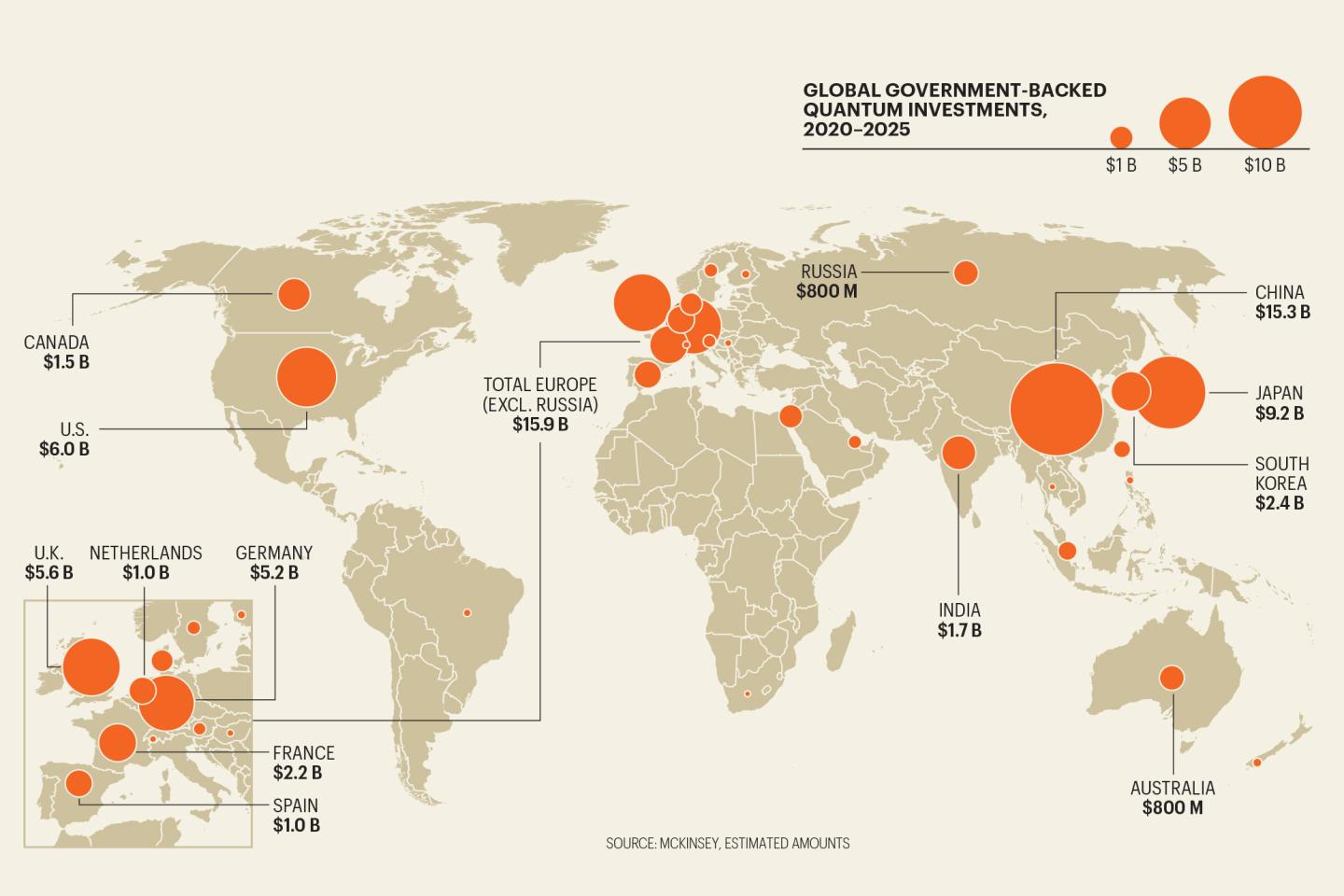
Illustration by Nicolas Rapp
European nations have committed $15.9 billion to quantum technologies in the five years to 2025. U.S. federal funding had reached only about $6 billion until May, when Washington pledged a further $2 billion to nine quantum companies.
However, private investment in quantum startups is still dominated by the U.S. A record $12.6 billion was invested worldwide in 2025, more than six times the 2024 total, with 64% going to American companies, according to McKinsey. The European Commission estimates that European quantum firms attract only about 5% of global private funding.
“American startups can draw on pension funds and university endowments, but there is no real European equivalent. We don’t have a unified marketplace, and we don’t have a very strong pension system,” Martellini says.
“In France we have ideas, but no money,” says Alice & Bob’s Guillaud. “We won’t build a useful quantum computer just using ideas.” Alice & Bob’s €100 million ($110 million) Series B, one of Europe’s larger quantum rounds, is dwarfed by the $1 billion the California company PsiQuantum raised in a single round in September 2025.
Consequently, many of Europe’s brightest prospects have crossed the Atlantic for capital. Britain’s Oxford Ionics was sold to U.S.-listed IonQ for $1.075 billion in 2025, and this year Finland’s IQM and France’s Pasqal both floated on Nasdaq. IQM also trades in Helsinki, and Pasqal is planning a second listing in Paris.
Wasiq Bokhari, Pasqal’s chief executive, insists it was never a choice between New York and Paris. “Nasdaq just happened to be our first public listing on the way to our eventual Euronext listing,” he says. “Once a quantum company reaches the commercial stage it’s important to get access to capital at scale.”
The bigger problem, according to Bokhari, is Europe’s scattered funding model, which is split across national plans.
“The U.S. and China are single entities able to make decisions quickly,” Bokhari says. “Europe has all the ingredients. We just need to make sure we align them quickly and in a unified direction.” The EU’s Quantum Act, which aims to coordinate research and spending across the bloc, could help.
The frontier, meanwhile, is racing ahead. The most powerful quantum computers remain in the U.S. and China, led by IBM, Google, Quantinuum, and the Chinese Academy of Sciences. IBM is building its first large- scale, error-corrected machine in Poughkeepsie, N.Y., which will be capable of running 20,000 times as many operations as today’s machines.
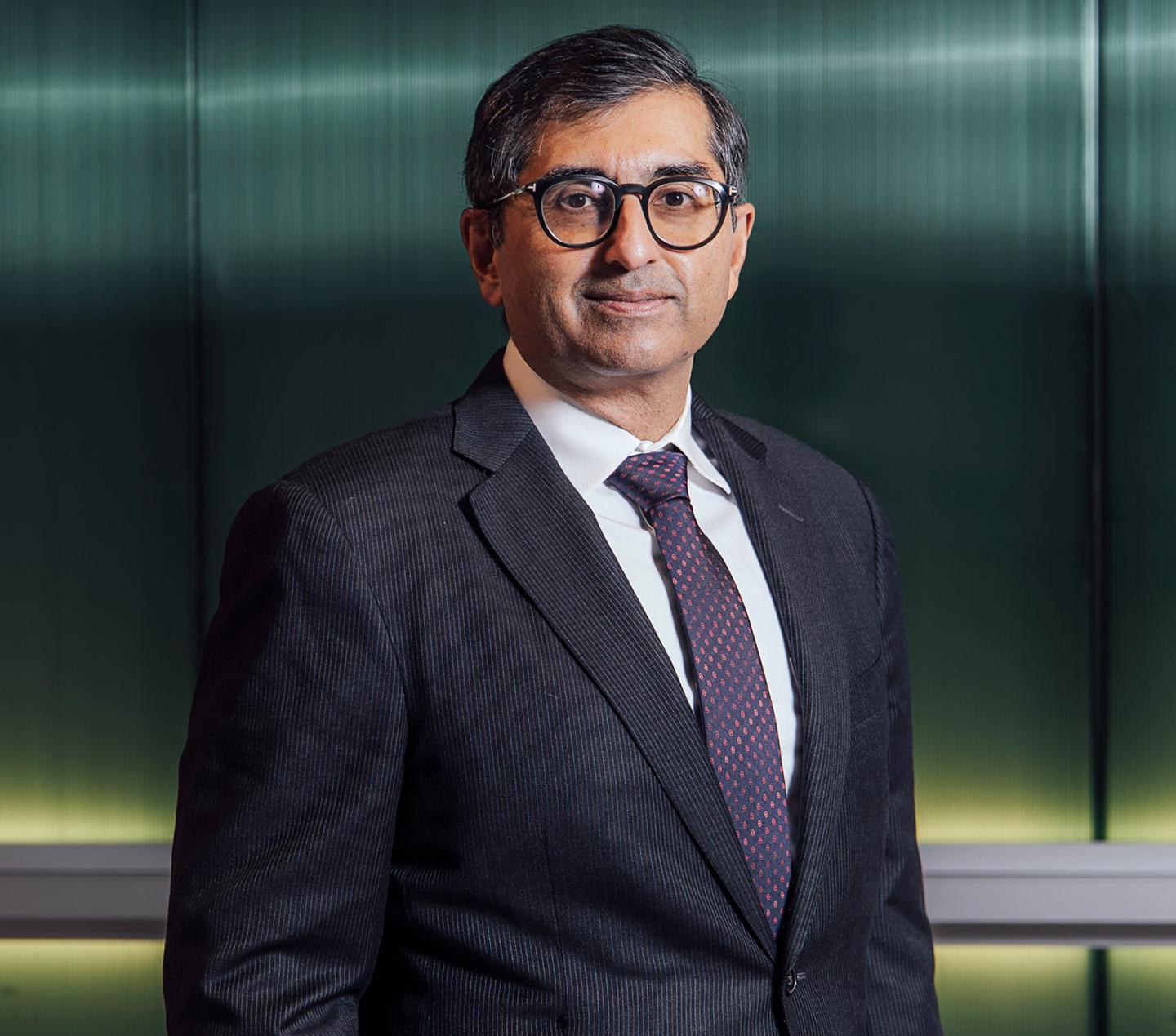
COURTESY OF PASQAL
Alessandro Curioni, vice president of IBM Research Europe and Africa, says this puts the company “two to five years ahead” of the pack on top-class hardware. That, he argues, means Europe risks “running the wrong race.” In his view, “the real prize is not the machines but a new software industry combining AI and quantum computing.” Europe’s diverse industrial economy gives it the best shot at leading that industry, he says, “but only if it starts now, on whatever machines are best.”
“Europe has all the ingredients. We just need to make sure we align them quickly and in a unified direction.”
Wasiq bokhari, CEO, PAsqal
He calls Europe’s instinct to build everything itself “arrogant,” and says refusing a machine because it comes from the U.S. would be “politically stupid.” If Europe waits for its own hardware, he warns, “you will have another Microsoft that is not going to be in Europe, that is going to sell you the software.”
However, Pasqal’s Bokhari believes the race is far from over. “Heavy spending by big companies does not necessarily trans- late to a seat at the table or market dominance down the road.” European firms are still winning commercial customers, he adds.
Crédit Agricole’s investment bank has signed a deal with Pasqal that aims to put its first quantum applications into live production as early as 2028. Bokhari says this makes it one of the first major banks to commit publicly to a production timeline. “Not only is it possible, but it is happening.”
Quantum technology is also a potential threat to national security. Quantum sensors could eventually allow submarines, missiles, and military aircraft to navigate with greater precision than GPS, and quantum’s ability to break encryption could enable bad actors to intercept state messages.
That makes ownership a question of sovereignty, says Martellini. “I don’t see why the world should be happy to rely on U.S.- based hardware. Europe has learned the hard way it needs to be more independent.”
Europe’s greatest edge may be in supplying the critical components required to build quantum computers. Brierley compares it to the model of ASML, the Dutch company whose extreme ultraviolet lithography machines are essential for making the world’s most advanced AI chips.
“Every new industry starts with companies building everything themselves, because there is no supply chain,” he says. “As the technology grows more complex, it splits into specialist layers, and whoever owns an indispensable layer gains enormous leverage.”
Riverlane’s error-correction technology, for example, works across different types of qubit. Elsewhere, Finland’s Bluefors produces the gilded chandeliers that cool the world’s quantum computers, while Switzerland’s Zurich Instruments and the Netherlands’ Qblox supply the advanced electronics needed to run quantum hardware.
It is a potentially much stronger position than Europe occupies in AI. EU companies supply nearly half the hardware and software components used in quantum technology worldwide, according to the European Commission. By contrast, EU firms account for less than a tenth of the region’s market for data center chips, servers, and cloud infrastructure, according to the Global Electronics Association. Owning a critical piece of the quantum supply chain, Brierley says, would give Europe “table stakes in a globally important technology.”
An ordinary computer bit is like a coin lying flat: It is either heads or tails, 0 or 1. A qubit is more like a coin spinning in the air, capable of holding both possibilities at once until it lands on one. The quantum industry is in a similar state of uncertainty. The coin is still spinning, and Europe has a chance of making the correct call.
This article appears in the December 2026/January 2027 issue of Fortune with the headline “Quantum Leap Can Europe Win The Next Tech Race?”
https://fortune.com/img-assets/wp-content/uploads/2026/11/QUAE_IQM-Quantum-Computer_Horizontal.jpg?resize=1200,600
https://fortune.com/2026/11/25/europe-has-spent-15-9-billion-win-quantum-race/
Sam Birchall





