
[
This year’s World Cup was the most profitable in FIFA’s history, just as Gianni Infantino promised. FIFA’s own figures put the 2026 tournament’s revenue at roughly $9 billion to $13 billion, well above the $11 billion FIFA had forecast before the event. Revenue across FIFA’s full 2023–2026 cycle, which includes the Club World Cup and Women’s World Cup alongside the men’s tournament, is on track to top $15 billion, which Infantino called proof the tournament had “opened a lot of doors, a lot of opportunities, a lot of possibilities.” That’s roughly double the $7.5 billion FIFA brought in during the 2022 Qatar cycle.
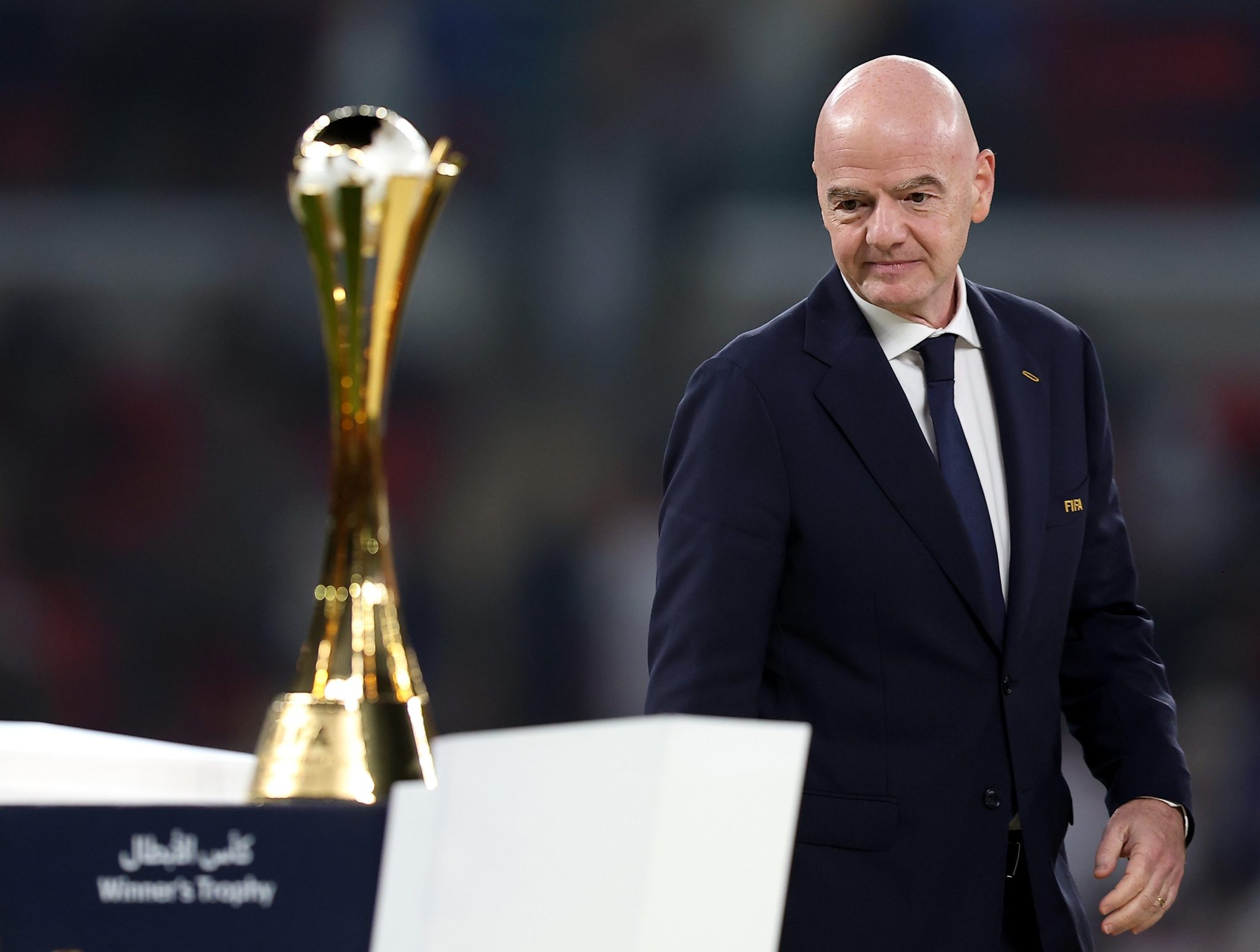
Now Infantino wants more. FIFA is reportedly studying whether to expand the 2030 World Cup from 48 to 64 teams. The vehicle is a plan called FIFA Forward Enterprise, announced nine days after that record-setting tournament closed, and it’s why the European contingent, which has won more World Cups than any other confederation, is now threatening to sit out the next one.
That revenue arrived with the costs falling largely on someone else. As Fortune has reported, FIFA’s contracts assigned security, transportation and stadium retrofits to host cities, while keeping the revenue from tickets, sponsorship and media for itself.
A $40 million incentive to accept
European teams have won more than half (13) of the 23 men’s World Cups played since 1930. Europe has taken four of the last five titles and seven of the last ten, including this summer’s, when Spain beat Argentina in the final. Those teams currently hold six of FIFA’s top 10 men’s world rankings, and made up six of the eight quarterfinalists and three of the four semifinalists at this year’s tournament.
So when FIFA restructured the World Cup this year—assigning security, transportation and stadium retrofits to host cities, while keeping the revenue from tickets, sponsorship and media for itself—a good portion of that huge profit went back to FIFA, and the costs often fell on someone else, like this year’s 16 host cities.
FIFA revealed the FFE proposal on July 28: A commercial subsidiary valued at $20 billion that would stay under FIFA’s control while selling minority stakes to outside investors, raising up to $4.2 billion and paying each of FIFA’s 211 member associations up to $40 million. Thrive Capital, founded by Jared Kushner’s brother Joshua, is expected to lead the investor group.
FIFA set September 19 as the deadline for members to accept the deal, which needs 75% support to pass. Initially, Infantino offered $20 million per association to accept the deal, but then doubled it to $40 million the next day after backlash began. This is particularly noteworthy given many of the 211 member associations rely on FIFA funding in the first place: the $40 million is a pretty penny to balk at.
Many of FIFA’s 211 member associations depend on FIFA funding just to keep running: smaller federations often use FIFA Forward money to cover basic costs like coaching programs, youth development and administrative overhead. Against that backdrop, Infantino’s initial $20 million offer, then doubled to $40 million within a single day of the backlash beginning, isn’t a nice-to-have. For federations already leaning on FIFA’s support, it’s the kind of money that’s difficult to walk away from on principle alone.
That revenue arrived with the costs falling largely on someone else. As Fortune has reported, FIFA’s contracts assigned security, transportation and stadium retrofits to host cities, while keeping the revenue from tickets, sponsorship and media for itself.
An imminent showdown
That’s exactly what critics say makes the structure look less like a genuine consultation and more like leverage. The Union of European Football Associations (UEFA) is Europe’s official governing body for soccer in the continent, and manages 55 national member associations while running major sporting tournaments of its own. UEFA has called the arrangement “governance by intimidation” rather than a legitimate vote, saying FIFA didn’t just propose a plan and ask members to weigh in; it attached a large, time-limited payment to a September 19 deadline, effectively pressuring cash-strapped federations to sign on before they’ve had time to fully assess what they’d be trading away.
As a result, UEFA said its members will boycott the men’s and women’s World Cup unless FIFA drops the plan, calling it “not merely a profound failure of leadership, but an abdication of FIFA’s duty as the custodian of world football.”
“So long as Europe has a voice, it will never be for sale.”
The backlash hasn’t stopped there. CONCACAF, or the Confederation of North, Central America and Caribbean Association Football, one of FIFA’s six continental governing bodies for association football, called it a “lack of due process.” The Asian Football Confederation said it was “disappointed” it hadn’t been consulted, and the EU’s sport commissioner, Glenn Micallef, posted: “Hands off our game.”
The plan cost Infantino an ally too: per CNN, senior advisor Carlos Cordeiro resigned, calling it “a bad deal for FIFA’s Member Associations, a bad deal for football, and a bad deal for the long-term future of the game.”
Infantino defended the plan as “an opportunity but not an obligation.” FIFA itself said “nobody is selling football” and blamed “erroneous reporting” for the uproar.
It’s a familiar move for Thrive. The firm built much of Kushner’s fortune on an early, concentrated bet on OpenAI, investing first at a $29 billion valuation, then at $86 billion, then roughly $1 billion more at $150 billion as OpenAI’s value climbed toward $500 billion. Kushner is known for his concentrated bets rather than spreading capital thin. The FFE proposal extends that same approach from a fast-growing startup to global soccer’s flagship event.
https://fortune.com/img-assets/wp-content/uploads/2026/07/GettyImages-2252433381-e1785522673237.jpg?resize=1200,600
https://fortune.com/2026/07/31/european-nations-won-world-cups-threatening-boycott-gianni-infantino/
Catherina Gioino




