
[
The scandal swirling around Nvidia CEO Jensen Huang and his romance with an alleged Chinese spy got a whole lot more complicated over the past 24 hours:
- The FBI has begun “looking into” the issue, President Trump told the FT.
- The company was sued by shareholders in a California federal court, who allege they were the victims of fraud because the company concealed the full extent of Huang’s relationship with Megaspeed executive Alice Huang (no relation).
- Nvidia’s general counsel, Tim Teter, called commerce undersecretary Jeffrey Kessler in the summer of 2025 to inquire about a U.S. government investigation into suspected chip smuggling to China, Bloomberg reported. In the call, Teter reportedly asked whether the Trump administration had a role in the decision by Singapore police to bring Alice Huang in for questioning and to secretly ban her from leaving the country. (Teter was told that the Bureau of Industry and Security had no role in that decision.)
If true, that last move would demonstrate the company’s senior officials were sensitive to the Alice Huang/chip smuggling issue 18 months before the board’s decision to launch its own internal probe into its CEO.
The fast-moving cycle of events is exposing weaknesses in Nvidia’s corporate governance structures, experts are telling the media. “Governance is now an investment risk,” Charu Chanana, chief investment strategist at Saxo Bank, told Fortune this morning. “The absence of a publicly identified successor creates key-person risk.”
In the board’s Sunday announcement of its internal probe, it declared, “The Board has confidence in Jensen and his leadership team.”
That statement appears to offer a foregone conclusion. “To say there’s no issue before you’ve done an investigation, that’s not appropriate,” Harry Kraemer Jr., the former CEO of Baxter International who now teaches management at Northwestern University’s business school, told the WSJ. “That’s how you lose credibility.”
In addition, Nvidia’s board has no chairman. The role is performed by Huang and Stephen Neal, the board’s lead independent director and head of corporate governance, who set the agenda for board meetings, according to the WSJ.
At the same time, CNBC reported that Neal was likely to be a key figure in the administration of the probe, which will be conducted by outside counsel.
The company is now in an impossible position. If Huang were any other CEO, he would have been fired on the spot. That option remains open to the board: Although Huang is the company’s largest shareholder, he does not own a controlling share of the stock.
However, Nvidia without Huang would be a bit like Apple without Steve Jobs or Meta without Mark Zuckerberg. Huang has run the company for 33 years. At least two family members are employees and possible successors. The company has not published succession plans. And Huang’s org chart features 60 senior executives who report directly to him. He is credited with delivering a 700,000% return to shareholders. Who could possibly replace him?
Waiting in the wings is the newly Democratic Congress, filled with senators and representatives eager to hold inquiries into why Jensen and Alice were still socializing as late as May 2025 when the Trump administration had begun investigating Megaspeed as early as late 2024, per this timeline from the WSJ.
The prospect of Huang answering questions under oath awaits.
Next up: Nvidia will report Q3 earnings on November 17.
MORE FROM FORTUNE
The Midterms Flipped the Global Calculus. Here’s Why | Fortune Daily
Vietnam’s cheap coffee may lose its edge as the EU tightens sustainability rules, Nestlé Vietnam’s chair warns – Jay Ganglani
‘I’ll see you tomorrow’: What Michael Jordan’s trainer learned from the 1995 loss—and his three-tier test for winners – Heather Occhino
Anthropic debuts Claude Fable, Mythos 5.2 models, priced 20% below OpenAI’s GPT-6 Astra – Emily Forlini
‘One of the highest-stress occupations’: Why $148,000 median pay can’t fix the air traffic controller shortage – Steven John
Musk says many Cybertruck buyers will get deposits back as production ends, arguing ‘opportunity cost’ is vastly outweighed by new robotaxi – Marco Quiroz-Gutierrez
THE MARKETS
Bad news be damned: Oil is down, and everything else is up
The market has the wind at its back this morning. U.S. futures are up before the open in New York, after markets in Europe and Asia all rose. The price of oil sank to $89 per barrel after President Trump said he was winding down active combat with Iran, a level it has not seen since August.
Nvidia shares fell 4.27% yesterday but are up 2.15% overnight as investors have clearly decided to buy the dip despite the controversy.
Even SoftBank couldn’t spoil the party: It posted an unexpected $7 billion loss after writing down its U.S. data centers by $3.7 billion. Analysts had forecast a healthy profit. But shares rose 14% anyway amid a wider rally in Asian tech stocks.
- S&P 500 futures were up 0.13% this morning. The index rose 2.35% on Friday.
- In Europe, the Stoxx 600 rose 0.69% in early trading, and the U.K.’s FTSE 100 rose by 0.31% before lunch.
- Asia: South Korea’s KOSPI was up 4.39%. Japan’s Nikkei 225 was up 2.87%. India’s Nifty 50 was closed for a national holiday. China’s CSI 300 was up 0.07%.
- Brent crude declined to $89 per barrel.
- Bitcoin was at $74,355.
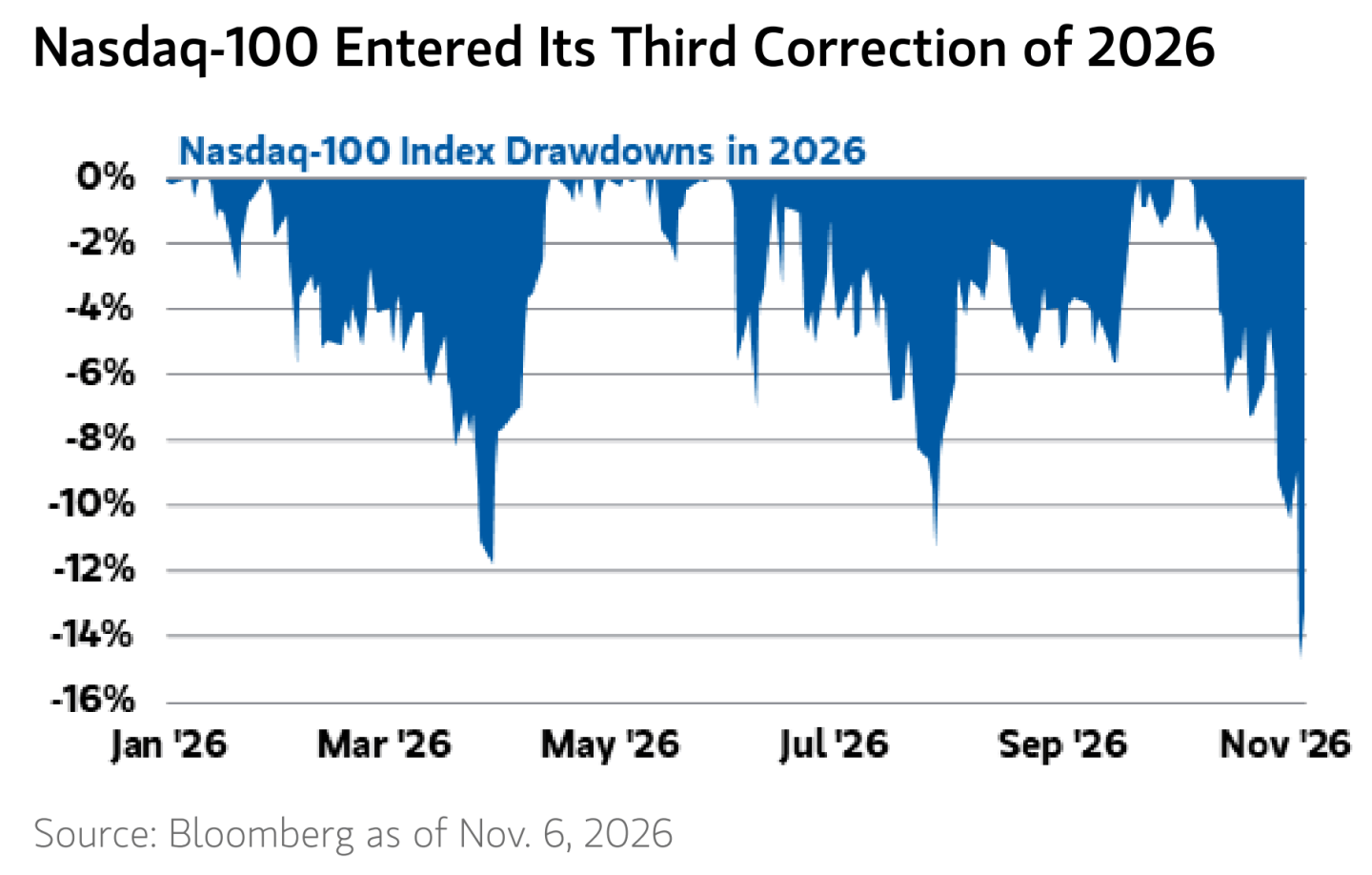
Don’t fret too much about tech stocks—they’ve already crashed three times this year!
Downward corrections in tech stocks are like buses—you wait ages, and then three come at once, as this chart of the Nasdaq 100 from Morgan Stanley shows. That’s one reason to believe that tech stocks will inevitably bounce back in short order, Lisa Shalett’s team said in a note: “While some are concerned about data center regulations and moratoriums following the Democratic sweep, on this issue, we think the cycle will simply slow from a pace entailing ‘boom-bust’ risks to a ‘Goldilocks’ pace.”
But why are stocks so bouncy?
HSBC’s Alastair Pinder notes that market volatility has been amplified by a new trend: The growth of leveraged exchange-traded funds. ETFs were invented for people who wanted diversification coupled with the knowledge that you’ll get market-level performance. Apparently, that wasn’t enough drama for some. Leveraged ETFs, as the name implies, apply borrowed money to amplify your gains and losses.
“We estimate these funds have around $130 billion in [assets under management], with a large skew towards tech. Daily leverage targets force leveraged ETFs to rebalance exposure at the end of each trading session, reinforcing market moves by selling into falling markets and buying into rising ones. Our estimates suggest that during the drawdown on 5 November, levered ETFs were forced to sell almost $48 billion,” he wrote. “Nvidia, Micron, and Apple faced $3.9 billion, $2.7 billion, and $2.5 billion of that selling pressure, respectively.”
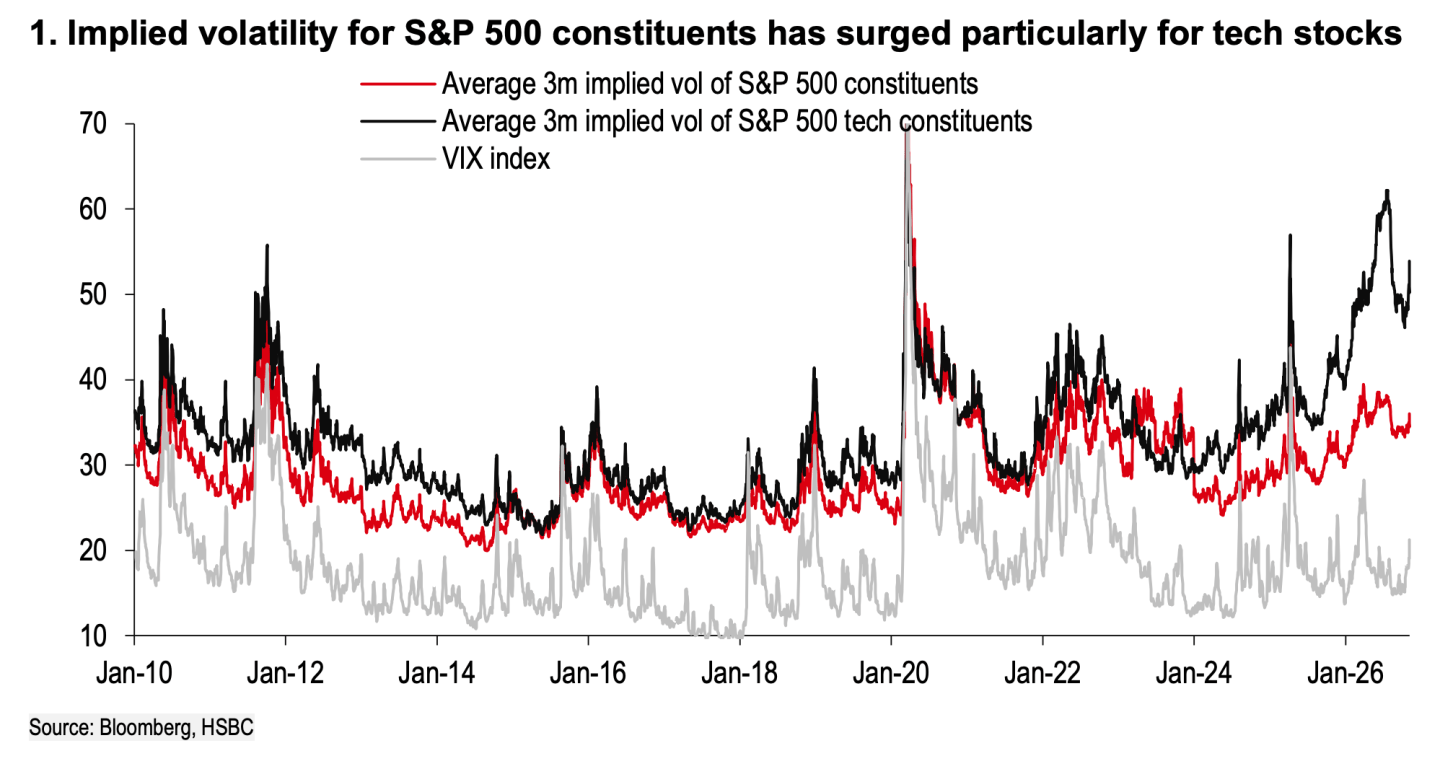
Despite the drama, the S&P 500 is quietly doing pretty well
Nearly 90% of the S&P 500 companies have reported Q3 results and 76% of them beat earnings-per-share expectations, according to Savita Subramanian and Victoria Roloff of Bank of America. That’s “a third straight quarter at 76%+, a streak last seen in 2021,” they say.
CHART OF THE DAY
The worst-case El Niño scenario could wipe 0.8% off global GDP
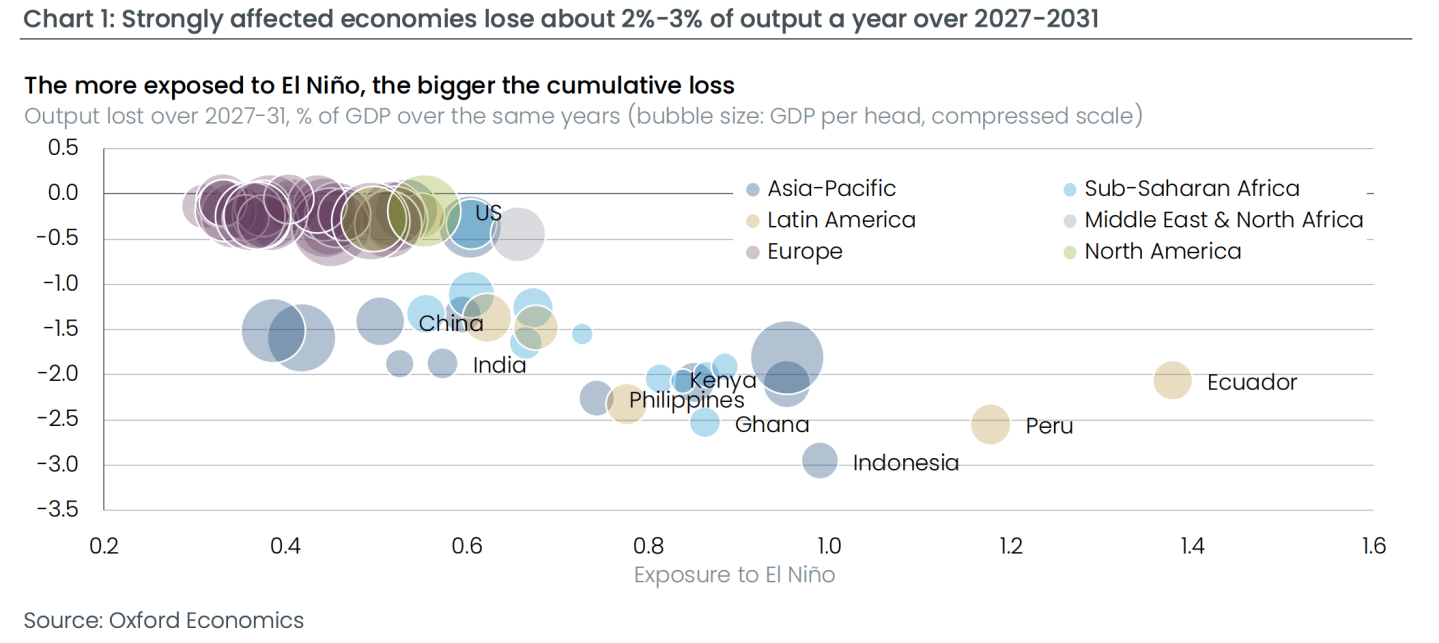
A record-strength El Niño could reduce world GDP by 0.6% next year and by 0.8% in 2028, according to Beatrice Tanjangco of Oxford Economics. Asia fares worst: “China, India, Pakistan, and Southeast Asia together account for about two-thirds of the fall in global output,” due to higher food prices and weaker spending, she said in a note.
QUOTE OF THE DAY
“If I make it my life goal to scrape your data, it can be done … The web is cooked today.”
—Michele Catasta, president of AI software development platform Replit, who was asked if publishers could ever reliably prevent AI from reading and copying their online content. He was speaking at Web Summit in Lisbon on Monday.
THE FRONT PAGES TODAY
Trump says Iran war to end ‘fairly soon,’ plays down prospects of new strikes – CNBC
France blames Iran for supermarket fridge hacks – Axios
Anthropic Prepares to Push Ahead With IPO Despite Market Jitters – WSJ
TSMC’s Revenue Rises 60% in a Sign of Resilient AI Chip Demand – Bloomberg
Exxon Strikes Preliminary Deal to Return to Venezuela – NYT
ONE MORE THING
Zillennials are spending 5 hours a week self-promoting themselves—it’s called ‘loud working,’ and it’s driving their colleagues up the wall
So you’ve heard of the trend quiet quitting, and its sister, loud quitting—but now workers are doing the complete opposite: “loud working.” Instead of doing the bare minimum to get by or chastising their employers, they’re pouring all their energy into making their work more visible, Fortune’s Orianna Rosa Royle reports.
Think of the colleague who posts every win on LinkedIn or pings the whole team on Slack the second a task is done.
The average U.K. worker spends 131 hours a year—or 2.8 hours a week—making their work visible. That includes singing their own praises on social media, posting updates on Slack or Teams, speaking up in meetings, and vocalizing their wins to anyone who will listen.
Opinion: This isn’t necessarily a bad thing! Bosses aren’t psychic. You’d be surprised what management doesn’t know about what it takes to get a job done.
- ➡️ Would you like to sponsor this newsletter? Contact advertising@fortune.com for details.
- ➡️ If you would like to receive this information in your inbox every morning before the markets open in New York, sign up here.
https://fortune.com/img-assets/wp-content/uploads/2026/11/GettyImages-2298607332.jpg?resize=1200,600
https://fortune.com/2026/11/10/fbi-looking-into-jensen-huang-nvidia-corporate-governance/
Jim Edwards





