
[
The first time the Federal Reserve took a close look at how the AI buildout is being financed, it found more than $3 trillion of promises that don’t show up as debt.
The Fed’s November Financial Stability Report includes a new section, “Leverage in the Data Center Buildout.” None of the report’s five previous editions, going back to 2024, had one. The closest, in November 2025, was about AI and algorithmic trading.
The new section counts more than $1 trillion in leases that are signed but haven’t started yet, plus more than $2 trillion in take-or-pay contracts and residual value guarantees, at Amazon, Alphabet, Broadcom, Meta, Microsoft, Nvidia, and Oracle.
Citing the report in a speech Monday in Milan, Fed Governor Michael Barr put the “potential maximum nominal value” of those obligations above $3 trillion. He said the seven largest AI firms’ on-balance-sheet debt “is expected to exceed $800 billion before year’s end.” The Fed notes the off-balance-sheet figures are undiscounted and “not directly comparable” with debt.
Amazon, Alphabet, Broadcom, Meta, Microsoft, and Oracle didn’t immediately respond to Fortune’s requests for comment.
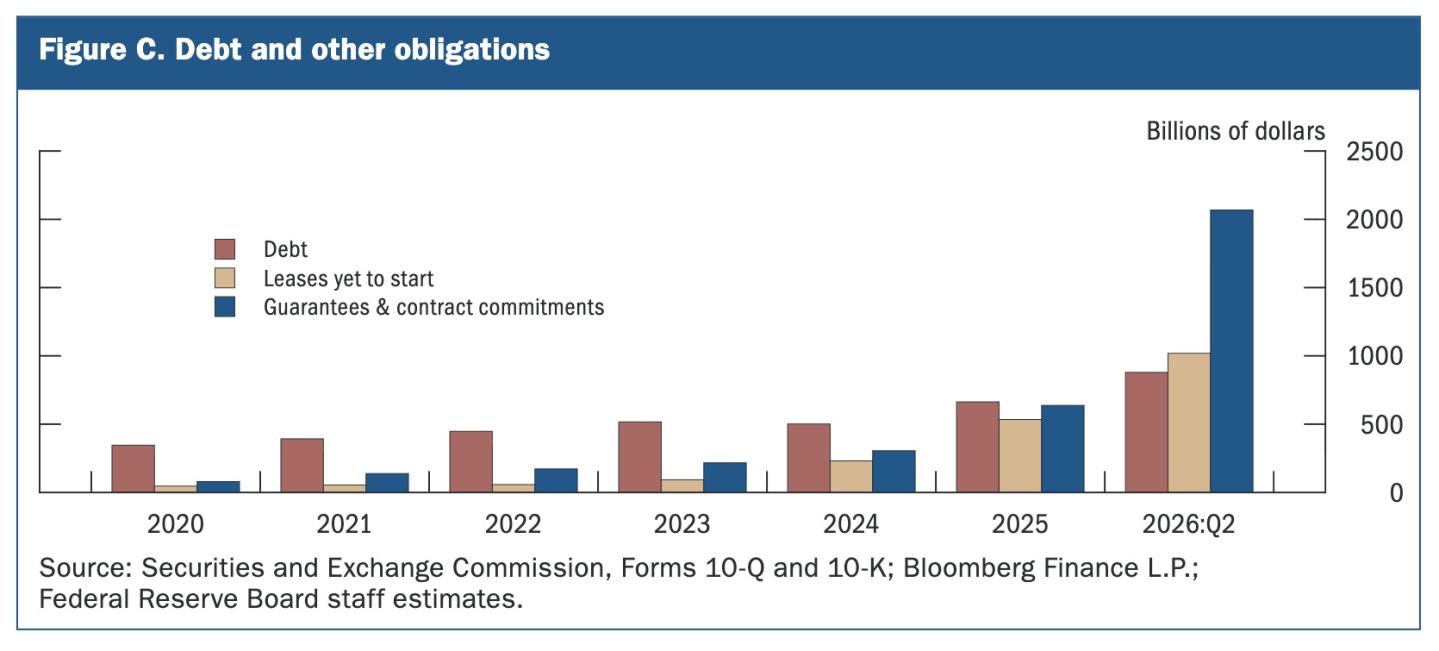
Federal Reserve Board, Financial Stability Report, November 2026
It raises the question of who takes the hit if AI demand comes in short. The report says the arrangements let companies with strong credit support weaker-credit projects “without having an immediate, direct effect on the balance sheets” of the big firms. Data-center developers use those leases to finance construction, and the riskier slices of the resulting debt are held by high-yield bond funds, life insurers, business development companies, and other private debt vehicles. The largest U.S. bank holding companies have “close to $1 trillion of exposure” to large technology firms, data-center developers, AI-related special purpose entities, private credit vehicles, and utilities, according to the Fed.
Barr warned the opacity “can exacerbate selloffs when investor sentiment shifts, as it is hard to know where risk resides.” Separately, Fed Chair Kevin Warsh said Monday Board staff have started modeling AI scenarios, from a growth boom to an AI disappointment.
The borrowing caught up fast
Debt issuance tied to advanced computing rose to more than $680 billion by October, the Fed found, about five times the $130 billion issued in all of 2023. Advanced computing’s share of nonfinancial investment-grade corporate debt issuance went from less than 6% in 2023 to about 31% this year. The Fed estimates outstanding public debt tied to advanced computing at more than $1.1 trillion and says private credit deals make the full total harder to measure.
Market players are worried, too. The Fed surveyed 23 contacts at broker-dealers, banks, investment funds, and advisory firms in September and October, and 87% named AI as a salient risk to the financial system, up from 50% in the May survey. A broad correction in risk assets came next, at 52%.
The report reflects data through Oct. 28, two weeks before Nvidia CEO Jensen Huang resigned.
Nvidia’s guarantees, without Huang
Huang resigned Nov. 12 as president, CEO, and board member of Nvidia, and CFO Colette Kress became interim CEO. Nvidia reports third-quarter results after the close today. Analysts expect revenue of about $108 billion, CoinDesk reported, and said Kress “faces questions about demand, financing commitments, and China exposure.”
Nvidia’s filings show the kind of commitments the Fed is counting. In August, the chipmaker agreed to residual value guarantees with SB Energy, the landlord for an AI campus in Pike County, Ohio, where an OpenAI affiliate will be the tenant on about 4.25 gigawatts of IT load. If OpenAI goes insolvent and defaults on a lease, or fails to make payments, Nvidia generally covers the gap between the lease’s guaranteed minimum value and what’s recovered. Its total obligation is “cumulatively capped at $105 billion” for the initial commitment, subject to conditions that include the sites being ready for service, expected beginning in 2028. OpenAI has agreed to reimburse Nvidia for anything it pays. Separately, Nvidia’s latest quarterly filing lists $3.5 billion in guarantees on AI cloud partners’ data center leases as of July 26, against which those partners have put $712 million in escrow. Nvidia, SB Energy and OpenAI didn’t immediately respond to requests for comment.
Barr said such guarantees “represent the degree to which hyperscalers and GPU producers might absorb losses” if borrowers default.
Telecom equipment makers tried a smaller version of this during the dot-com boom. Lucent committed $5.7 billion in credit to customers in 2000, eWeek reported at the time. One of those customers, Winstar, had a $2 billion vendor financing deal with Lucent. It filed for bankruptcy in April 2001 and sued Lucent for $10 billion. Four years later, a bankruptcy judge ordered Lucent to pay $244 million.
The banks have a cushion, mostly
Barr isn’t predicting a bank blowup.
“Given the still-limited amount of debt backing the current boom, I’m less concerned about direct losses,” he said. The Fed calls the banking system “sound and resilient, with high regulatory capital ratios.”
The New York Fed’s annual check on bank vulnerability, published Nov. 12, shows some strain. Researchers there found a measure of banks’ liquidity stress is at “a level not seen since 2014.” In a scenario replaying 2022’s rate shock, banks would face a $151.1 billion capital gap, little changed from a year earlier. Three of its four measures show rising vulnerability. That analysis uses data through June and doesn’t look at AI exposure specifically. Fortune reported in June the Bank for International Settlements found direct lending funds had quadrupled their lending to AI and IT over five years.
The Fed’s first look ends on a limit to what it can see. The biggest tech firms “may absorb losses in the event of a future downturn,” the report says, but their economic exposure to one “may be substantially larger than suggested by their on-balance-sheet liabilities.”
Its next report is due in the spring. Nvidia’s call starts at 5 p.m. ET.
Generative AI was used for research assistance and/or transcription of this article. The reporter independently reported and verified the factual claims in this article, and a human editor reviewed it before publication.
https://fortune.com/img-assets/wp-content/uploads/2026/11/GettyImages-2304963149-e1794930042868.jpg?resize=1200,600
https://fortune.com/2026/11/17/fed-financial-stability-report-ai-data-center-3-trillion-off-balance-sheet-nvidia/
Nick Lichtenberg





