
Fires are typically tackled using sprinkler systems and fire extinguishers across homes and larger buildings, but Ohio company Sonic Fire Tech is testing a fire-fighting system with a difference: it uses sound waves rather than water or chemicals.
The immediate benefits are obvious, in that people and properties don’t get drenched at the same time as the fire is put out. There’s another advantage too, because unlike water, sound waves can tackle grease fires — a type of blaze that’s increasingly common.
Former NASA engineers form part of the team behind the “acoustic fire suppression technology”, and Sonic Fire Tech raised $15 million in funding earlier this year, CNN reports. So is it the next big thing in fire defenses? These are the details.
Latest Videos FromTechRadar
How the technology works
The overall trend for fires in the US is, thankfully, downwards. However, while there are fewer fires than there were 40 years ago, they’ve become deadlier — if a fire is reported in your home, you’re more likely to die. Fires from cooking have actually been on the rise in recent years, which is a worrying trend-within-a-trend.
As pointed out on the Sonic Fire Tech website, the standard dousing you get with a sprinkler system can cause as much damage as the fire itself in some cases: furniture and fittings get drenched, electronics are put out of action, and family heirlooms and keepsakes can be damaged beyond recovery.
With sound waves, those problems aren’t there. In basic terms, the Sonic Fire Tech system works by producing high-pressure infrasound waves. These are sent down a dedicated system of pipes, in a similar way to how a sprinkler or air conditioning system would work, and then the sound waves are targeted at the source of the blaze.

The sound waves vibrate the oxygen molecules in the air, which essentially pushes them away faster than the fire can grab hold of them. That leaves the fire starved of the oxygen supply it needs, and it dies out. It can be put into action as soon as heat is detected, and false alarms don’t matter, because there’s no damage done.
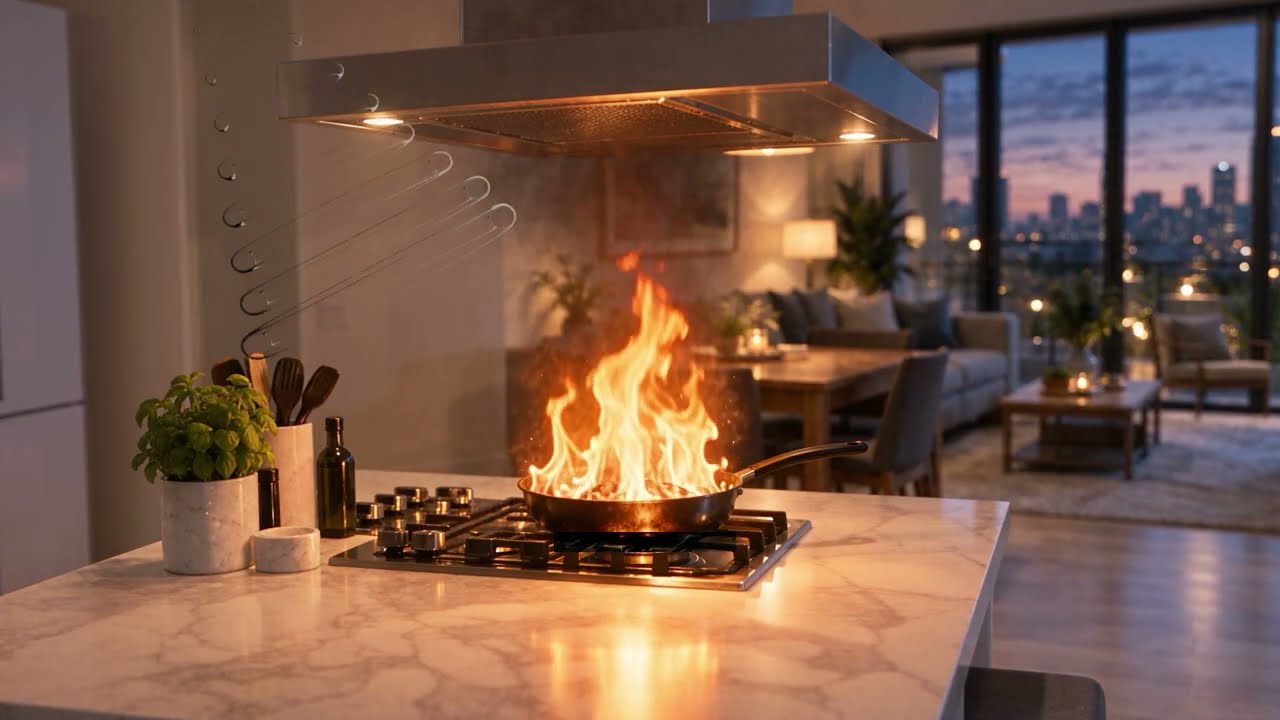
You can see how the setup might work in one of the official videos on the Sonic Fire Tech YouTube channel. In an apartment building, a network of ducting pipes lead from a central acoustic generator to each individual living space, with the emitters placed right over the cooking areas. Sensors detect the fire, and in response the sound waves are generated at the same time as the fuel supply for the cooking appliance is switched off.
The fire suppression tech has been proved to work at distances of up to 25 feet (7.6 meters), and certification testing is beginning before the end of the year — with the UL 300A protocol, for stovetop fire extinguishing, one of the safety standards that the sound wave system has been designed to comply with.
The challenges ahead
There’s a lot that’s promising about the systems Sonic Fire Tech is working on: there’s nothing to run out of (only electricity is required), no water supply is needed (making this tech potentially transformative for wildfires), and there’s no water damage or chemical residue when the fire’s been put out.
It can tackle types of fires that water alone can’t (grease fires), and it can act earlier and more reliably because false alarms are less of an issue. There’s even a portable, backpack version of the system in development — one that firefighters could potentially carry with them when tackling blazes.
However, the technology isn’t a sure thing yet, and there’s work to do before you’ll see it installed anywhere (or on board a fire truck). Researchers have actually been working on the idea of sound waves suppressing fires for several years now, and one of the challenges has been scaling the techniques up for larger fires across bigger areas.
There are also questions about everything that comes along with a blaze. “Sound may knock down a small flame, but it does not cool hot surfaces or wet fuel,” Los Angeles fire protection engineer Nate Wittasek told Ars Technica. “That raises real questions about re-ignition, smoldering fires, hidden fires, and fires that are partially blocked by contents.”
Michael Gollner, an associate professor of mechanical engineering at the University of California, Berkeley, has some concerns about whether the whole package will end up improving on sprinklers. “Water suppression sprinklers are terribly efficient, and this new technology still needs to prove that it’s more efficient than this,” he told CNN.
These are challenges that the Sonic Fire Tech experts think they can overcome, not least because CEO and co-founder Geoff Bruder has a background in NASA, working on acoustic wave systems for spacecraft designed to land on Venus. That’s a decent foundation for anyone working on putting out fires in homes and offices.

Follow TechRadar on Google News and add us as a preferred source to get our expert news, reviews, and opinion in your feeds.
https://cdn.mos.cms.futurecdn.net/4URe4w3Uw3HsMeLBbvF4eW-2000-80.jpg
Source link
David Nield





