
[
Thanksgiving is one of the most stressful and busiest times to travel. But for a record number of young adults, that trip looks less like a three-hour flight and more like a two-minute walk from their childhood bedrooms.
According to a report from Realtor.com released Monday, the regions Americans have long moved to for cheaper housing are now where young adults are most likely to be moving back in with their parents.
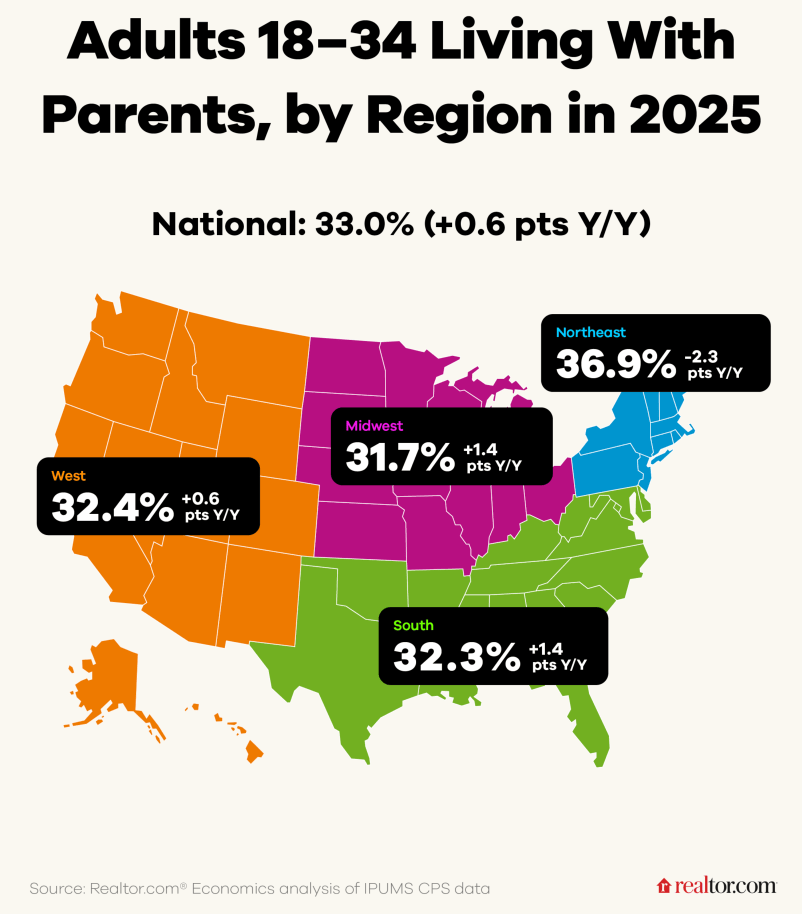
The share of 18- to 34-year-olds living with their parents rose 1.4 percentage points in both the South and the Midwest in 2025, to 32.3% and 31.7%, which were the largest increases of any region. But in the Northeast, where living at home has long been most common, the share fell 2.3 points to 36.9%, its lowest level since 2010.
“This is not a coastal problem that has stayed coastal; it has spread to even the more-accessible parts of the country,” wrote Hannah Jones, the Realtor.com senior economist who wrote the report.
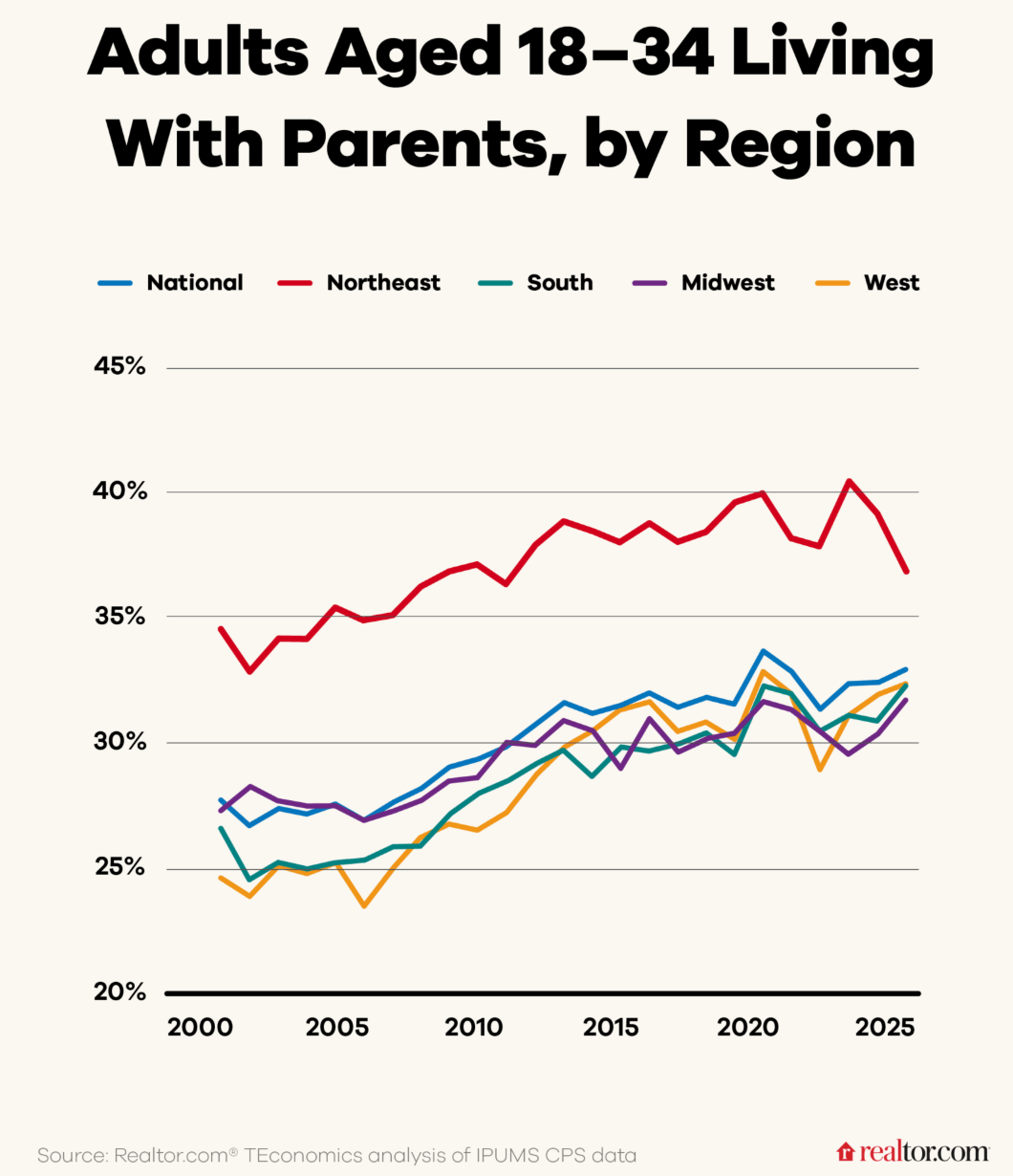
Realtor.com
Nationally, a record 25.2 million young adults lived with their parents last year, about 1 in 3, a figure Realtor.com first reported in June.
It’s also not just young people moving into their parents’ home. Geoffrey Sanzenbacher, an economist at Boston College’s Center for Retirement Research, found that the share of 25- to 34-year-olds hosting their parents rose from 1.6% in 1996 to 4% in 2025.
About 22% of Americans lived in a multigenerational household in 2024, up from 13% in 1970. When the Pew Research Center asked adults in these households why they live together, financial issues were the most common answer, cited as a major reason by 40%.
Buyers are shopping for it, too. Fourteen percent of homebuyers in the year ending in June purchased a multigenerational home, according to the National Association of Realtors. Caring for aging parents was the top reason, at 30%, followed by saving money (23%), adult children who never left home (19%) and adult children moving back (18%).
Some families are planning for living together long-term. In the Bay Area, Tim Yee of RE/MAX Gold said buyers are showing more interest in homes with accessory dwelling units, “which allow younger adults and their families to live close to their parents while maintaining some independence.”
Homes marketed for multigenerational living in San Antonio drew 65.2% more page views than standard listings in 2025, Realtor.com found, but their median asking price of $573,105 was nearly 69% higher.
Realtor.com
A decreased housing stock
More homes on the market have not solved the problem. Active listings in San Antonio are more than 40% above pre-pandemic levels, according to Jones, yet the metro posted one of the largest increases in young adults living at home.
She said higher-earning newcomers and current owners looking to trade up are better placed to buy those homes than local young adults, who often can’t qualify at current prices and rates.
“Markets where supply growth is concentrated in the mid-to-upper tiers still see entry-level households struggle to keep up,” Jones added.
Generative AI was used for research assistance and/or transcription of this article. The reporter independently reported and verified the factual claims in this article, and a human editor reviewed it before publication.
https://fortune.com/img-assets/wp-content/uploads/2026/11/GettyImages-1600895362-e1795470304438.jpg?resize=1200,600
https://fortune.com/2026/11/25/young-adults-living-with-parents-south-midwest-realtor-crowded-nest/
Catherina Gioino





