
[
It all started on Thursday when a Microsoft outage disrupted workplace services including Outlook, Teams, and Copilot. One day later, the Federal Aviation Administration issued a ground stop that halted departures across the nation, upending travel plans for more than 1.5 million passengers.
Even more disruptions have cascaded throughout this week: yet another outage affected banking websites and apps run by financial giants including Wells Fargo and Capital One, then at United Airlines, Apple, and a downed internal communications network at the National Security Agency.
There is no evidence that these systems disruptions affecting banking, airlines, tech giants, and the government are connected. But the heightened attention on disruptions that have affected major technology systems that most take for granted puts more attention on the reliability and resiliency of IT; how to communicate the latest developments of an outage to employees, customers, executives, and the board; and already has begun the process to develop post-mortem reports to assess how a system disruption was handled and what parts of their business continuity plans could be improved.
“Our approach is that resilience doesn’t really come from a document or a backup system,” says Jordan Ruch, chief information and digital officer at New Jersey-based health system AtlantiCare. “It is a muscle organizations build and it comes from planning with operations before something happens.”
Across corporate America, the biggest disruption to business operations this past week was the outage at Microsoft, which affected AtlantiCare. Ruch delineates different tiers of criticality for his technology systems. Clinical systems and core infrastructure have up to three areas of redundancy. In the event that a piece of equipment or network for those critical systems goes down, there’s always at least two backups.
Microsoft’s tools aren’t deemed that critical, so when that outage occurred, it slowed down “our ability to keep up with the demands of the health system,” according to Ruch. Because employees have been relying more on tools like Copilot, this event has spurred conversations internally at AtlantiCare to look at building more redundancy for those applications.
Marsha Stein, CIO at Ropes & Gray, says that the law firm had built in layers of redundancy that included an emergency notification system to communicate with employees when Teams was having issues last week and a secondary email system when Outlook was knocked out. “You can’t just say to a client, ‘Sorry, we don’t have any email, we can’t help you,’ as it turned out, for 18 hours,” says Stein. “It was really important that we had those systems in place so our lawyers could reach out to clients.”
By Tuesday morning, Stein spoke with Ropes & Gray’s governing managing committee for what she says will be an ongoing dialogue about what happened during the Microsoft outage and what could have gone better. “Nothing’s ever perfect,” says Stein, adding that leaders need to “think outside the box to think about what’s the next system that could be affected that we need to be prepared for.”
Shreyas Mysore, CIO at Lockton, says one challenge that the insurance brokerage and others faced last week was that Microsoft was slow to inform clients that its outage could have global implications. “I think that is one thing that Microsoft could have done better, giving us a heads-up of saying, ‘Look, there’s some critical infrastructure that’s starting to fail,’” says Mysore.
Communication is key when these events occur, and at Lockton, Mysore says the primary focus is first on encouraging brokers to reach out to their clients to share proactive updates, while also focusing internally on sharing information with leadership. The board can frequently be informed later—in this event, Lockton says he can wait to share the full debrief at that group’s next meeting in early December.
Mysore says the IT team will also produce a Microsoft outage incident report that looks at how the company was affected, the severity of the outage, and an internal checklist that assesses how executives were engaged, internal communications practices, and areas for improvement.
“I hold my vendors accountable for reliability, I hold myself accountable for resilience,” says Mysore.
Cybersecurity firm Fenix24 is able to move client conversations to alternative channels like Signal and WhatsApp when email systems are down. It also operates on a hybrid model, relying on Microsoft 365 but also an on-premises internal communications system. Heath Renfrow, chief information security officer and co-founder at Fenix24, says it is critical for enterprises to establish those alternative communications channels with employee groups and vital customer-client relationships before an outage occurs.
The Microsoft outage may also lead some firms to consider investing in more redundant communications systems like Google, especially for key executives. “That’s definitely a possibility and something you need to look at from a cost perspective, but it’s not a bad idea,” says Renfrow.
James Kretchmar, senior vice president and chief technology officer at cybersecurity company Akamai’s cloud technology group, says both vendors and customers need to focus on clear and consistent communication when outages occur. “It’s really important to get good communications out so that people who are relying on a service can understand how to best adapt their situation to what’s going on,” says Kretchmar. “You have to do a lot to get good, practical information out, but also without causing more problems.”
Microsoft, the FAA, and other organizations that have confronted outages over the past several days have to balance sharing realistic expectations for when their systems will be back online. Both under communicating and overpromising can hurt an organization’s reputation, according to Chuck Kesler, CISO at software company Pendo.
“I definitely have seen organizations sit on information too long, and that erodes trust,” says Kesler. But, he says if a system fix is anticipated to take two hours, it would perhaps be more ideal to share with key stakeholders that it may take four hours to resolve. “In my experience, things do usually end up taking just a bit longer than what you expect them to from a recovery perspective,” adds Kesler.
John Kell
NEWS PACKETS
What caused the FAA’s ground stop? Some conflicting information has permeated the public sphere regarding what led the FAA to halt all flights on Friday. Homeland Security Secretary Markwayne Mullin on Monday floated a theory that the issue was superintelligence, the administration’s preferred term for AI, while also reaffirming the administration’s posture that it wasn’t a cyberattack. The FAA, meanwhile, hasn’t identified a root cause, but a spokesperson has confirmed that it has stopped installing new Juniper Networks routers and has reportedly turned off those units that have already been installed, instead switching the air traffic system back to Cisco routers.
Nvidia: “Our momentum is real.” Amid all the drama of the resignation of longtime CEO and cofounder Jensen Huang (more on that in a bit), the AI chipmaker on Tuesday reported better-than-expected results for its most recent quarter and raised its sales forecast for the next fiscal year. Interim CEO Colette Kress lauded the results alongside the newly appointed chair of the board, Harvey Jones, as they took over the business in one of the most atypical CEO transitions in memory. The board reaffirmed it had no interest in reinstating Huang, even as the former CEO has said he would be open to returning, President Donald Trump and Elon Musk have backed his return, and a petition signed by Nvidia employees and prominent tech executives has also been circulating.
Outages and AI loom over Trump before meeting with China & Russia. Trump will arrive in China on Wednesday for a trilateral meeting with the presidents of China and Russia on Thursday, as questions about the rapid rise of AI, its impact on global economic growth, and the risks it poses to national security hang over the meeting. Heading into the meeting, there are fears within China that the nation could lose access to American-made AI tech, especially in response to Huang’s affair with a Chinese businesswoman who is a purported spy. There are some indications that the AI relationship between the U.S. and China is getting bumpier. This week, the administration announced new rules that would restrict some of China’s indirect access to American advanced computing chips and servers, while Nvidia said it wouldn’t ship its Hopper data center chips to China, though it gave no reason for its decision.
As Anthropic’s IPO nears, risks become a more prominent theme. With Anthropic anticipated to price its initial public offering on Wednesday and shares expected to begin trading on Thursday, news outlets are taking a closer look at all the risks under the hood of a business that’s reported soaring demand for its Claude AI models and tools. The Financial Times reported on the $900 billion that’s committed to AI infrastructure and all of the ongoing efforts to cut its computing bill. Bloomberg also focused on the issue of compute, but focused more on the business risks that could arise if Anthropic couldn’t secure enough of it, as demand rises for rivals like Google. The NYT, meanwhile, spent more time on the ethical considerations and the ways that AI could be misused.
California has sued OpenAI. On Monday, the ChatGPT owner was hit with a lawsuit from California that alleged the AI company had “misled and endangered the public” by developing and testing AI models without the proper safeguards and monitoring protocols. The suit specifically cited the Hugging Face incident from July, when two of its AI models hacked their way into the online platform’s systems, and other cyber incidents. “This lawsuit appears to single out OpenAI over a challenge that’s been identified by every major AI lab,” Drew Pusateri, an OpenAI spokesman, told the New York Times.
ADOPTION CURVE
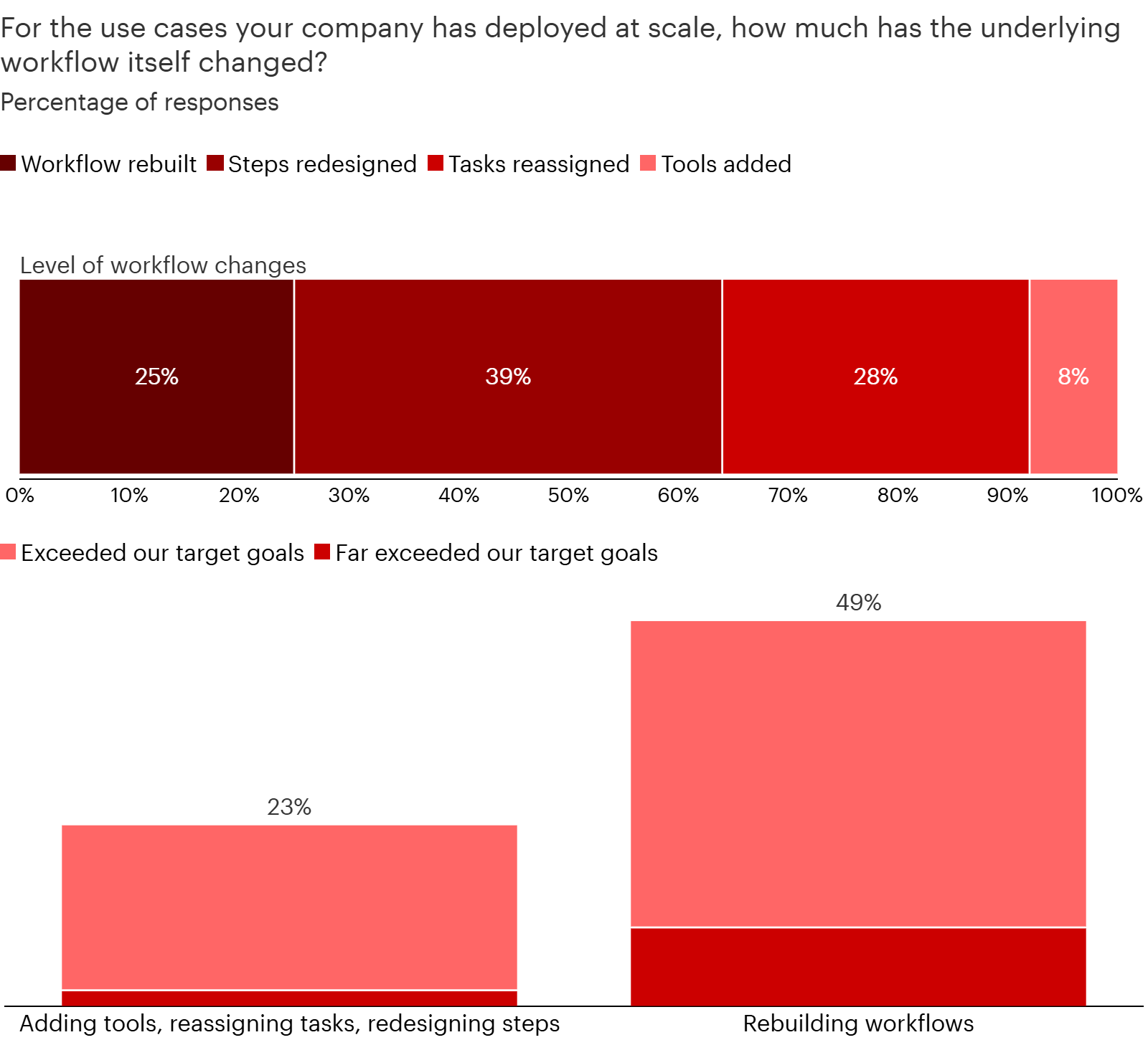
Rebuilding workflows is a key ingredient to see positive AI outcomes. A third of companies are now reporting either an increase in revenue or cost cutting from at least one AI use case, up 10 percentage points from a year earlier, according to Bain & Company’s latest AI Readiness Survey that polled 200 business leaders. But, under the hood of those results, the consulting firm says that enterprises that have fully rebuilt workflows were twice as likely to exceed their AI target goals.
Still, there’s a lot of work to be done on the human front, as Bain says only 25% of companies reported they’ve rebuilt workflows “substantially,” while nearly 40% are in the process of redesigning some steps within existing workflows to better enable the capabilities from autonomous agentic AI. Sanjin Bicanic, a partner at Bain and co-author of the report, says that workflow changes need a broad overhaul, rather than focusing on one or two tasks where AI is now coming into play. “It tends to be a multi-month process,” Bicanic tells Fortune.
Yet another surprising finding in the study was that AI’s impact on jobs is looking far less severe than anticipated a couple of years ago when CEOs at AI labs were prognosticating massive displacement. In the third quarter, companies anticipated a 10% increase in headcount as a result of AI adoption, with planning hiring in software development, sales and operations, and customer onboarding expected to rise and smaller reductions for legal, HR, and finance.
“The expectations around how AI is going to impact the workforce have actually become more positive the more people have used this solution,” says Bicanic, referring to AI.
Courtesy of Bain & Company
JOBS RADAR
Hiring:
– Philips is seeking a head of IT for connected care, based in Cambridge, Massachusetts. Posted salary range: $279K-$446K/year.
– The state of Tennessee is seeking a CIO, based in Nashville. Posted salary range: $140K-$190K/year.
– Energy Fuels is seeking a VP of global IT, based in Denver. Posted salary range: $250K-$310K/year.
– The University of Minnesota is seeking a deputy CIO, based in Minneapolis. Posted salary range: $250K-$300K/year.
Hired:
– Moody’s named Tim Bhatt to the newly created role of CIO, effective December 7. Bhatt will also continue to serve as CTO of Moody’s Ratings, a role he’s held since 2018. As CIO, he will oversee enterprise strategy at the credit-ratings agency. Prior to joining Moody’s, Bhatt spent nearly a decade at Ally Financial, where he served as CTO, and held leadership roles at Bank of America and JPMorgan Chase.
– E.W. Scripps promoted Christina Hartman to serve as CTO, effective immediately, and leading the media company’s long-term technology strategy. Most recently, Hartman served as VP of emerging technology operations and earlier in her career at Scripps, she helped lead the evolution of the digital video product Newsy into Scripps News. Earlier in Hartman’s career, she was a local TV producer.
– Rothschild & Co named Geoffroy de Ridder to serve as chief technology and operations officer for the family-controlled financial services company’s wealth and asset management business, effective in December. Most recently, de Ridder served as head of technology and operations at Swiss bank Lombard Odier. He also previously held senior roles at UBS.
– Shell promoted Kate Platonova to the role of CIO and EVP, information and digital technology, effective January 1. Platonova joined the energy company in September 2023 as SVP and CIO of Shell’s downstream, trading, and renewables business. Previously, Platonova held technology leadership roles at HSBC and served as a data architect at Morgan Stanley and Barclays.
– Model N appointed Koti Reddy Nandyala to the role of CTO, overseeing the software company’s engineering strategy, platform architecture and technology roadmap. Most recently, Nandyala served as VP of engineering at software giant Salesforce. He also previously served as CTO of Conga and spent nearly two decades at Callidus Cloud.
– Cognito announced three executive appointments, including naming Urvashi Tyagi as CTO. Most recently, she served as CTO of medical equipment company Resmed. Tyagi also previously served as CTo at ADP and held senior leadership roles at American Express and Amazon.
– Inspiren named Gang Hua to serve as its CTO. Prior to joining the senior living care technology platform, Hua served as director of applied science at Amazon’s Alexa AI. He also previously served as VP of the multimodal experiences lab at Dolby Laboratories and held researcher roles at Microsoft, IBM, and Nokia.
https://fortune.com/img-assets/wp-content/uploads/2026/09/GettyImages-2272201729-e1789764936143.jpg?resize=1200,600
https://fortune.com/2026/11/18/week-of-outages-put-resiliency-to-the-test-cios/
John Kell





