
[
Rhythm Bazari, a high school senior in Atlanta, says every networking opportunity he has had came through LinkedIn, including his invitation to speak at United Nations events during high-level week in September. He also says the person who writes on the platform isn’t quite the person he is in real life.
“Every networking thing I’ve done has been through LinkedIn, to be honest,” said Bazari, 17. “I wouldn’t have found out about a lot of stuff if it wasn’t for LinkedIn.” Earlier this month, LinkedIn said the number of members listing “Founder” on their profiles has risen 125% since 2022, with new Gen Z businesses up 275%.
Asked whether there is a LinkedIn Rhythm and a real one, he said, “I think so.” On the platform, he said, “I try to be more service lesson-oriented versus how I am in person.” He added: “I can’t show my true self too much on LinkedIn.”
How he got in
It started on Instagram. “I see these students who are my age, and I’m like, how are they getting to the United Nations? And I’m not going there,” Bazari said. He began researching and contacted a major UN youth organization, which didn’t respond at first. He then went through a third-party group, the International Organization of Youth, which pointed him to a flagship event near the UN.
People he met there invited him to speak on the “AI and Human Development” panel. “It was very last minute,” he said. “When I got invited, it didn’t feel real, to be honest.”
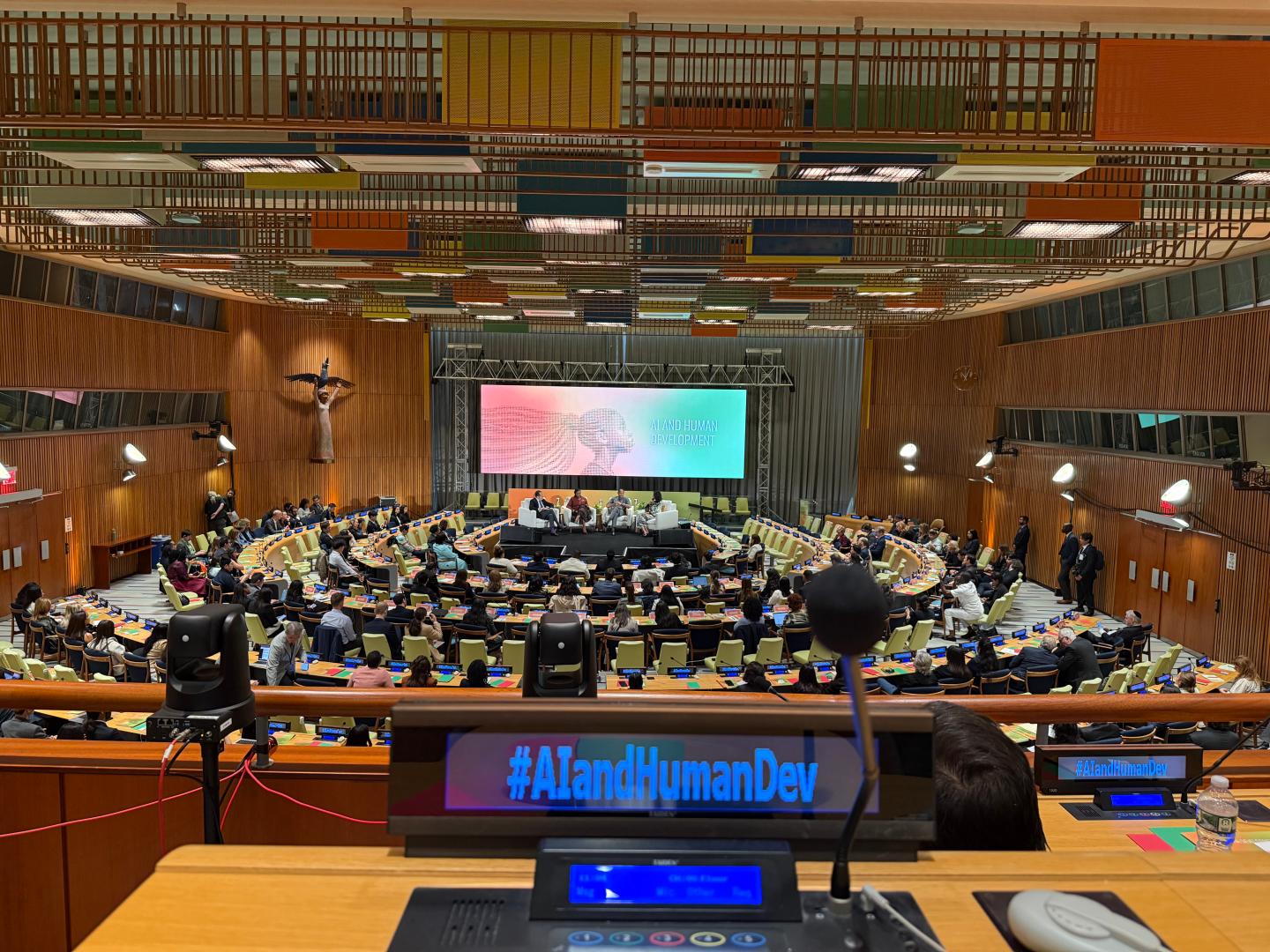
He spoke at a UN event on AI and human development that had no youth speakers, he said. His pitch: “We’re the generation who’s going to deal with AI the most.” That’s what his company, Avants AI, is about. It began as an AI community project and has evolved into an AI tool that vets job candidates. “Now we’re making an automated interview process,” he said, adding that he built it with KR3 Information Systems, a cybersecurity company where he has interned since ninth or tenth grade.
Avants AI has about 1,000 users and has summarized 5,000 resumes, Bazari said. “We’re not making any money right now because we’re mainly in the product shipping stage,” he said. “It’s mainly for free right now.”
An AI believer’s caveats
Bazari’s product lands in a hiring market that is already automated. In a five-country Greenhouse survey of about 1,350 recruiters and hiring managers, 52% of employers said they already use AI interviews, and 73% use or plan to use them within a year. Northeastern University researchers found that 54% of U.S. hiring decision-makers use AI to screen resumes at least some of the time. Among those whose hiring AI has changed, 26% said they hire fewer entry-level workers because of it, against 7% who hire more.
In the Greenhouse survey, 90% of U.S. employers said they may have turned away real candidates because applications looked fake or AI-generated. Bazari said his own research found that recruiters “spend six or seven seconds on your resume,” and they prefer to see real work over stats. His advice to job seekers: show the code base for what you built.
“I feel like people are not understanding that AI can really automate everything,” Bazari said, adding that he worries about overreliance. “Whenever I pull up a package, I’m like, ‘Claude, just tell me what this does.’ I actively learn while it does everything for me.”
Bazari said his team has submitted early college applications. He started posting on LinkedIn during his junior year, when it felt like “educational Instagram, a very mature Instagram.” He says he writes his own posts. “I try to keep my personal voice,” he said, and uses AI only for images.
His motive, he said, is helping people. “I’m definitely trying to be impressive,” he said, “it’s part of the deal, I guess.” Still, he stressed, “the main focus is helping .”
https://fortune.com/img-assets/wp-content/uploads/2026/11/1760992958685.jpg?resize=1200,600
https://fortune.com/2026/11/27/17-year-old-ai-founder-united-nations/
Nick Lichtenberg





