
[
Welcome to Eye on AI. Emily Forlini here, filling in for Jeremy Kahn. In today’s issue:
- OpenAI relies almost exclusively on Nvidia GPUs, but it’s scaling up its fleet of AMD chips
- Jensen Huang says he would be “honored” to return as Nvidia CEO
- Nvidia’s first earnings call without Huang is at 5 p.m. ET today
- Anthropic will set its IPO share price tomorrow
- California’s Attorney General sues OpenAI, following Texas
- Demis Hassabis’ Isomorphic Labs raises $5 billion for AI drug discovery
- OpenAI invites third-party researchers to inspect its models
Before we get to the news, can I just say, you are not going to want to miss this year’s edition of Fortune Brainstorm AI San Francisco.
We have an exceptional line-up of speakers for you: OpenAI president Greg Brockman and Microsoft AI CEO Mustafa Suleyman will both be onstage. Once the closest of partners, their two companies are increasingly, competitors, so I’m eager to hear how differently they see the road ahead. AI pioneers Fei-Fei Li, now of World Labs, as well as Andrew Ng, now of LearnVector, will be discussing their view of AI’s future too. Palo Alto Networks CEO Nikesh Arora will talk about AI and cybersecurity. Greylock partner Reid Hoffman, CapitalG’s Jill Chase, and Kleiner Perkins’ Mamoon Hamid and Ilya Fushman will weigh in on where the money is going. Recursive Superintelligence’s Richard Socher will talk about RSI and automating AI research.
It’s going to be epic. So please join me and many of my Fortune colleagues at the St. Regis in San Francisco on December 7th and 8th. You can apply to attend here.
Long before Jensen Huang resigned, the major AI companies were already building toward a world where he was less central to their success. Companies like OpenAI and Anthropic have been acutely aware of their dependence on Nvidia hardware, given that much of the AI ecosystem is built on it, and have ongoing efforts to diversify their infrastructure.
OpenAI is particularly vulnerable to any disruption in Nvidia’s business. Its models run almost entirely on Nvidia GPUs, a source familiar with its compute infrastructure tells me. Its CEO Sam Altman said this week that it would be “hard to imagine the AI revolution without Jensen” when speaking at a Semafor conference.
Meanwhile, Anthropic has a more diversified chip base. It relies on four main providers: Google TPUs, AMD GPUs, Amazon Trainium GPUs, and Nvidia GPUs, its S-1 revealed. This is a major competitive advantage, and Anthropic has built a “proprietary orchestration layer” that optimizes which workloads run on which chips, reducing its costs.
OpenAI has been focused on replicating this setup through a few initiatives. For one, it’s designing its own chip architecture, called Jalapeño. It’s also signing deals with non-Nvidia suppliers. OpenAI is reportedly planning to buy Google’s TPU chips, and this week, it announced a big step forward in a massive compute deal it signed with AMD in October to provide 6 gigawatts of capacity. For context, that’s five times the capacity of OpenAI’s flagship data center in Abilene, Texas, which has 1.2 gigawatts, and is one of the world’s largest campuses.
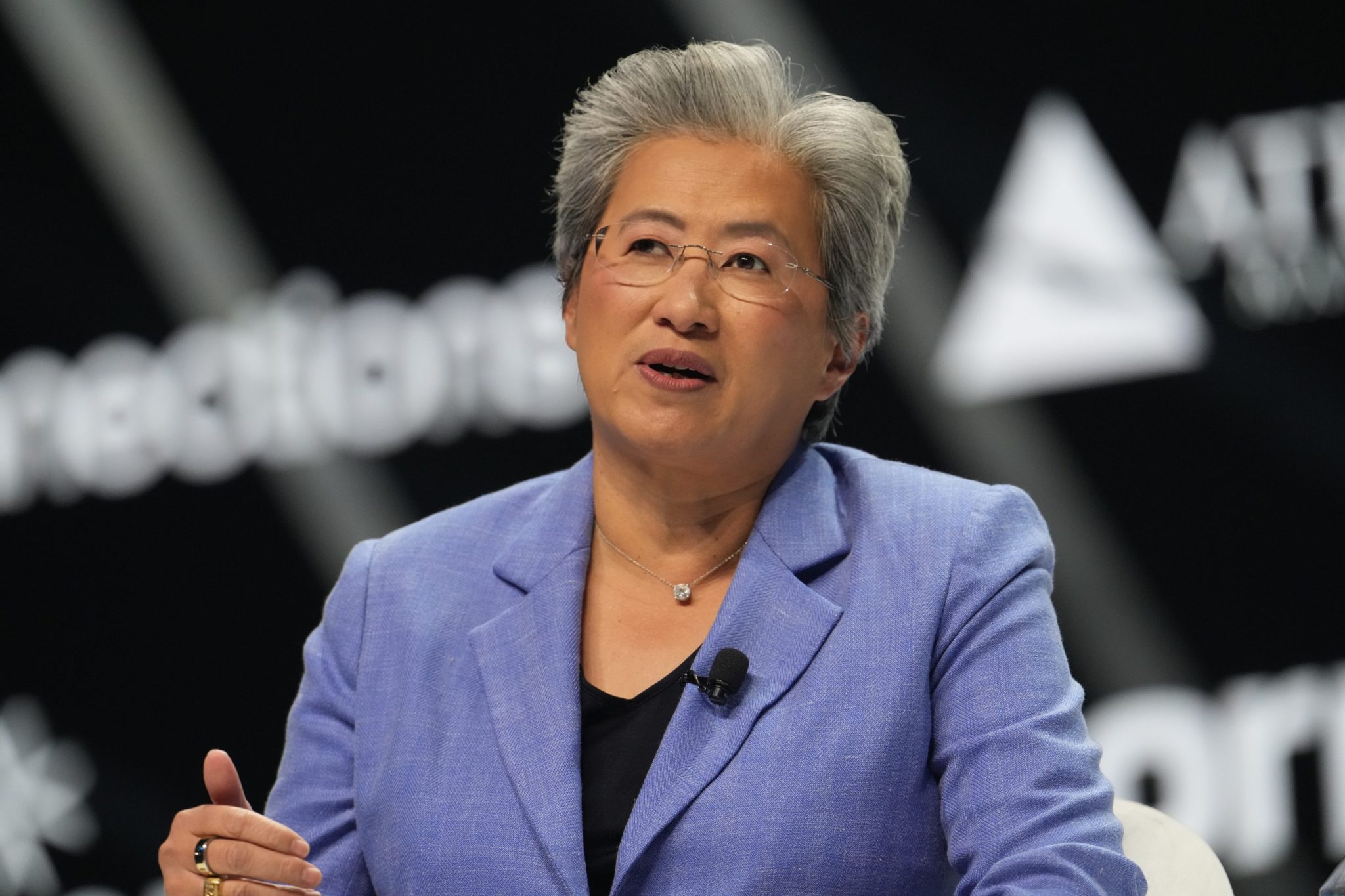
(AMD is curiously run by Jensen Huang’s first cousin once removed, Lisa Su. One source tells me Su’s least favorite question from reporters is about them being cousins; she hasn’t made it a part of her public image.)
OpenAI revealed the first neocloud company associated with the AMD deal, called TensorWave. TensorWave will provide OpenAI with 457 megawatts of capacity across multiple U.S. data center sites. That’s just 7.6% of the total capacity involved in the AMD deal. However, it’s TensorWave’s largest deployment ever, and the company will need to roughly triple its staff to support it, a company spokesperson tells me.
Why announce this now? The timing might seem a bit opportunistic given the turmoil at Nvidia, but a TensorWave spokesperson tells me it had been trying to determine the timing of this announcement for a while. It wasn’t sure now was the right time given Huang’s resignation, but it decided to move forward in light of this week’s Supercomputing 2026 conference, which is “one of the last major compute conferences of the year.” The company wanted to get the news out “ASAP since there will be a lot of great people attending, a lot of great opportunities to meet with potential hires.” (Nvidia also has a booth.)
The first gigawatt of capacity from the OpenAI-AMD deal is set to come online in the second half of this year. The TensorWave capacity will follow, expected in the first half of 2027, with the full deployment expected by early 2028. Meanwhile, OpenAI’s proprietary Jalapeño chip, developed in partnership with Broadcom, is set to scale up production in 2027.
OpenAI’s plan is to become less Nvidia reliant over time. But it would still be ideal for Altman if Huang came back to preserve stability.And Huang is already trying to do just that. Today, he hard launched his comeback campaign, posting on X that he would be “honored” to return as CEO.
For now, Huang’s return is looking unlikely. Sources tell me the Nvidia board is already working with multiple search firms to find his replacement, and the board told CNBC it is not considering bringing Huang back. Investigations into any foul play, specifically selling chips to China, are also underway. The board has created an oversight committee to ensure compliance with U.S. export controls, and Huang has agreed to appear before the House in a closed-door hearing on on Dec. 1.
But Huang, who is considered almost God-like in some AI circles—as my colleagues Beatrice Nolan and Jeremy Kahn wrote in this excellent piece for the Fortune print magazine—could surprise us.
With that, here’s more AI news.
Emily Forlini
emily.forlini@fortune.com
@emilyforlini
Finally, just a reminder to check out the latest episode of our vodcast, Fortune AI Weekly, here on YouTube.
FORTUNE ON AI
The downfall of AI’s $5.7 trillion man—by Beatrice Nolan and Jeremy Kahn
Microsoft’s Satya Nadella: Jensen Huang ‘a singular person’ but it’s up to Nvidia to decide whether to bring him back as CEO—by Sebastian Herrera
Jensen Huang says he ‘would be honored’ to return as CEO in first statement since resigning from Nvidia—by Catherina Gioino
Singapore defends status as ‘trusted business hub’ after the U.S. proposes extending AI chip controls to Southeast Asia—by Angelica Ang
Exclusive: Cognition bets on ‘Devin Bots’ coding agents in challenge to Anthropic’s Duet and OpenAI’s Dots—by Wen Shao
AI IN THE NEWS
Isomorphic Labs has raised a $5 billion Series C for AI-powered drug discovery. Former Google DeepMind CEO Demis Hassabis’ company tells me the funding will accelerate its efforts to find new drugs. Some of its most advanced projects are focused on treatments for cancer and malaria. The money will go toward expanding its proprietary AI models, scaling up its infrastructure, widening its partner portfolio, and more. Read more here from Isomorphic Labs.
California Attorney General sues OpenAI over the Hugging Face breach. Attorney General Rob Bonta accuses OpenAI of developing its products without adequate safety procedures, and fostering a company culture that prioritizes speed over safety, thus endangering the public. The suit follows another from Texas Attorney General Ken Paxton, who last month sued OpenAI—and Sam Altman himself—for allegedly endangering its users, primarily children. OpenAI also faces a lawsuit filed by eight states over its alleged harming of young users, as well as over 30 lawsuits filed in relation to a school shooting in Canada. Read more here in Reuters.
OpenAI grants access to four third-party safety organizations to inspect its models. In a key step to improve its processes, especially since the Hugging Face hack, OpenAI has invited outside researchers into its offices, giving them special access to its most advanced models. Apollo Research, METR, Transluce, and Goodfire will assess problematic behaviors such as subversion and scheming, as well as the effectiveness of OpenAI’s safeguards over an extended period. Read more here from Quartz.
Google identifies a threat actor using AI to autonomously exploit vulnerabilities in the wild. An LLM framework called exploit_agent, which was configured with Russian-language tooling, could identify vulnerabilities and automatically develop exploits without human intervention. Google says it’s the first time such a discovery has been made, and the wider adoption of agentic tools by bad actors has “crossed a significant threshold.” Read more here from Google.
EYE ON AI RESEARCH
Always-on AI agents struggle to finish tasks without intervention. A team of researchers at Microsoft set up a simulated workplace to see how AI agents would perform at finding and completing tasks without being asked. They say current model benchmarks only evaluate how well agents complete tasks explicitly given to them. But what if the AI has to identify tasks on its own, and then complete them, without humans involved?
The team unleashed the models on the simulated workplace—complete with fake employees, projects, business systems, and historical events—and, it turns out, they’re not very good. The study found varying breakdowns for different models. The weaker ones were the worst at discovering tasks. The intermediate models were better at identifying tasks, but often stopped short of carrying them out. The strongest models also often failed mainly during execution.
Maybe our jobs are safe, for now. Read the full study here.
AI CALENDAR
Nov. 16-17: Fortune 500 Innovation Forum, Detroit. Apply here to attend.
Dec. 6-12: Neural Information Processing Systems (Neurips) conference. Sydney, Australia.
Dec. 7-8: Fortune Brainstorm AI, San Francisco. Apply here to attend.
BRAIN FOOD
AI-powered houseplants can now shame you for not watering them. A Carnegie Mellon PhD student created a small gadget that sits next to any object, such as a plant, and brings it to life. The display shows a cute AI avatar, called an Object Agent Twin (OAT), that reacts on the object’s behalf. For example, if the plant’s leaves are yellow and you haven’t watered recently, the OAT will look sad and dejected. When you add water, it becomes visibly excited and happy. As Wired puts it, the AI is turning everyday objects into needy virtual pets.
https://fortune.com/img-assets/wp-content/uploads/2026/11/GettyImages-2305062990-e1794938569608.jpg?resize=1200,600
https://fortune.com/2026/11/17/openai-reveals-first-amd-neocloud-provider-amid-nvidia-collapsejensen-huang-launching-his-comeback-campaign/
Emily Forlini





