
[
The AI trade has officially gone from boom to correction, and the economists who spent the year calling it a bubble are taking a victory lap. Wall Street’s answer is that they may be right about the stocks and wrong about the economy.
The S&P 500 fell 8.6% last week and is down 11.6% from its Oct. 6 peak, its biggest drop since the “Liberation Day” selloff of April 2025. David Kelly, chief global strategist at J.P. Morgan Asset Management, noted the tech sector, at 25% down, “can be considered to be in a bear market.” Stocks bounced on Monday morning, with the SPDR S&P 500 ETF up about 4.7% as of 10:15 a.m. ET, still about 7% below its October high.
The triggers piled up fast last week in what was widely seen as AI’s week from hell. Jensen Huang resigned as Nvidia’s CEO earlier this month after admitting to an affair, and reports tied the woman involved to a Singapore chip buyer that U.S. authorities are investigating for alleged shipments to China. On Friday, Reuters reported that the SEC is probing Nvidia’s accounting. Huang was reinstated as Nvidia CEO earlier this morning and its stock rocketed up by a stunning percentage — it was over 30% as of press time.
Anthropic’s IPO, which was supposed to steady the trade, slid to within 5 cents of its offer price on its second day. And minutes after Friday’s close, Oracle posted, unprompted, that it had secured all the funding it needs for its OpenAI contract. Anthropic stock is down at 1.6% in intraday trading.
The AI critics crowed over the weekend about the bubble finally popping, waving off any stock-market bounce on Monday as beside the point. Paul Krugman piled on Monday. “This is how the exuberance ends,” Krugman wrote, “not with a whimper but with a bang,” arguing the market had priced the hyperscalers “as if they’re all future Microsofts” when they may turn out to be “future WorldComs, companies that raised investor hopes only to go bankrupt.”
Matt Stoller, the antimonopoly writer, went further and got specific. “We’re likely in a bear market,” he wrote in a post co-written with Lee Hepner, and he warned readers not to trust the first rally. “We may see a bounce on Monday, but a key part of a crash dynamic is the bear market bounce,” he wrote, noting that six of the 10 biggest daily gains in the Nasdaq’s history came during the dot-com bust or the 2008 crisis. Monday’s rally is the first test of that call. The Nasdaq took from March 2000 to October 2002 to hit bottom, down 78%, and the recession came a year after tech stocks started falling. Stoller also called Oracle’s post “a creepy denial” that amounted to “panic,” pointing out that its credit default swaps had spiked and that “no one asked.”
Stoller’s bigger target was Nvidia. The company’s “circular financing” of the neoclouds that buy its chips, he claimed, was an instance of “Enron-style off-balance sheet accounting.” He also pointed to Singapore, which generated 22% of Nvidia’s revenue in the summer of 2025 and then disappeared from the company’s geographic breakdown. “If true, that smells a lot like securities fraud,” Stoller wrote. Nvidia changed its reporting that fall from where customers are billed to where they’re headquartered, saying the new method “provides a better representation of the geographic profile of our revenue,” and has said products billed to Singapore were almost always shipped elsewhere.
Then there’s Anthropic. Stoller called its IPO a “rug pull,” arguing the banks priced it to maximize what went to insiders rather than to help small investors profit. The stock, priced at $83, hit $115.10 on its first day and fell as low as $83.05 on Friday. In less accusatory language, some Wall Street veterans have focused on the “greenshoe” instead: the underwriters exercised their option to sell another 147 million shares, raising about $12.2 billion, one day after the debut. That option is usually held back to support the stock if it sinks. Craig Coben, a former head of equity capital markets at Bank of America, argued in a Financial Times column that Anthropic likely approved the early exercise, which sent a signal about the company’s appetite for cash.
What turns a crash into a downturn, in Stoller’s telling, is leverage: by his estimate there’s “at least $9 trillion of excess leverage that didn’t exist when ChatGPT was first announced.” Pension funds, endowments, and states that live on capital-gains taxes would take the hit. “We may wind up in recession, or worse,” he wrote.
The math doesn’t work
Dean Baker, the Center for Economic and Policy Research co-founder who has posted about the AI bubble at least seven times since Nov. 2, makes a simpler argument: the math just doesn’t add up.
“It is almost impossible to tell a story where Anthropic and OpenAI would have the trillion-plus annual revenue that would be needed for them to be profitable,” he wrote Friday. The problem, he argues, is that AI is cheap. U.S. frontier models charge as much as $40 per million output tokens, while Chinese open-weight models do most of the same work for a fraction of that. Baker priced out 75 twenty-page papers on Alibaba’s cheapest model: 47 cents, total.
The U.S. labs sell cheap models too, but at 50 cents per million tokens, Baker calculated, getting to $500 billion a year in revenue would mean selling the equivalent of 75 trillion twenty-page papers. “It doesn’t seem plausible that this sort of demand can possibly be there,” he wrote. His verdict on the plunge: “a good beginning.”
Baker’s second argument is about how the damage spreads. Economists measure the “wealth effect” as how much people cut their spending for every dollar of stock wealth they lose. Baker uses the textbook figure of about 3 cents. By his math, a 30% market drop would wipe out about $24 trillion in stock wealth and $720 billion in annual consumer spending, “a bit more than 2 percent of GDP.” Combined with a collapse in AI investment, he wrote on Nov. 17, that “would almost certainly be large enough to throw the economy into a recession.”
Baker told Fortune by email on Monday that he was a “bit surprised” to see Huang get reinstated, considering how much of what he did was of “questionable legality.” Baker acknowledged that the market’s reaction is “striking” and walked back talk of a bubble somewhat. Noting President Donald Trump’s admission that he had personally lobbied the Nvidia board for Huang to come back, Baker speculated that Trump has proactively promised pardons, or for the SEC to look the other way on investigations. “If the bubble does ultimately burst,” he added, “that will not protect the company and quite possibly its board members from civil suits.”
“It makes an already crazy story even crazier,” Baker said.
Wall Street’s two-cent bet
Jason Furman, the Harvard economist who chaired President Obama’s Council of Economic Advisers, has argued the effect has been closer to 1 cent since the pandemic, Baker noted. On a Nov. 14 episode of Krugman’s podcast, Furman treated a 2001-style recession as the tail risk rather than the base case: “But if the bubble bursts and I’m wrong, we get 2001.”
JPMorgan’s Kelly sides with the low number, for a reason that says a lot about who owns the market. In past corrections, “those households with the biggest investment in the stock market are the least sensitive to stock market moves, at least in terms of their spending habits,” he wrote Monday. And if wealthier consumers do pull back, he argues, the market would gain about as much from lower inflation and interest rates as it lost from slower growth.
He’s not alone. Capital Economics’ group chief economist Neil Shearing said the firm’s base case “is that the U.S. economy will hold up reasonably well,” which should mean smaller losses in the wider stock market than in the early 2000s, though “policymakers are treading an increasingly narrow path.” UBS chief economist Paul Donovan said Monday there is “still no evidence that this reflects a broader concern about the macroeconomic outlook.”
Where the critics have a point
The banks aren’t dismissing the damage. Goldman Sachs’ Financial Conditions Index has tightened about 100 basis points this year, all of it since early September and more than 40 basis points last week alone, the economists wrote Sunday. That’s the equivalent of a full point of Fed hikes, and if it persists, Goldman estimates it will knock 0.5 percentage point off 2027 growth. Goldman still expects the Fed to hike in December and again in March; Kelly expects December and then a long hold.
The concentration is real, too. The U.S. now makes up about 75% of developed-market stock value, up from about 50% in 2008, according to Apollo chief economist Torsten Slok, which means owning “global equities” by index weight has become a bet on a handful of AI companies.
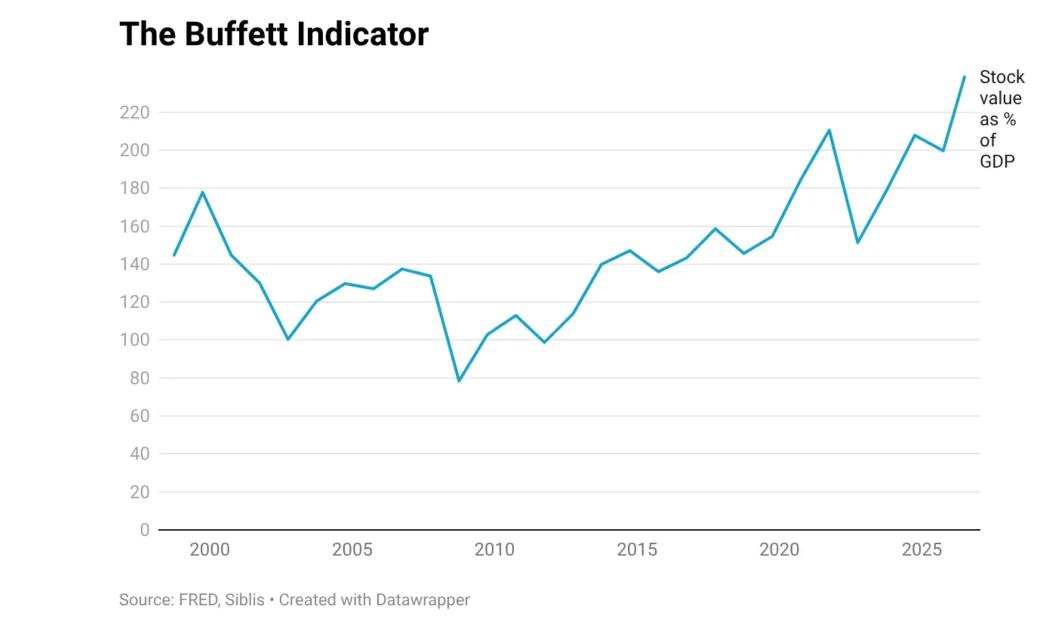
Part of the disagreement is which ruler you use. Krugman points to the “Buffett indicator,” the value of all U.S. stocks against GDP, which he says was “well above its level at the peak of the dotcom bubble” before the drop. A return to 2019 levels would erase about $25 trillion of wealth, roughly 80% of GDP, he estimates.
Paul Krugman
Kelly uses earnings. After the selloff, the S&P 500 trades at 17.1 times forward earnings, below its 10-year average of 19.1 and far below the dot-com peak of 25.2. By his count, 84% of S&P companies beat earnings estimates last quarter, according to FactSet.
Kelly, for his part, says he has seen this movie: the dot-com bust “triggered the recession of 2001.” His forecast is that this time the expansion reaches its eighth year in April 2027. In 2000, the recession took about a year after tech stocks peaked to arrive.
https://fortune.com/img-assets/wp-content/uploads/2026/11/GettyImages-2306040803-e1795453441718.jpg?resize=1200,600
https://fortune.com/2026/11/23/ai-bubble-krugman-stoller-dean-baker-wall-street-recession-wealth-effect/
Nick Lichtenberg





