
[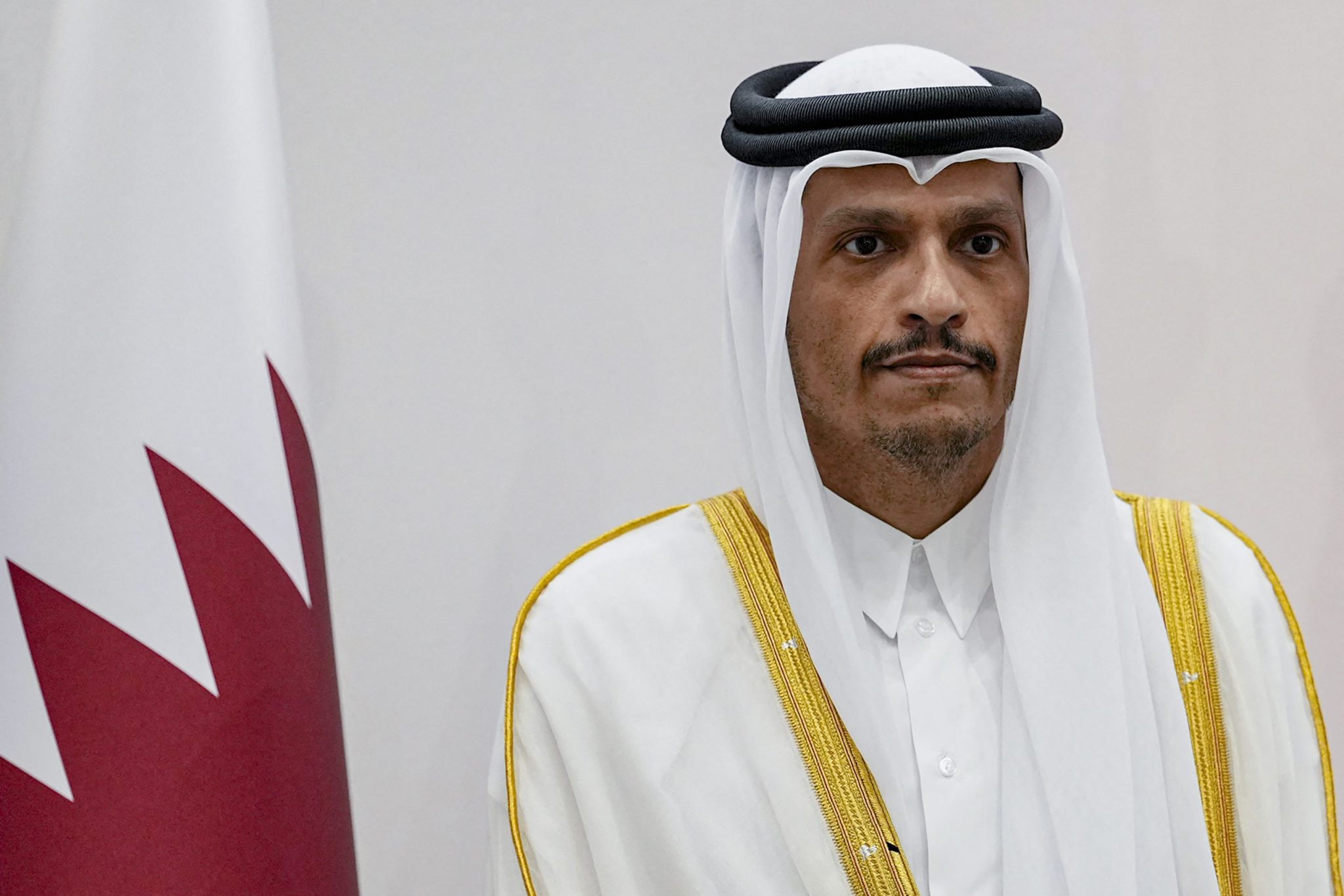
Qatar continued its diplomatic push to broker an end to the U.S.-Iran war this week, but prospects of a breakthrough remain uncertain.
On Tuesday, a Qatari government spokesperson said that Monday’s closed-door talks between the U.S. and Iran were “focused on making progress”, but that the timeline for a potential agreement remained unclear.
“We cannot say how close or how far away an agreement is,” Ibrahim bin Sultan Al Hashmi, director of the foreign ministry’s media and communication department, told a weekly briefing in Doha.
His remarks followed those of Qatari Prime Minister Sheikh Mohammed bin Abdulrahman Al Thani who described his White House meeting on Monday with U.S. President Donald Trump and Vice President JD Vance as “positive”.
Emerging from the latest round of shuttle diplomacy, Al Thani said he was “Grateful for the positive discussions on reaching a deal and bringing peace to the region.” Before Al Thani’s visit to Washington, Qatari officials had held talks in Tehran as well as consultations with other regional governments.
On Tuesday, Al Thani made an unscheduled stop at the G7 foreign ministers meeting in Paris where top European diplomats have reportedly been pressing U.S. Secretary of State Marco Rubio to avoid any new escalation against Iran.
Trump, meanwhile, took to Truth Social to argue that Qatar, Saudi Arabia, Kuwait and the UAE “would prefer the status quo”, referencing both the US naval blockade and restrictions on Iran’s overland trade under Operation Iron Gate. Echoing Qatar’s comments, he said: “We are seeing positive momentum toward an end to this conflict” but warned that the U.S. is “locked and loaded” should there be any changes in regional developments, adding “that seems to be quite unlikely”.
Speaking at a geopolitical forum in Abu Dhabi on Monday Anwar Gargash, diplomatic advisor to UAE President Mohamed bin Zayed, said: “We should prepare for a long period of uncertainty in which neither a decisive resolution nor stable regional order can be taken for granted.” This would require the UAE to invest in its defensive capabilities and stronger international security partners, he said.
The number of attacks on commercial shipping in and around the Strait peaked in October, reaching its highest monthly level since the U.S.-Iran war began, with more than 30 incidents recorded, according to the U.K. Maritime Trade Operations.
On Tuesday, GCC defence ministers approved plans to establish a joint command center in Kuwait, with member states contributing forces to strengthen military integration across the six-nation bloc.
The advanced command will form part of the existing Unified Military Command which is headquartered in Riyadh. However, the announcement offered no details on the number or composition of forces to be assigned, the command’s specific mandate or when it would become operational.
The continuing uncertainty did not deter Barclays from opening its new office in Riyadh’s financial district on Monday. It marks the U.K. lender’s return to the market after more than a decade as it seeks to expand its Gulf business. Barclays’ Asia-Pacific CEO Jaideep Khanna told Bloomberg last month that the bank was a “big believer” in the Middle East.
Riyadh’s business district has been under remote work orders for about a month, while ongoing travel restrictions continue to create additional challenges for commuting from nearby Gulf hubs, as well as for global executives flying directly into the kingdom.
Melissa Hancock
As ever, thanks for reading, and do keep in touch with your thoughts and ideas.
melissa.hancock@fortune.com
EMIRATES’ PROFITS HIT TURBULENCE
Iran-U.S. war clouds Emirates’ financial performance
Emirates Group’s profits fell 66% for the April to September period as the U.S.-Iran war reduced passenger demand and drove up global jet fuel costs.
The Dubai-headquartered airline made a profit before tax of AED 4.1bn ($1.1bn) in the first half of its 2026-27 financial year, compared with the AED12.2bn ($3.32 billion) it made in the same period last year.
The airline carried 21.8 million passengers, 22% fewer than a year earlier while available seat kilometers—the industry’s standard measure of passenger-carrying capacity—fell 17%.
Cargo operations helped to cushion the decline, with Emirates SkyCargo transporting 1.2 million tons over the six-month period. While this represented a 1% decline year-on-year, it still translated to a 52% increase in revenue, as the war prompted more shipping companies to turn to air transport.
Emirates fuel price risk management strategy significantly offset the impact of a 60% jump in fuel prices. Gains of AED 7.1bn ($1.9bn) from fuel hedging cut the net increase in costs to 13% but fuel remains the largest component of the airline’s operating cost at 34%.
Emirates had restored operations across 91% of its network by the end of September, serving 150 airports in 78 countries and territories. At the end of March, it was flying at 58% of its passenger capacity to 122 destinations in 65 countries.
While other airlines’ operations have been affected by regional airspace restrictions and travel advisories, Emirates has stepped in to meet passenger demand.
In total, 11 airlines, including some of Emirates’ key rivals, currently maintain suspensions on flights to Dubai. Last week, British Airways resumed direct flights to Dubai after an eight-month suspension.
MIND THE DIGITAL GAP
Mobile World Congress Doha puts MENA’s digital divide center stage
The great and the good of the telecommunications industry gathered in Doha this week to attend the second Gulf annual Mobile World Congress.
The event opened with a call to action from H.E. Mohammed bin Ali al-Mannai, Qatar’s minister of communications and information technology, to align global industry standards and bridge the Middle East and Africa’s connectivity gap.
Almost half (48%) of MENA’s population used mobile internet in 2025, according to a GSMA report released at MWC Doha. However, 49% remained offline despite living within coverage.
Mobile connectivity is quickly becoming a core pillar of the region’s economic diversification, with the Gulf being home to some of the world’s most advanced 5G markets.
Mobile technologies and services, which generated $380 billion of economic value across MENA in 2025, equivalent to 5.8% of regional GDP, are forecast to reach $470 billion by 2030.
Meanwhile, 5G is expected to account for 40% of regional connections by 2030, up from 9% in 2025, as mobile operators invest a forecast $88.9 billion over the five-year period.
DUBAI’S DIGITAL LEAP
Banking on innovation: Dubai doubles down on its ambition to become a global fintech hub
In just under a decade, the Dubai International Financial Centre (DIFC) has become a hub for innovation and is now home to more than 2,000 AI, fintech, and technology companies—a sizeable leap from just 11 startups that joined its accelerator in 2017.
FinTech Hive is both the region’s first and largest financial technology accelerator and has played a key role in modernizing the emirate’s financial sector.
HSBC, BNP Paribas, Bank of America, Morgan Stanley, Standard Chartered, Visa, Ripple and Network International, were among the major names who attended Dubai Future Finance Week last week, a five-day event that incorporated the two-day Dubai FinTech Summit.
DIFC announced a strategic partnership with Japan’s Mizuho Financial Group to support the international expansion of Japanese startups and deepen economic ties between the UAE and Japan. The partnership will give up to 6,000 Mizuho startup clients access to DIFC’s Innovation Hub.
DIFC also announced plans for a Dubai Fintech Stack to support founders with payments, onboarding, risk, financial security and AI integration.
Speaking as part of a headline session at Dubai FinTech Summit, Noel Quinn, chair of the wealth manager Julius Baer and former group CEO of HSBC, predicted that AI is set to become an integral part of every bank’s technology stack, particularly in monitoring payments for potential money laundering and sanctions violations.
You can read my article here which takes a closer look at how UAE banks are embedding AI into their operations
The Big Number
$67 billion
ADIPEC 2026, Abu Dhabi’s flagship annual energy conference, concluded last week, with more than 50,000 deals worth an estimated $67 billion signed over four days. ADIPEC 2025 saw $46 billion in deals signed over the course of the event.
The 3 things we enjoyed reading this week
- Before the Iran war, the Gulf’s biggest challenge was reducing its dependence on oil. As Bloomberg Economics’ Ziad Daoud argues, the region must now pursue diversification on three fronts: developing economies beyond hydrocarbons, broadening its security partnerships beyond Washington, and establishing alternative trade and energy routes to the Strait of Hormuz. Gulf states are already exploring new industries, regional alliances, and infrastructure, but failure to address these vulnerabilities could have consequences far beyond the region.
- U.S. technology company Gecko Robotics is deploying advanced wall-climbing robots across ADNOC energy facilities to help identify structural damage and weaknesses in energy infrastructure, particularly following attacks on Gulf assets. Its new Raptor robot uses sensors and sound waves to inspect facilities, collecting millions of data points up to three to five times faster than its predecessor, while allowing operations to continue uninterrupted, reports The National. The technology could significantly accelerate damage assessments and repairs, with the company claiming it can reduce data collection costs by up to 50 times. Gecko is also considering manufacturing the robots in the UAE, reflecting the Gulf’s growing focus on robotics, AI, and locally developed technology to strengthen energy security and infrastructure resilience.
-
Yemen’s Iran-backed Houthis have effectively imposed their own shipping controls in the Red Sea through an often-overlooked application system for captains seeking transit clearances. The process is surprisingly simple: email the rebels. This Wall Street Journal investigative piece does a deep dive into how, in early 2024, the Houthis set up the Humanitarian Operations Coordination Center, an administrative body responsible for processing shipping applications and communicating the group’s sanctions. The Houthi militants, if they choose to reply, will typically do so within 24 hours, according to crew members and emails seen by the Journal. It provides an example from September when the Houthis approved passage for the Zhong Cheng Chang Ling, a Chinese containership, which sailed through the Red Sea without incident.
https://fortune.com/img-assets/wp-content/uploads/2026/11/GettyImages-2282682509-e1794392762224.jpg?resize=1200,600
https://fortune.com/2026/11/11/qatar-signals-progress-on-iran-deal-but-gulf-fears-persist/
Melissa Hancock





