
[
An old mattress showroom on San Francisco’s Van Ness Avenue has recently taken on a new life. Instead of rows of springy California kings, queens, and twin XLs, the space now hosts six-foot-tall humanoid robots—some armed with steel claws—who square off in a small arena to thrash each other with clangy superhuman force. These metal-on-metal cage fights, put on by REK (Robot Entertainment Kombat), inspire a passionate fan base.
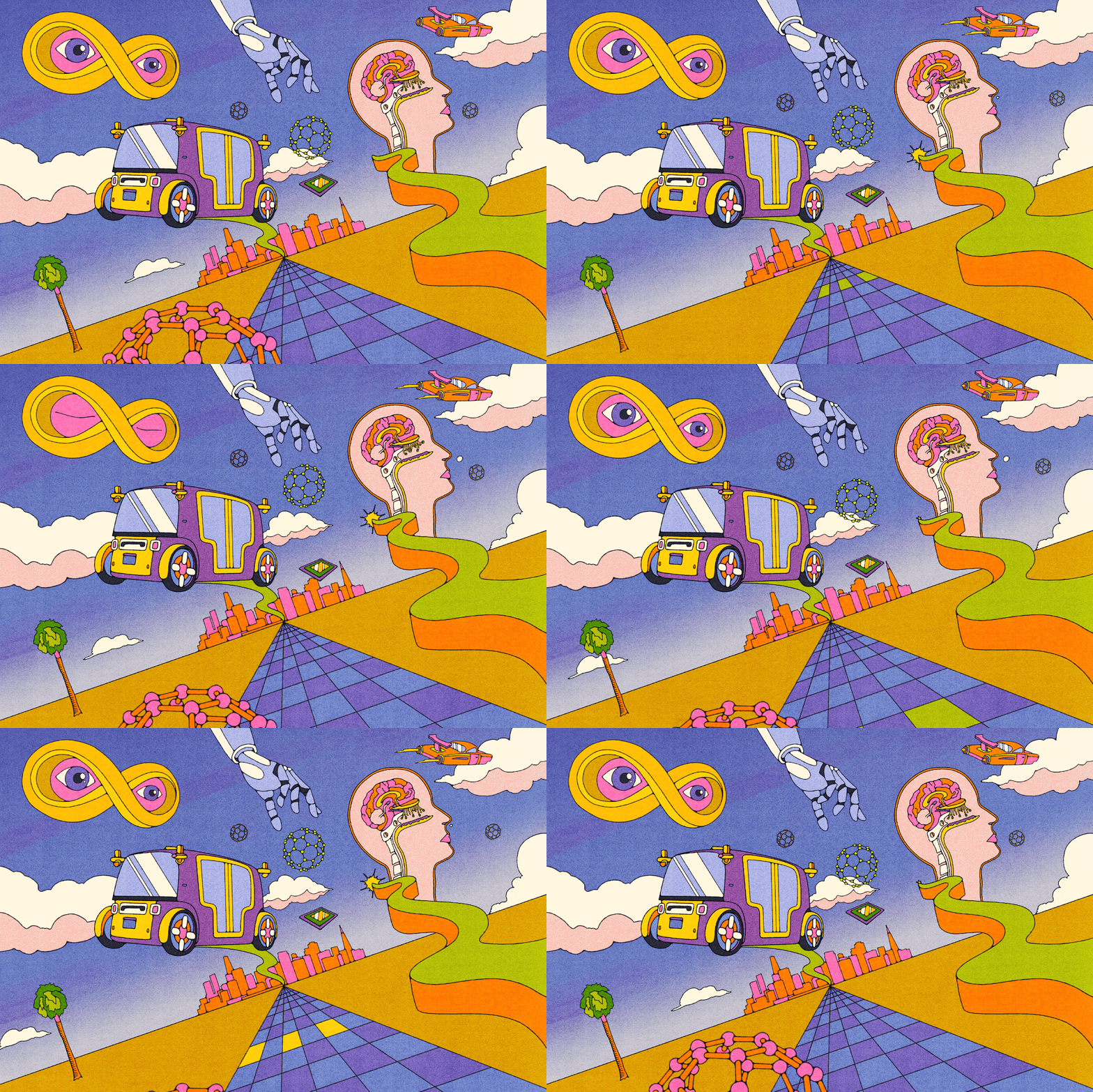
Things are moving fast in America’s tech capital. For now, only the mattresses have been displaced. But in a city intent upon reengineering everything from work to the human brain, perhaps one day sleep itself will become outmoded. As we adapt to always-on AI agents and cerebral chip implants, it’s getting harder to know which parts of this imagined future to laugh at, and which to prep for.
Even the workers at AI companies can’t keep up with the blizzard of competing model versions being launched every day. Startups are mixing hardware, software, and biotech, blurring the line between science fiction and the next funding round.
I recently visited a startup in Palo Alto called Subsense that’s developing a brain-computer interface, NanoBCI. The field has been heating up ever since Elon Musk’s Neuralink proved that a wireless computer chip placed on the brain can turn a person’s thoughts into actions.
But while having telekinetic powers would undoubtedly be cool, most people don’t want holes drilled in their skulls. That squeamishness is what Silicon Valley techies call a “barrier to adoption.” And it’s why Subsense is developing a different approach: snorting nanoparticles through the nose, to be controlled via metal receptors in a cap that looks like a cross between a baseball cap and a bike helmet.
Ray Kurzweil, the futurist who popularized the concept of “the Singularity”—the moment when AI overtakes humanity’s intelligence and humans transcend our biological limitations—works with Subsense as an advisor. At 78, Kurzweil still sounds bullish on AI’s ability to improve life for humans and even to help us reach “longevity escape velocity” by 2032. “We can actually speed up the brain itself; that’s the ultimate goal,” he explained, and held up his smartphone: “[We’re] trying to get this inside the mind. I’m sick and tired of losing this in the bathroom!”
And really, who’s to say we won’t have nanoparticles swimming through our brains in a couple of years? Or that we won’t crack the code for immortality? Irrational exuberance is hardly new to San Francisco, a city whose football team, the 49ers, is named for a literal gold rush. We have entire ecosystems devoted to dreaming up the next boom, financing it, and—if it goes bust—cleaning up the mess. We’re used to this.
Still, there’s something disorienting about living in San Francisco right now, especially if you’re covering the tech scene. There’s a cartoonish futurism to everyday life—making the line between Silicon Valley and a satire of Silicon Valley harder and harder to find. Self-driving cars deftly weave around cyclists without anybody at the wheel. Billboards urge employers to “stop hiring humans”—while one company is reportedly offering $20 an hour for humans to “walk” robot dogs, training them to navigate city streets. Even the coffee comes with a startup partnership: At Corgi Cafe, you can order a “Coretado” co-branded with CoreWeave or a “Sip It and Ship It” by Pendo. What once seemed preposterous is increasingly mundane.
In past booms, even the wildest ideas were grounded in some shared conception of reality. The internet was a novel idea, but it didn’t defy our understanding of nature or consciousness. The leap of faith back then was about whether the concepts and technologies being hatched and pumped to life with massive infusions of money were sound and viable. When the dotcom bubble burst, it was the business models that collapsed, not our understanding of how the world worked.
Some of the smartest people on the planet are here in San Francisco, working at OpenAI, Anthropic, and other companies building the large language models that underpin generative AI. But even those smart people admit they’re not really sure how the technology actually works. The models are a black box. They can pull levers and turn dials, but the essence of what’s inside—the ghost whirring through machines in data centers several states away—remains a mystery.
That disconcerting fact explains a great deal about the reality distortion that inflects life in San Francisco these days. The usual tools for separating a genuine breakthrough from a sales pitch—the experts, the safeguards, the well-calibrated BS detector—can feel unequal to the task, and there’s no upgrade available yet. Meanwhile, the questions keep getting bigger and more existential: Is AI conscious? Does it suffer? Can it advance itself without human controls? Can we trust it not to kill us all?
When the Anthropic cofounders, in their IPO letter to investors, described an incipient “age of miracles,” they may have hit upon a deeper truth than they intended. Miracles are about faith, rather than understanding. Silicon Valley’s problem-solvers and future-builders have prided themselves on understanding how things work and seeing what’s coming next before the rest of us do. Now, even they struggle to comprehend what they have built, or what it will do. In Silicon Valley, faith may be all we’re left with.
This article appears in the December 2026/January 2027 issue of Fortune with the headline “A dispatch from the ‘reality distortion field’ of the AI boom.”
https://fortune.com/img-assets/wp-content/uploads/2026/11/Fortune_AI-Boom-animated-web-smaller-1.gif?resize=1200,600
https://fortune.com/2026/11/18/san-francisco-silicon-valley-ai-boom-humanoid-robots-brain-computer-interfaces/
Alexei Oreskovic





