
[
Investors were less sure. Nvidia shares fell as much as 8.8% on Monday and closed down about 4.3%, wiping roughly $190 billion off the market value of a company that ranked as the most valuable on the 2026 Fortune 500.
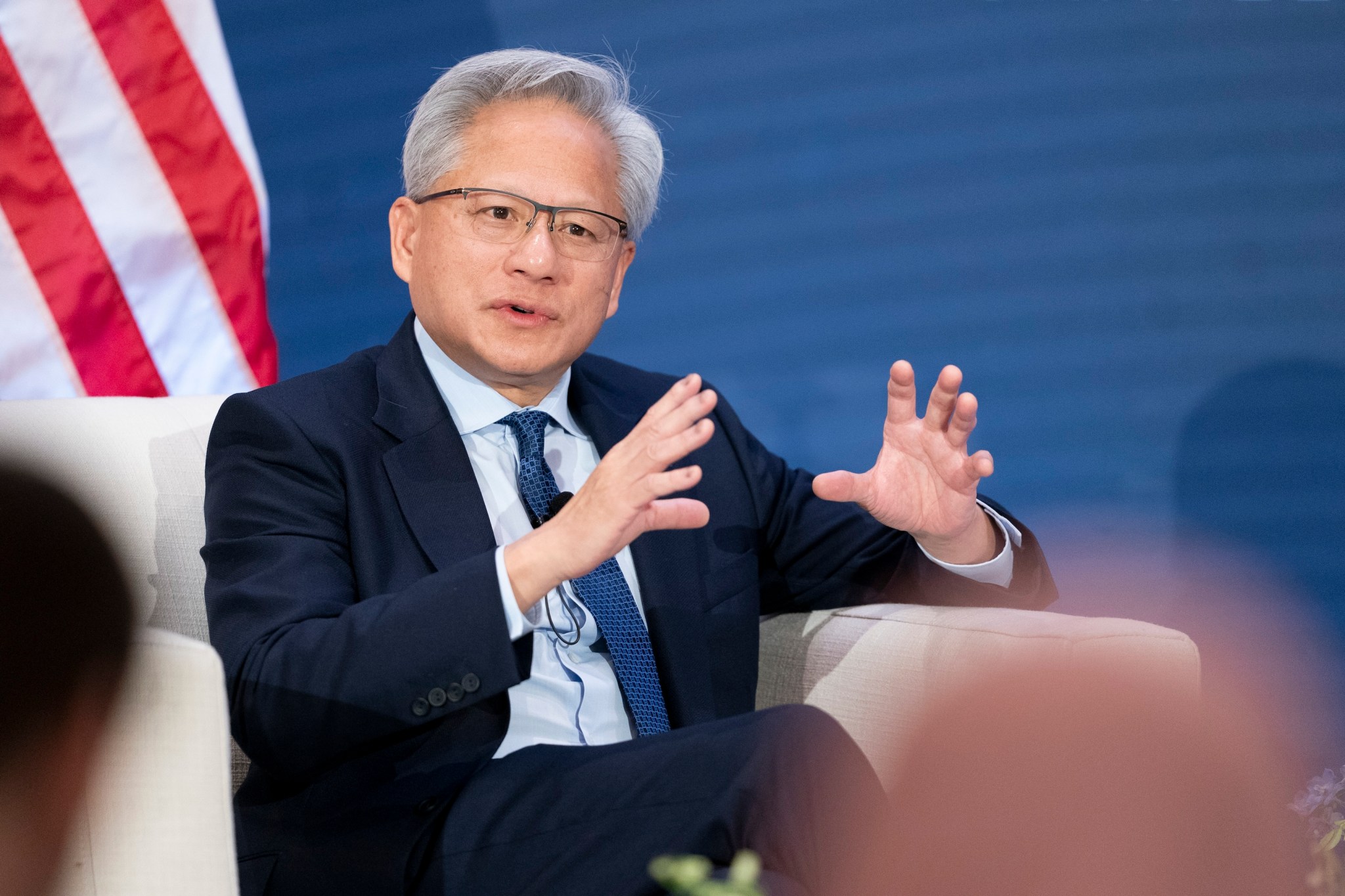
For most CEOs, that sounds like the kind of week that ends with a resignation letter. But at Nvidia, even removing the CEO could be complicated.
“In most cases of scandal at major corporations, the CEO is either replaced or put on leave while investigations are carried out and appropriate responses decided,” Jo-Ellen Pozner, an associate professor of management at Santa Clara University’s Leavey School of Business, told Fortune.
Nvidia’s board faces two problems. It may be reluctant to force out the man who built the company, and even if it wanted to, there is no obvious successor.
“I don’t expect a ‘stay or go’ decision. It will be more like a ‘stay, with less,’” Jason Schloetzer, an associate professor of accounting at Georgetown University’s McDonough School of Business, told Fortune.
Schloetzer said the board could appoint a clear second-in-command, communicate more openly about succession planning, and reshuffle board seats to signal stronger oversight. Huang would remain CEO, but under closer supervision
A flat org chart with no obvious heir
At a typical large corporation, the board oversees the CEO and succession planning, while layers of senior management provide potential replacements. Nvidia operates differently.
Huang has built an unusually flat management structure, with dozens of direct reports and few layers of hierarchy. Pozner calls it “an extremely unusual organizational structure.” It has kept Huang at the center of the company since its founding in 1993.
“I also imagine that he did it in part to prevent politics and political factions within the organization,” Pozner said. That model can work well at a small organization, she explained, but Nvidia has outgrown it.
“There needs to be disagreements and productive conflict and things like that,” she added. Over time, she said, the structure “had the effect of suppressing the emergence of potential successors, probably diminishing conflict and consolidating power in the hands of Jensen Huang.”
Nvidia has not publicly identified a successor. Pozner said promoting an insider would be risky because investors, regulators and business partners would be looking for credibility and stability. That leaves bringing in an outsider, which carries risks of its own.
A ‘captive board’ with decades of ties to Huang
Finding a replacement is only half the problem. The other half is whether Nvidia’s board would be willing to remove Huang at all.
Nvidia has no board chair, a position typically responsible for leading the board and overseeing management. Instead, Huang works with lead independent director Stephen Neal to set board meeting agendas, while management prepares the information presented to directors, according to the company’s filings. Neal can also convene meetings of independent directors without Huang.
Of Nvidia’s 11 board members, three, including Huang, have served continuously since the company’s founding in 1993, while another joined in 1997. A fifth director, Mark Stevens, served from 1993 to 2006 before returning in 2008, according to the company’s 2026 proxy statement.
Although Nvidia classifies all directors other than Huang as independent, Pozner questioned whether their longstanding relationships and the company’s governance structure could affect their willingness to hold him accountable.
“They’ve become billionaires because of their affiliation and ownership of this company. And just working together with the same CEO since the inception of the organization makes it impossible for them to act as outsiders,” she said.
The board’s Sunday statement said a committee of independent directors, with help from outside counsel, would oversee the investigation. It said it had expressed confidence in Huang before that work was completed and that the board had no reason to believe national security or Nvidia’s secrets had been compromised.
“It is unclear that a captive board like this—which in some ways is not unlike Tesla’s—has the heart to question, censure, or sanction Huang, and it is doubtful that it has taken succession planning very seriously,” Pozner said.
Washington, the FBI, and a shareholder lawsuit
The controversy has also produced something rare in Washington: bipartisan agreement. On Monday, Sen. Elizabeth Warren (D., Mass.) and Sen. Jim Banks (R., Ind.) issued a joint statement calling for answers from Nvidia and tighter restrictions on advanced AI chip exports to China.
Nvidia and Huang are also being sued in a proposed shareholder class action that alleges they misled investors about Huang’s ties to Alice Huang. And President Trump said the FBI was looking into the nature of the relationship.
For now, Nvidia is standing behind its CEO. A company spokesperson told Axios that Huang was committed to continuing as CEO without interruption.
Some investors are equally reluctant to see him go. Michael Monaghan, a partner at Founder ETFs, told Axios that his firm would sell its Nvidia holdings if Huang departed, calling him in some ways “irreplaceable.”
“We don’t really believe there is such a thing as succession in these massive founder-led companies,” Monaghan said. Prediction markets lean the same way: Polymarket traders put the odds of Huang resigning or being removed by year-end at 16%, Fortune reported.
Why ‘stay, with less’ may be the likeliest outcome
Keeping Huang doesn’t necessarily mean business as usual.
A failure to be candid with the board, however, could still cost Huang his job.
“Boards remove CEOs over candor issues,” Schloetzer said. “What did he tell the directors, and when? Can he be trusted with board communications going forward?”
If Huang does leave, Pozner questions whether Nvidia’s current board is equipped to choose his successor. “I think it was very short-sighted and is exacerbating the danger that Nvidia is in,” she said.
She suggested that several long-serving directors could accept some accountability for a governance failure and step down. Replacing them with experienced directors from outside Silicon Valley, she said, would create a board capable of making the tough call on a successor.
Such a board, Pozner said, would be capable of “selecting the right successor—even if they plan only a temporary substitution—to weather the coming storm.”
https://fortune.com/img-assets/wp-content/uploads/2026/11/GettyImages-2292610034.jpg?resize=1200,600
https://fortune.com/2026/11/11/nvidia-board-directors-jensen-huang-captive-board/
Bilin Lin





