
[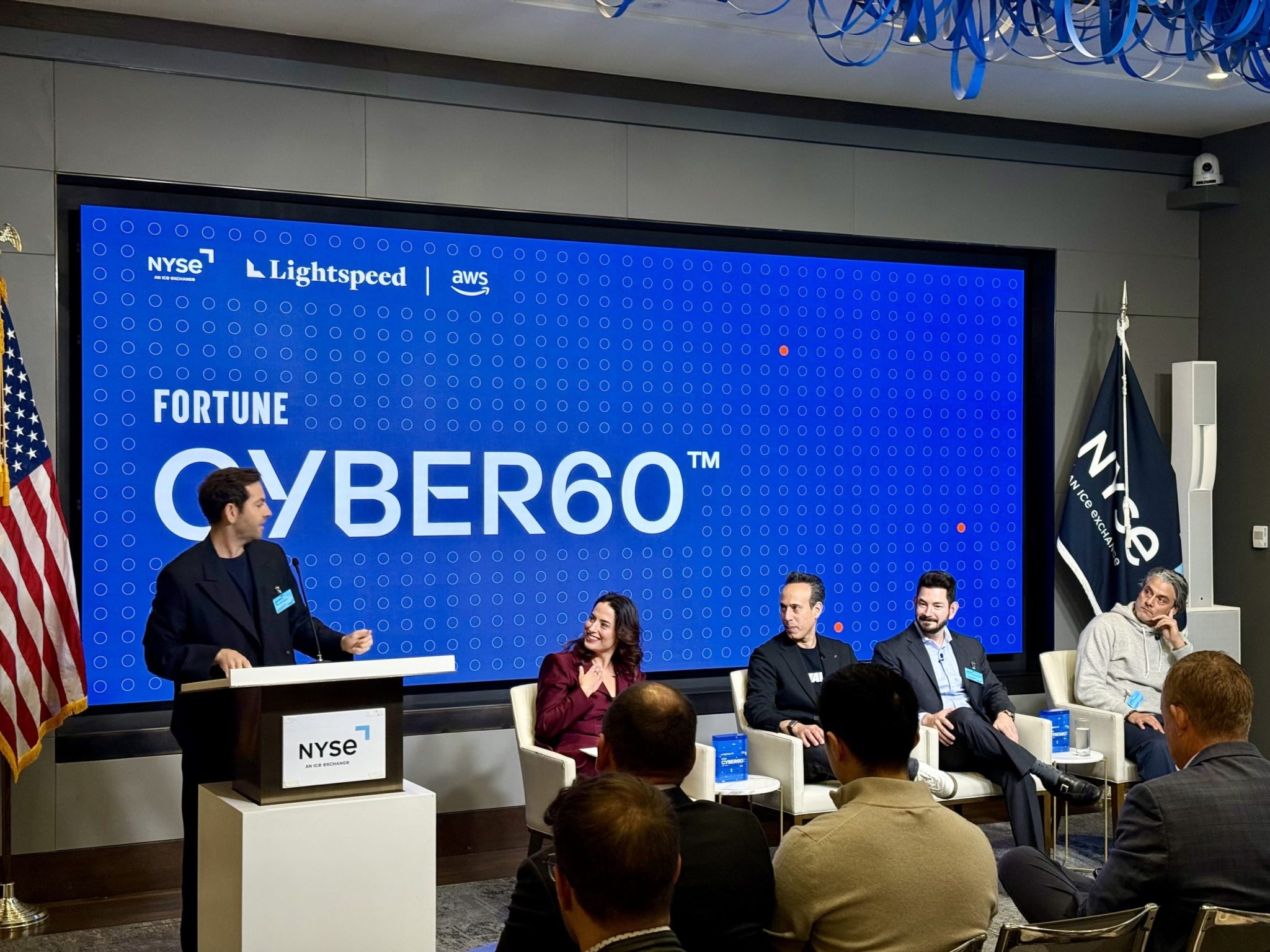
In cybersecurity, that’s reality right now, Evan Peña, cofounder and chief offensive security officer at startup Armadin, told me onstage Wednesday at Fortune, Lightspeed, and AWS’s Cyber 60 event.
“I definitely think the attackers are winning right now,” said Peña, listing recent headline-grabbing cyber vulnerabilities. “Look at the last few weeks: You have Citrix, BeyondTrust, PHP, Node.js, all within a three or four week window. These are unprecedented emerging threats… [Using AI] attackers can now scan the entire external attack surface of a Fortune 500—over 10,000 externally facing systems—within hours. Humans could never scale like that…. What you can do in hours would have taken us a year. The scale and speed are just unparalleled.”
Speed, scale, and high stakes have been the story of cybersecurity in 2026, from the much-discussed cataclysm the rise of Mythos promised to OpenAI agents’ attack on Hugging Face.
“We’re living in a continuum,” said Lior Div, cofounder and CEO of 7AI, on one panel. “…The gap between events is going to shrink and shrink and shrink.”
Yesterday’s event, held at the New York Stock Exchange, marked the release of the 2027 Cyber 60, Fortune’s annual list of cybersecurity’s most innovative startups. The companies acknowledged include longtime Term Sheet mainstays like open source security juggernaut Chainguard, new names on the list like frontier AI security company Irregular, and honorable mentions like data loss prevention startup Jazz. Bringing many of these startups together, the message was clear: AI is the best tool an attacker could ever hope for.
“The biggest thing is the attackers have no barriers,” Nick Schneider, CEO of cybersecurity unicorn Arctic Wolf, said onstage. “An organization has to go through change control. They have to get budgets, convince their teams, convince their boards. Many organizations weren’t built AI-native. They weren’t built to operate at the speed of bad actors. Bad actors don’t care: They’ll carry out the attack en masse, and if they don’t get anything, no big deal, they move on to the next one.”
Our digital world, in short, has changed for good—and a whole lot of work lies ahead.
“We’re living in a very vulnerable world,” said 7AI’s Div. “Everything is vulnerable, and you can hack everything. The idea that you have a perimeter that can’t be penetrated just isn’t true.”
See you tomorrow,
Allie Garfinkle
X: @agarfinks
Email: alexandra.garfinkle@fortune.com
Submit a deal for the Term Sheet newsletter here.
Joey Abrams curated the deals section of today’s newsletter.
VENTURE CAPITAL
– Upwind, a San Francisco-based provider of cloud and AI security software, raised $400 million in Series C funding. Bessemer Venture Partners led the round and was joined by Greylock Partners, Cyberstarts, Craft, Salesforce Ventures, and others.
– Foundry Robotics, an Emeryville, Calif.-based builder and operator of autonomous assembly factories for defense and commercial industries, raised $100 million in Series A funding. Marlinspike Partners led the round and was joined by Khosla Ventures, Red Glass Ventures, and others.
– Lumaril, a New York-based developer of AI software for optimizing industrial production, raised $66 million in Series A funding. Elad Gil led the round and was joined by Felicis, Koch Disruptive Technologies, Pax Ventures, Lux Capital, and General Catalyst.
– Plato, a San Francisco-based developer of workplace simulations for AI training and evaluation, raised $16 million in Series A funding. Nava Ventures led the round and was joined by Gradient Ventures and others.
– Rocker, a developer of AI assistants for enterprise workers, raised $12.9 million in funding. Greycroft led the round and was joined by Anthropic, Menlo Ventures, Matchstick, Stripe, and angel investors.
– Blue Arbor Technologies, a Grass Lake, Mich.-based developer of neuromuscular interfaces for prosthetic limb control, raised $10.5 million in Series A funding. Ottobock led the round.
– Sava, a New York City-based provider of AI-powered trust administration services, raised $10 million in seed funding. Gradient Ventures led the round and was joined by Y Combinator, SV Angel, and others.
– Omabit, a San Francisco-based developer of AI software for scientific analysis and drug development decision-making, raised $2 million in seed funding. Bright Ventures led the round.
PRIVATE EQUITY
– Numeracle, a McLean, Va.-based provider of business identity verification and communications trust software, raised $28 million in growth funding led by Edison Partners.
– Burns Engineering, backed by OceanSound Partners, acquired PRVN Consultants, an Iowa City, Iowa-based engineering firm serving the district energy, power generation, and combined heat and power markets. Financial terms were not disclosed.
– Equiti, backed by GTCR and Heritage Group, acquired Lexi AI, a Cambridge, Mass.-based developer of AI-powered healthcare language interpretation software. Financial terms were not disclosed.
– Exponent agreed to acquire Crane Building Services & Utilities, an Ipswich, U.K.-based manufacturer of engineered flow control products for utility and building systems. Financial terms were not disclosed.
– Officine Maccaferri, backed by Ambienta, acquired Metallurgica Irpina, an Ariano Irpino, Italy-based manufacturer of steel wire, wire mesh, and fencing systems for infrastructure, industrial, and agricultural applications. Financial terms were not disclosed.
– Orangewood Partners acquired a majority stake in Refrigerated Solutions Group, a Hudson, Wis.-based manufacturer of commercial walk-in coolers, freezers, and refrigeration systems. Financial terms were not disclosed.
– Platinum Equity agreed to acquire EDP, a Chicago-based distributor of propane and light fuels serving residential, commercial, and agricultural customers. Financial terms were not disclosed.
EXITS
– CoStar Group agreed to acquire Vexcel, a Graz, Austria-based provider of aerial imagery and geospatial data, from Riverwood Capital, for approximately $730 million in cash.
PEOPLE
– Eclipse, a Palo Alto, Calif.-based venture capital firm, promoted Ryan Gibson and Michael Laser to partners.
– Franchise Equity Partners, a New York City-based private equity firm, hired Chris Holzshu as an operating partner. He was previously executive vice president at Lithia & Driveway.
https://fortune.com/img-assets/wp-content/uploads/2026/10/4664C425-7A64-4B9C-927F-AA7DC3133307_1_201_a-e1793223940494.jpg?resize=1200,600
https://fortune.com/2026/10/29/attackers-winning-cyber-60-founders-ai-giving-hackers-upper-hand/
Allie Garfinkle




