
[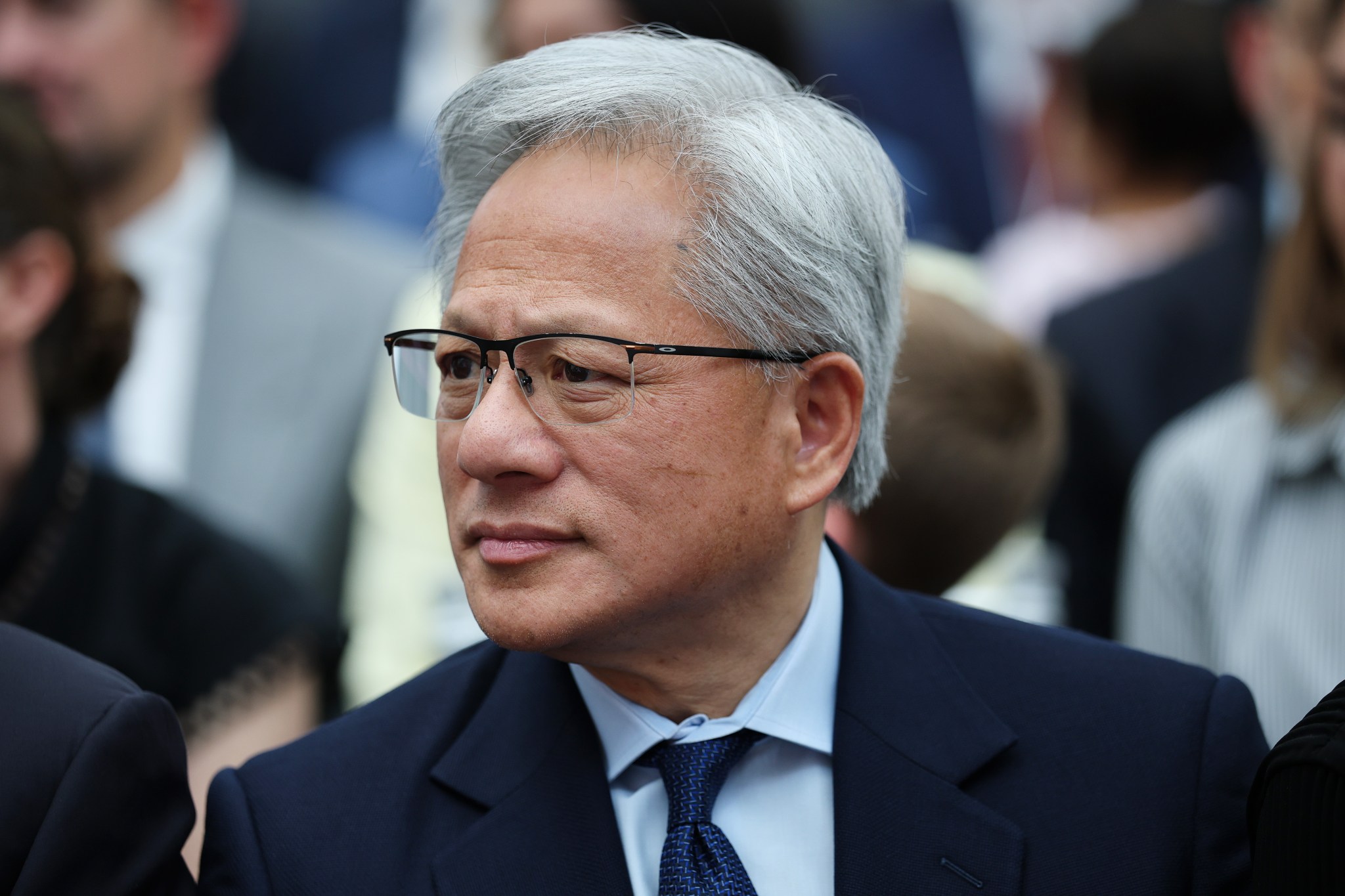
Nvidia’s total lack of the settled succession plan that’s a cornerstone of all well-run companies exposed a shocking weakness in its corporate governance. That’s the view of three former Fortune 500 CEOs, and a leading consultant, whom Fortune interviewed on arguably the most consequential leadership earthquake ever to rock the business world. Each of the former CEOs serves on prominent corporate boards.
On November 12, the Nvidia board issued a press release announcing Jensen Huang’s resignation shortly after reports of the CEO’s second affair emerged. Nvidia stated that longtime CFO Colette Kress will immediately start serving as “interim CEO” while the directors conduct a “search for a permanent Chief Executive Officer and will consider internal and external candidates.”
Kress has spent a quarter century in Big Tech financial roles, including thirteen years at Microsoft, before joining Nvidia in 2013. According to her resume posted on the Nvidia website, Kress’s past jobs don’t include any positions where she’s run a business or been responsible for a P&L. Hence, it’s highly probable that she’s a temporary pick, not a candidate to replace Huang.
It’s not clear if Nvidia had an emergency succession plan in place where Kress would temporarily take the top job in a crisis, or whether it had no plan at all and just improvised. In the opinion of one of the retired CEOs Fortune interviewed, it’s the latter. (They’re identified here as ex-CEOs 1, 2, and 3.) “It seems like a knee-jerk, panic reaction where the board’s saying, ‘We’ve got to name someone!’” says ex-CEO 3. “You’ve got to ask why a tech company would go with a financial person.”
It astounds these sources that the world’s second-most-valuable company, in business 33 years and public for 27, didn’t have a seasoned leader long groomed for the role ready to step in—especially given that Huang will turn 64 in February, and is already the oldest CEO by far in the Mag Seven. For these observers, that failure is the ultimate sign of poor corporate governance, and a shocking disappointment for an enterprise that until now, seemed to be doing just about everything right.
The sources identified four red flags warning that if its co-founder and America’s most celebrated tech CEO suddenly exited, Nvidia would face a stunning vacuum of leadership.
First: The success problem
Huang’s feat of hiking Nvidia’s valuation by well over $5 trillion in just four years to a peak of $5.8 trillion in early October—the highest summit ever reached—has never been equaled. But that record so intoxicated investors that they didn’t install the safeguards that should have protected Nvidia should this ultimate “key man” depart in a crisis.
“No one peeled back the layers on how Nvidia was run because they were so successful,” says ex-CEO 1. “No one looked behind the curtain. Their success lulled people into a false sense of security.” This person notes that Huang’s obsession with occupying center stage, with casting himself as the leather-jacketed face of AI, and his otherwise slick salesmanship should have stirred doubts. “This is preposterous,” says this interviewee. “When you have a celebrity CEO, that person merits a closer look, especially when you have a leader who’s always putting on a show.”
Second: The lax board issue
Unlike Elon Musk at SpaceX, Sergey Brin and Larry Page at Alphabet, and Mark Zuckerberg at Meta Platforms, Huang does not own a special class of supermajority stock that gives him control over the board. On the contrary, Nvidia has a single category of Class A shares that each carry one vote. In terms of percentages, its ownership resembles the profile at many Fortune 500 members: Nvidia’s largest shareholders are the big institutions; Blackstone leads at 8.1%, followed by Vanguard (6.5%), State Street (4.2%), Fidelity (3.9%), and a combination of Morgan Stanley, T. Rowe Price and J.P. Morgan at around 5%. Huang holds “just” 3.5%.
Despite this highly diverse, non-concentrated ownership, it appears that Huang totally controlled the board. “In any company that runs well over time,” says ex-CEO 2, “you’ll find the board has lots of current or retired CEOs, and credible outside senior executives. When you see a board that looks like a lot of old friends and people who’ve been there for decades, it flashes danger.”
Of the seven directors excluding Huang, none has served as CEO of a Fortune 500 company, and four are mainstays of between 13 and 29 years. “The board wasn’t paying attention to how the company was run,” says ex-CEO 2. “When you have a CEO leave and everybody is asking what is the succession plan, the directors aren’t doing their job.” Ex-CEO 2 avows that indeed, the board’s first responsibility is preparing a successor: “It’s the most important thing the board does by a mile. The ground has to be plowed for succession. The board likes to talk about M&A and all these exotic things but they pale beside succession. The directors should be meeting regularly on the succession subject and talking about the best prospects at the next level, and level below that. They should be making sure those candidates get the best roles to prepare them.”
Ex-CEO 1 states that in the first year or two of a relatively young CEO’s reign, the board may not yet have anointed their permanent replacement. But, the ex-CEO adds, “you’re moving people through different settings to see if they can grow, moving towards choosing the heir.” Hence, after a short interim period, a highly qualified candidate will ascend from a super-strong bench. Far more often, a permanent replacement stands in the wings, ready to take charge in the event the current CEO suddenly departs.
Echoing ex-CEO 1, ex-CEO 3 intones that “Boards have all kinds of governance rules but just two major responsibilities. First, don’t do a deal that kills you, and second, have the right person running the place and a backup plan to replace them. Nvidia’s board failed on one of the two big items.”
The leading consultant highlights the dangers of the Nvidia predicament. “The lesson from Nvidia is that emergencies happen more often than you think and it’s a big mistake to have a structure and mindset that assumes they won’t happen to you,” notes this person. “That Nvidia has no obvious successor imposes a real cost.”
Third: The “too many reports” pitfall
Huang talked proudly about overseeing around 60 “direct reports,” extolling the supposed virtues of a “flat” organization. What appears to be an extreme division of responsibility may account for the lack of a leader ready to lift the mantle from the legend. “It’s highly possible that none of those lieutenants had enough responsibility to have actually been tested,” notes ex-CEO 3. Adds ex-CEO 1, “In big companies, the optimal number of direct reports is 8 to 12. The presence of 60 direct reports that Huang was making a big deal about tells you the board wasn’t doing its job.”
The issue also struck the consultant as a major negative. “The downside of having a very high number of direct reports is that none have been exposed to top roles in a deep and meaningful way. So it’s hard to imagine anyone internally who is ready to take over.”
Fourth: The “what do we do now?” issue
The consultant reckons that training an insider would prove a big challenge. “They’d have to telescope the training to get the candidates up to speed in a hurry since it appears they haven’t been doing that and need to catch up,” says this person. Or, Nvidia could look outside. Ex-CEO 3 believes they’d go not for a veteran in, say, their early 60s, but a young tiger in their 40s or early 50s. “They’d want someone who is, say, 50 and wants to show the world something,” says this observer.
Ex-CEO 2 concludes that the board was so excessively lax that, “If Nvidia hadn’t been performing well, it would have been exhibit A for an activist attack.” The fall of Jensen Huang unleashed another kind of broadside that exposed a big need for reform, and hopefully, it will have the same legacy as a raid from outsiders: A new era where this exceptional performer masters what it’s sorely lacking, and what most of the Fortune 500 already does far better: strong corporate governance.
https://fortune.com/img-assets/wp-content/uploads/2026/11/GettyImages-2299248530_b426dc.jpg?resize=1200,600
https://fortune.com/2026/11/15/fortune-500-ceos-say-nvidia-succession-failed-most-basic-test/
Shawn Tully





